Agronomy Update
Apr 20, 2026
Tank Mixing and Tank Cleanout
We get questions all the time about the order in which chemicals should be added to a sprayer tank when tank-mixing different products. When we write out chemical prescriptions, we include the mixing order as a guide—but we always remind people to follow the label since the label is the law.The general rule of thumb is to first ask what the product is doing (its purpose), and then consider the formulation. If you are using a product that treats your water exclusively, it should go into the tank first. An example is ammonium sulfate, which helps keep glyphosate from tying up with hard particles in the water.
Dry products like ammonium sulfate are usually added before any liquids or flowables. If liquids are added first, the oils or emulsifiers they contain can coat dry products and prevent them from coming into contact with water and dissolving properly. The proper mixing sequence can be remembered with the acronyms WALES or DALES.
W refers to dry formulations such as wettable powders and water-dispersible granules.
D refers to dry flowable products, which are sometimes packaged in water-soluble packets. These should go into the tank first so they can fully disperse before adding any liquids. If mixing either W or D products, fill the sprayer tank about one-third full of water before adding them.
A means agitate the sprayer tank to get products circulating and mixing with the water before adding any other chemicals.
L refers to liquids or flowables. Add suspension concentrates (SCs) before emulsifiable concentrates (ECs), and microencapsulated formulations after ECs. An example of an SC is Zidua 4.17SC. This formulation contains 4.17 lbs of pyroxasulfone per gallon and is designed to mix readily with water.
E stands for emulsifiable concentrates. These are pesticides mixed with an oil, solvent, or emulsifier that allows them to mix with water, typically resulting in a milky appearance.
S stands for surfactants or oils. These are generally added last, although they can sometimes be added alongside pesticides. Crop oil concentrates and MSOs are ECs, while non-ionic surfactants (NIS) are typically added last. Class Act contains both AMS and NIS, but due to the AMS component treating the water it should go in first. Most drift control or deposition agents can also be added at the end.
As mentioned earlier, the label is the law. Some pesticides have specific warnings regarding tank mixes, and potential incompatibility, so we always recommend reading the label of any pesticide you are handling.
Make sure to allow time for products to mix thoroughly in the tank, and rinse out hoses or cones in between the addition of each product. You don't want the undiluted products to come into direct contact with each other.
Tank Cleanout
Once you have finished your spraying operation, it is just as important to know how to clean out any remaining products in your sprayer tank and properly decontaminate your equipment—especially when switching from one crop to another.The first step is to clean your tank as soon as you are done spraying. Dried material becomes much harder to remove, and residues can build up over time, making the problem worse.
Empty the sprayer tank completely, then rinse it and flush the booms. Fill the tank halfway with water and add a commercial tank cleaner. Circulate the solution for a few minutes and run a small amount through the booms and nozzles. Ideally, let the solution sit in the tank for an extended period—preferably overnight. Remove and clean strainers, nozzle tips, and screens as well.
After this step, flush the tank, lines, and nozzles with clean water, and the sprayer should be ready to use again.
A commercial tank cleaner is the best option, but some people use cheaper alternatives like household ammonia or bleach. SU (sulfonylurea) herbicides, which are effective at very low doses, are a good example of chemistry that must be thoroughly removed from spray equipment. Examples include Express, Harmony, Panoflex, Affinity TM/BroadSpec, and Audit 4:1 or 1:1. Ammonia does not break down SU herbicides but has a high pH that improves their solubility. Chlorine bleach can break down residues of SUs and certain other herbicides into inactive compounds, but it is generally not recommended for tank cleanout. If mixed with ammonia, bleach produces chlorine gas, which is hazardous to human health. Furthermore, rinsate containing bleach is not registered for application on cropland.
If a proper commercial tank cleaner is not used, be aware that some products can unintentionally act as cleaners. One of the most common examples is Group 1 grass herbicides, including clethodim and quizalofop (e.g., Assure II). We often see this when switching from cereals to pulse crops. At field borders, there may be patches of dead plants that gradually taper off—this is typically caused by the grass herbicide flushing out residues of previously applied products, especially dry formulations like SU herbicides.
Some pesticides also have specific cleanout requirements, so always read the label. The label is the law.
Why It Matters
What happens if you don’t follow proper mixing orders or cleanout procedures? In the worst-case scenario, you could injure or even kill your crop. More commonly, you end up with reduced performance. The most expensive crop protection program is the one that doesn’t work.For that reason, we strongly recommend taking the time to follow proper procedures and avoid problems altogether.
John Salvevold, CCA
Agronomy Division Manager
Maximizing Nitrogen Fixation: A Practical Guide to Pulse and Soybean Inoculation
The need for inoculation isn’t new to pulse or soybean producers, but the science behind this bacterial-plant symbiosis is worth understanding. This association produces what is called biologically fixed nitrogen, which is an important source of nitrogen not just for this years’ pea or lentil crop, but also for next years wheat or canola crop. While the exact figure ranges by location and season, pulse crops and soybeans can fix up to 75 to 112 lb/A of nitrogen annually. Studies have found that wheat yields can be 25% higher following pea or lentil crops compared to wheat seeded into wheat residue, while requiring less fertilizer. With the current cost of fertilizer, making the most of biological nitrogen fixation is more important now than ever.While there is a high degree of variability in host specificity for legume nodulation, for the crops that we grow, the rhizobia bacteria that will form nodules are generally specific to their plant hosts. The rhizobial species contained in commercial inoculants associated with the legume crops we produce in this area are the following:
Crop — Rhizobium Species
Pea/Lentil — Rhizobium leguminosarum biovar viciaeChickpea — Mesorhizobium ciceri
Soybean — Bradyrhizobium japonicum, Bradyrhizobium elkanii
Dry Bean — Rhizobium leguminosarum biovar phaseoli
Some rhizobia, like Rhizobium leguminosarum biovar viciae, are native to our soils, and can form nodules on native legume species found in North Dakota. Other rhizobia, like those which nodulate chickpea and soybean, are not native to our soils, making successful inoculation on first year crops essential. While this might suggest that inoculation is less critical in peas and lentils over time, it is also important to realize that not all rhizobia strains are alike, even within the same species. Rhizobia can freely swap, lose, and gain genes so strains that become naturalized to a field will be genetically different to those in commercial inoculant products. This may impact their ability to fix nitrogen for their plant host. There are even some “cheater” rhizobia that trick the plant into forming a nodule and feeding them carbon while producing little to no nitrogen in return.
Pea, lentil, chickpea and soybean can derive all their nitrogen needs from nitrogen fixation; however, dry bean is less efficient at fixing nitrogen and thus requires supplemental nitrogen. NDSU recommendations for nitrogen fertilization are much lower for inoculated dry beans compared to non-inoculated dry beans (40 lb N/A vs 70 lb – 100 lb N/A). Research conducted in Manitoba has demonstrated the potential for increased pinto bean yield from inoculation. Given the low cost of inoculation, these benefits provide ample reason to inoculate dry beans.
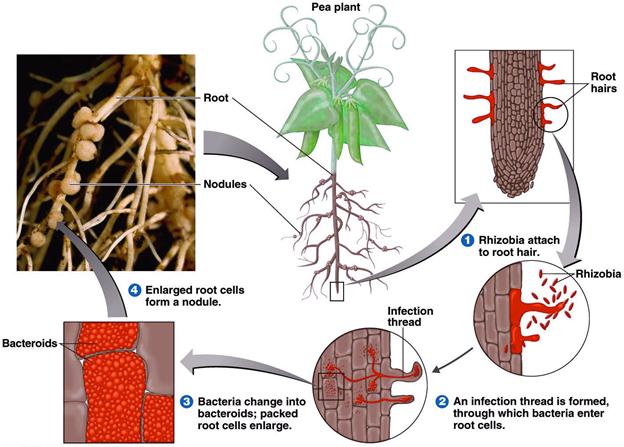
Nodule formation begins at the root hairs, so rhizobia need to be very close to seedlings as they germinate (see figure below). Using an inoculant is a way to ensure an effective rhizobia strain is present where the plant needs it.
Inoculant Formulations
We have three inoculant formulations to consider: liquid, peat and granular. While all three formulations will work under ideal conditions, there are some circumstances where you might consider one formulation over the other.Liquid
Pros:- Inexpensive
- Applied directly to the seed, getting rhizobia where they need to be.
- Easy to use and less messy than peat
- May not be compatible with fungicide/insecticide seed treatments.
- Least protected formulation; review label guidelines for survival on seed.
- Survival subject to environmental conditions such as drought.
Peat
- Inexpensive
- Applied directly to the seed, getting rhizobia where they need to be.
- Rhizobia are stabilized on a peat carrier, making them less sensitive to stress.
- May not be compatible with fungicide/insecticide seed treatments.
- More challenging to handle and apply than liquid formulations.
Granular
- Rhizobia stabilized on a granule, protecting them against environmental conditions.
- Generally compatible with fungicide/insecticide seed treats as the product is not applied to the seed.
- With the right equipment, may be easier to use.
- Generally more expensive than peat or liquid.
- Needs to be metered accurately as the rhizobia must be close to the seedling.
As stated above, for fields being planted to pulses for the first time it is especially critical to establish nodulation from inoculation, as there are little to no soil rhizobia to fall back on. Soybeans planted onto virgin ground have been shown to benefit from double inoculation. This involves combining a granular product with a seed-applied product to ensure adequate populations of rhizobia are present during seedling development. Dual inoculation has been demonstrated to increase soybean yield in studies conducted in Manitoba and Saskatchewan. It takes three to four weeks for nodulation to establish, so if you choose not to double inoculate, using a more stabilized format like a granular inoculant is advantageous, particularly under dry conditions.
Seed Treatment Compatibility
Seed treatment with a fungicide can prevent stand and yield loss due to soil-borne and seed-borne pathogens, particularly when planting early into cool and wet soils. Some products can also reduce transmission of Ascochyta blight from seed to seedling, reducing and delaying foliar disease progression. Insecticide seed treatment can reduce damage from wireworm, cutworm, and/or early season grasshopper feeding.Liquid and peat inoculant products differ in their compatibility with fungicide or insecticide seed treatments. Similarly, some fungicide seed treatment products may be more compatible with rhizobial inoculants than others. Inoculant manufacturers provide compatibility information using different application strategies, usually evaluating wet or dry sequential applications. In these approaches, the seed treatment is applied first, followed by the inoculant. In a dry sequential application, the seed treatment is allowed to dry before the inoculant is applied.
If you are using a liquid inoculant along with a fungicide or insecticide seed treatment, ensure that the products are compatible. Unfortunately, while there is a wide range of seed treatment products available, there is limited information on inoculant compatibility, so using a seed-applied inoculant may restrict your options. Granular inoculants are generally considered compatible because they are not in direct contact with the seed treatment, which expands your choices.
Handling
Rhizobia are living organisms and thus inoculant products need to be handled accordingly. If products are stored outside of the recommended conditions, either too cold or too hot, those bacteria will die. Dead bacteria do not form nodules.Even in the absence of a seed treatment, inoculants have a limited shelf life once applied to the seed. Be sure to check the inoculant label to determine the appropriate window for seeding after inoculation. Inoculate seed as close to planting as possible to avoid issues associated with storing inoculated seed overnight.
Successful inoculation is a simple, cost-effective management practice that can have lasting impacts on both current and future crops. By selecting the right inoculant formulation, ensuring compatibility with seed treatments, and handling products properly, growers can maximize nodulation and nitrogen fixation. In a high-input cost environment, paying attention to these details helps capture the full agronomic and economic benefits of pulse and soybean production, while supporting long-term soil fertility.
Dr. Audrey Kalil, CCA
Agronomist/Outreach Coordinator
Genetic Screening for Shifty Weeds
Herbicide resistant weeds are moving targets each year. Weeds with resistant traits can be introduced to new areas by natural and agricultural practices. Floods, strong winds, and wildlife can bring unwanted weeds to fields. Also, weed seed can be introduced by moving soil with equipment from field-to-field or spread as hitchhikers in crop seed bags. So, just as you get a handle on existing weeds and their resistance traits, newly introduced weeds can rewrite the rules of control.If weeds keep changing the rules, how do we keep up? Quicker diagnostic tools, like genetic screening offer ways to cut through some of the guesswork when evaluating weedy survivors after herbicide applications. These genetic methods detect changes within the weed’s DNA that are linked to resistance to specific modes of action. All it takes is a little bit of time scouting, proper weed ID, and a collection of a couple leaves to screen for resistance.
At the National Agricultural Genotyping Center (NAGC) located in Fargo, we have led a multi-year survey to track herbicide resistance using genetic screening methods. Below is an overview of the project for anyone interested in submitting samples during the fast-approaching cropping season.
Horizon Resources will have pre-paid collection kits. Contact Dr. Audrey Kalil about sampling or to obtain a kit. If funds run out for FREE testing, NAGC will notify submitters and let them decide whether to run them as a fee-for-service
($75-$195/sample). You will not get a surprise bill.
Why participate?
Effective HR weed control starts with knowing where resistances exist. By continuing this genetic screening survey, we can generate near real-time data to help fine-tune management strategies on the farm where they matter most. At the same time, the survey builds county-level maps that benefit everyone, giving a broader picture of which resistance traits are moving across the landscape. Together, this bigger-picture perspective helps drive outreach efforts and inform decision-makers that shape herbicide policy.Who can participate?
Anyone with weed ID skills can help us with the survey. NAGC has funding for FREE testing in North Dakota and Montana at a first-come, first-served basis for 2026. The funding for this testing was provided through commodity group support from the ND Corn Utilization Council, ND Soybean Council, ND Wheat Commission, Northern Canola Growers Association and the Northern Pulse Growers Association.Horizon Resources will have pre-paid collection kits. Contact Dr. Audrey Kalil about sampling or to obtain a kit. If funds run out for FREE testing, NAGC will notify submitters and let them decide whether to run them as a fee-for-service
($75-$195/sample). You will not get a surprise bill.
What Weeds?
The testing is limited to known DNA changes linked to resistance. At the time of this posting, we test Kochia, Palmer Amaranth, and Waterhemp for DNA markers linked to Group 2, Group 9, and Group 14 herbicide resistances. NAGC can test Redroot Pigweed and Powell Amaranth but only the Group 2 resistance test works on these pigweeds. We are also asking for Green Foxtail and Wild Oat samples and hope to have tests for Group 1 and Group 2 resistances soon.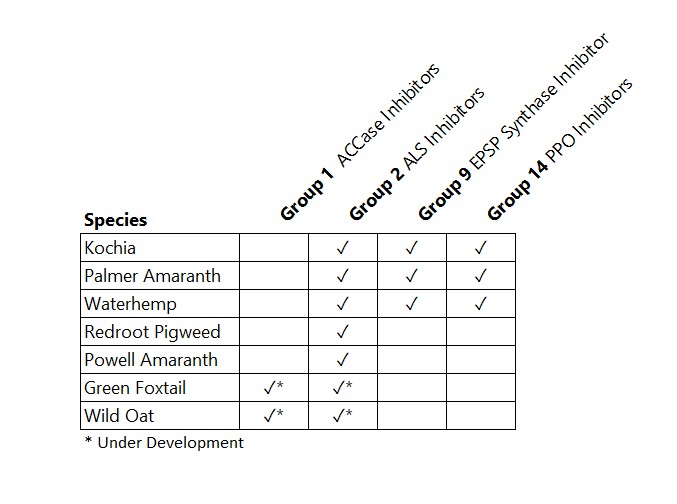
How to Sample?
DNA testing is still relatively expensive per sample ($75-$195), and since funding for the FREE testing is limited, we ask that one kit be used per operation with some flexibility for sprawling operations that extend into multiple counties. Sampling should target weeds that survived herbicide applications (PRE or POST) and/or sample from areas where large weed patches have been a persistent issue. Submitters can collect from separate weed patches found in the same field or collect from one weed patch across multiple fields. The choice is theirs.Proper weed ID is critical to the success of every test. DNA tests are very specific to the targeted weeds. For example, waterhemp will completely fail if a kochia test is used. Each pre-paid collection kit contains four (4) collection envelopes. Use one coin envelope for one plant but make sure to submit 2-3 leaves per plant. Do NOT mix leaves from multiple plants in a single coin envelope.
How to Label?
To create a county-level map, we want to know the county origin of every sample. What else to include in the label is up to the submitter, but make sure you can recall where each sample was collected based on the Sample ID label provided on the coin envelope. Make sure this label is readable and identical to what is listed on the submission form too.
Left: Easy to read sample
Right: Difficult to read sample
Mc = McLean, McHenry, McIntosh County? 5We? 5Wu? 42? 4Z?
Submission Form
Fill in Name, Phone Number, and Email Address (multiple emails are ok). Also include Sample ID, Weed Species, Crop, and Herbicides Applied. Include the form along with the coin envelopes in the pre-paid business USPS envelope. Drop the pre-paid envelope in any USPS mailbox.Reporting and Interpretation
Tests are performed 2-3x per week and results are released to the email address(es) provided within 5-7 days of arrival to NAGC. Reports provide the Sample ID Label provided on the coin envelope and the associated results for all three tests (Groups 2, 9, and 14). It is possible for samples to have stacked resistance.A sample that does NOT contain the resistance marker is reported as WILDYTYPE. This unusual descriptor is used because there are other genetic and non-genetic mechanisms that lead to resistance besides the specific ones that we test. NAGC cannot confirm susceptibility based solely on a WILDTYPE result, usually further tests in greenhouse herbicide trials are needed.
Example of reported results. Notice that plants 1 and 3 have stacked resistances.
| Plant | Group 2 | Group 9 | Group 14 |
| 1 | Resistant | Wildtype | Resistant |
| 2 | Wildtype | Wildtype | Wildtype |
| 2 | Resistant | Resistant | Resistant |
Maps
All individual reports are kept confidential. We do NOT share specific location, or a list of submitter names to the public. The resolution of public maps are county level and no GPS or point markers are included even if exact locations are given on the Sample ID Label. NAGC will create colored maps that will be shared in newsletters, at various commodity meetings, and regional conventions.Further Questions?
Don’t hesitate to reach out to NAGC at research@genotypingcenter.com.Dr. Zack Bateson
Research Director
National Agricultural Genotyping Center Fargo, ND

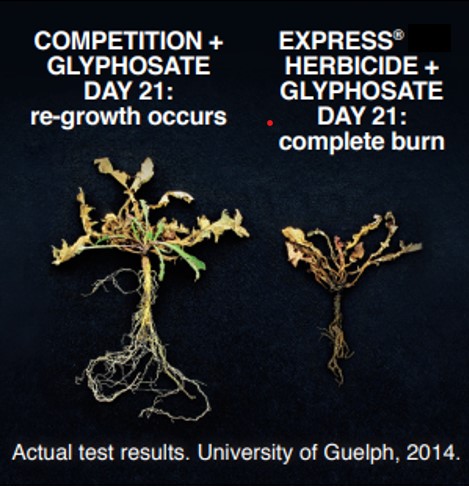
Express® Herbicide with TotalSol® Granules is now labeled for a 1-day plant-back interval to most pulse crops when applied at 0.25 oz/A in a burn-down application. This provides growers with an effective tool for controlling some of the more difficult winter annual and perennial weeds commonly found in our fields. The image below demonstrates control of dandelion.
In our region, this application is best suited for field peas and chickpeas. Their larger seed size and deeper planting depth, compared to other pulse crops, allows Express herbicide to be used safely at the shorter plant-back interval in northwest North Dakota and northeast Montana.
Caution is required when using Express Herbicide ahead of lentils. A 7-day plant-back interval should be maintained, particularly in soils with a pH of 7.9 or higher.
An additional advantage of the 1-day plant-back interval at 0.25 oz/A ahead of field peas and chickpeas is increased flexibility in the burn-down application window. This treatment also provides effective control of troublesome weeds such as narrowleaf hawksbeard, prickly lettuce, and canola, while improving activity on perennial species like Canada thistle and dandelion.
Ryan Hunt
Technical Service Manager ND/SD
FMC Corporation
Communication: The Key to Success
With spring work right at our doorstep, it's a good time for a reminder about communication. I know, eye-roll topic, but it's honestly a cornerstone of operating any farm or business successfully. With the long hours and urgency of spring, communication issues can snowball and you only get one shot each year to start things on the right foot.
Nowhere is this truer than in your relationship with your agronomist, whether that's one of the agronomists at Horizon Resources or an independent consultant like myself. Take something as simple as field names. If we're building variable-rate Rx files that need to load on your machine, it goes a whole lot smoother when we know what you call your fields in your monitor. Sorting through a long list like "SW of 21-142-99" or "NE of NE 7-137-98" to find the right file is a real pain — especially if you don't navigate your operation by legal descriptions. Knowing what brand and model of monitor you're running is just as critical. How those Rx files need to be built, formatted, and organized on a USB drive or in cloud storage varies by platform, and getting it wrong means the file won't load when you're sitting in the field ready to go.
Plans change, that's farming, but anytime you make a switch, make sure it gets back to your agronomist. Here's one that hit home for me recently. I work with a father and two sons who farm together but buy their inputs separately, market their grain separately, and make their cropping decisions independently. I'd had their fertilizer Rx files made and dropped off over two weeks prior. Then I got a call, they were pulling up to a field ready to apply NH3 and couldn't find the variable-rate map on their monitor. I asked which field, and when they told me, I said, "You were planting sunflowers there and I built a urea spreading map for the coop to custom apply, not an NH3 map for your drill to put down for corn." The response: "Yeah, I meant to tell you that sooner." Honest mistake, no hard feelings, but I wasn't near the farm that day and the soonest I could get them a new file was the next day. They moved on to the next field and now they'll have to backtrack. A two-minute call or text when the plan changed would have saved them a trip.
The same goes for spray and rotation history. An agronomist's favorite answer is "it depends" and for good reason; the right variety, the right chemistry, or the right rate all come down to details we can only work with if you share them. A good example of what I mean; you ask for the best grass and broadleaf spray for wheat and get prescribed a dynamite mix that gets control of all your problem weeds. But if lentils are in your rotation and that hasn't come up, nobody's thinking about the 15 to 18 month plant-back restriction until it's too late.
I've focused primarily on communication between an agronomist and the farm, but this principle applies inside the farm itself. With hired help, family, and custom operators all moving at once in the spring, it's easy for details to fall through the cracks. Which field got seeded, what rate went down, which tank mix was sprayed, whether a bag of seed got swapped mid-day; if it isn't communicated or written down, it's gone. A quick group text, a shared notebook in the shop, or a pinned whiteboard with the day's plan can save a lot of second-guessing a week later when someone asks what went on a field. The bigger the operation and the more hands involved, the more those small habits pay off.
Nowhere is this truer than in your relationship with your agronomist, whether that's one of the agronomists at Horizon Resources or an independent consultant like myself. Take something as simple as field names. If we're building variable-rate Rx files that need to load on your machine, it goes a whole lot smoother when we know what you call your fields in your monitor. Sorting through a long list like "SW of 21-142-99" or "NE of NE 7-137-98" to find the right file is a real pain — especially if you don't navigate your operation by legal descriptions. Knowing what brand and model of monitor you're running is just as critical. How those Rx files need to be built, formatted, and organized on a USB drive or in cloud storage varies by platform, and getting it wrong means the file won't load when you're sitting in the field ready to go.
Plans change, that's farming, but anytime you make a switch, make sure it gets back to your agronomist. Here's one that hit home for me recently. I work with a father and two sons who farm together but buy their inputs separately, market their grain separately, and make their cropping decisions independently. I'd had their fertilizer Rx files made and dropped off over two weeks prior. Then I got a call, they were pulling up to a field ready to apply NH3 and couldn't find the variable-rate map on their monitor. I asked which field, and when they told me, I said, "You were planting sunflowers there and I built a urea spreading map for the coop to custom apply, not an NH3 map for your drill to put down for corn." The response: "Yeah, I meant to tell you that sooner." Honest mistake, no hard feelings, but I wasn't near the farm that day and the soonest I could get them a new file was the next day. They moved on to the next field and now they'll have to backtrack. A two-minute call or text when the plan changed would have saved them a trip.
The same goes for spray and rotation history. An agronomist's favorite answer is "it depends" and for good reason; the right variety, the right chemistry, or the right rate all come down to details we can only work with if you share them. A good example of what I mean; you ask for the best grass and broadleaf spray for wheat and get prescribed a dynamite mix that gets control of all your problem weeds. But if lentils are in your rotation and that hasn't come up, nobody's thinking about the 15 to 18 month plant-back restriction until it's too late.
I've focused primarily on communication between an agronomist and the farm, but this principle applies inside the farm itself. With hired help, family, and custom operators all moving at once in the spring, it's easy for details to fall through the cracks. Which field got seeded, what rate went down, which tank mix was sprayed, whether a bag of seed got swapped mid-day; if it isn't communicated or written down, it's gone. A quick group text, a shared notebook in the shop, or a pinned whiteboard with the day's plan can save a lot of second-guessing a week later when someone asks what went on a field. The bigger the operation and the more hands involved, the more those small habits pay off.
Keeping an open line of communication with your agronomist and across your whole operation takes some work, but once that connection is built your critical input decisions get a whole lot easier.
Kyle Okke, CCA
Agile Agronomy LLC.
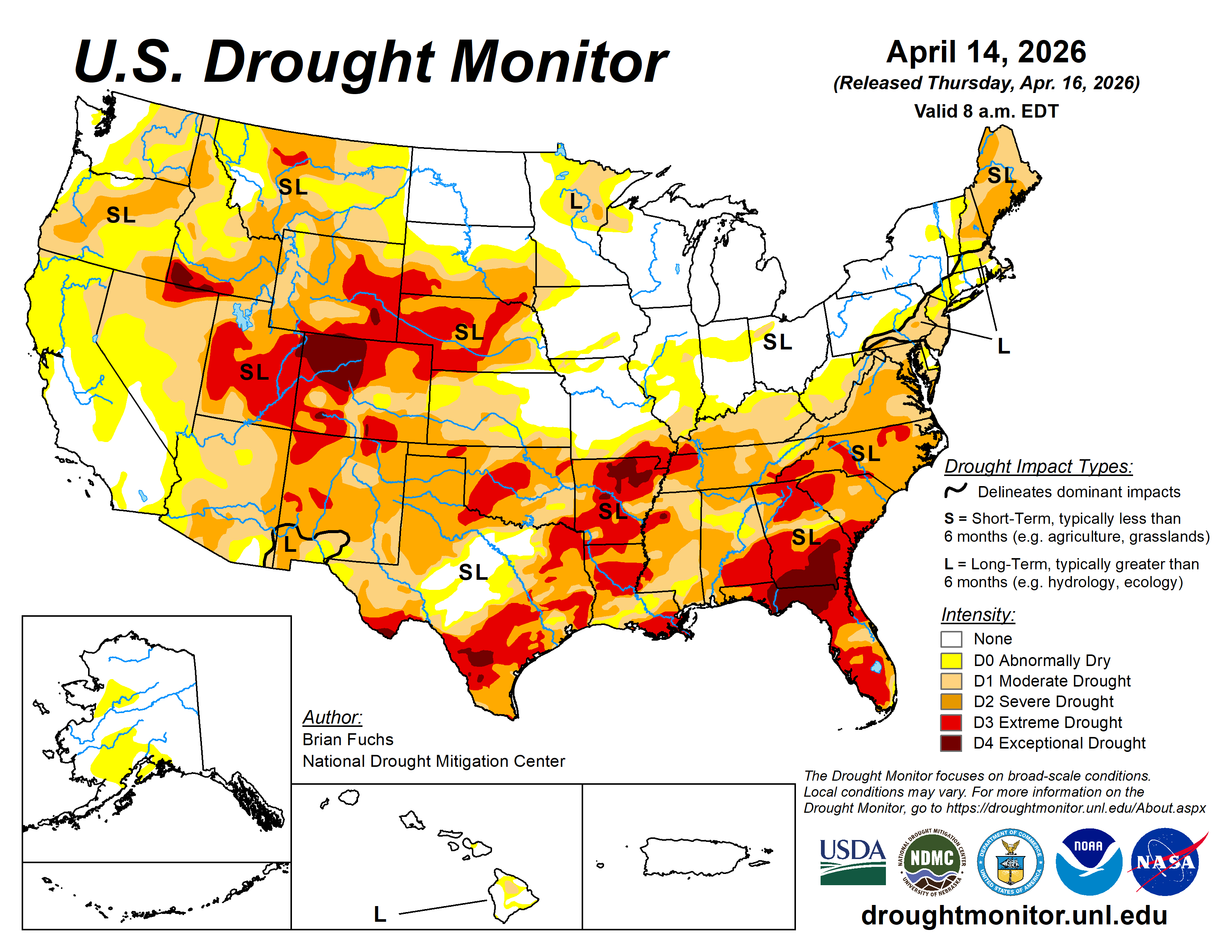
Weather Update