Agronomy Update
Aug 10, 2026
End of Season Report - Horizon Resources Internship Program
Thank you to Kylee and Shaun who did a wonderful job helping the Fairview and Williston agronomy locations this season. Below they share how their summer went, and what they learned over the course of their internship.
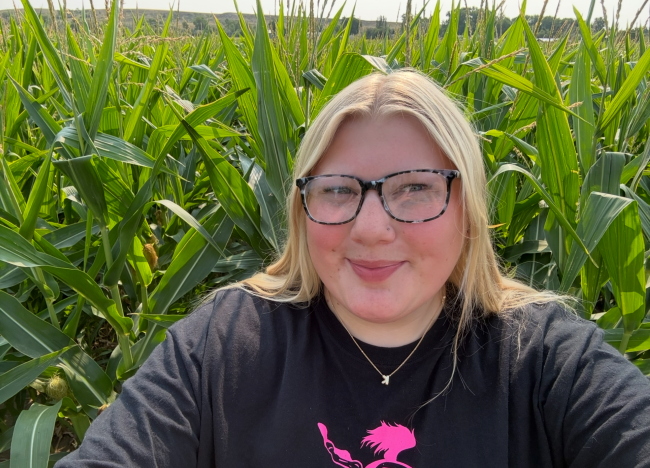
Kylee Janz - Fairview
Over the past few months, I have learned so many new things and had a great time doing so. I have learned how to identify crops, weeds, and insects while scouting, taken tissue samples to determine crop nutrient levels, and recently have started soil sampling again. I have spent the majority of the summer developing my scouting skills and getting to know customers. I am grateful for the experience the internship has provided me and have greatly enjoyed learning and growing throughout the summer.
Shaun Branham - Williston
This summer, during my second agronomy internship at Horizon Resources in Williston, I had the opportunity to gain hands-on experience in many different areas of agronomy. When I started in the spring, scouting was getting underway, and I spent a lot of time in the fields identifying weeds and other crop issues. After scouting, I also had the opportunity to help select herbicides for controlling problem weeds. This was especially valuable because being involved in both scouting and making recommendations helped me better understand which chemistries are best suited for different situations.
When I was not out scouting, I helped in the office and warehouse. I found that spending time in these areas was one of the best ways to learn. When farmers came in with questions for the agronomy team, I enjoyed listening to their concerns and learning from the answers and recommendations they received. I also really enjoyed interacting with customers and building relationships.
Mid-summer I helped stage crops for fungicide timing in durum, peas, and lentils and attended several field days. I really enjoyed attending these events and found them to be valuable learning experiences. Later in the summer, I spent time evaluating pea and lentil fields to help determine the appropriate timing for desiccation.
This fall, I will be attending NDSU and pursuing a bachelor’s degree in Agricultural Economics. I am grateful for the opportunity to intern at Horizon Resources and for everything I have learned throughout my time there. This experience has given me a better understanding of agronomy and valuable experience that I can carry with me into my future career.
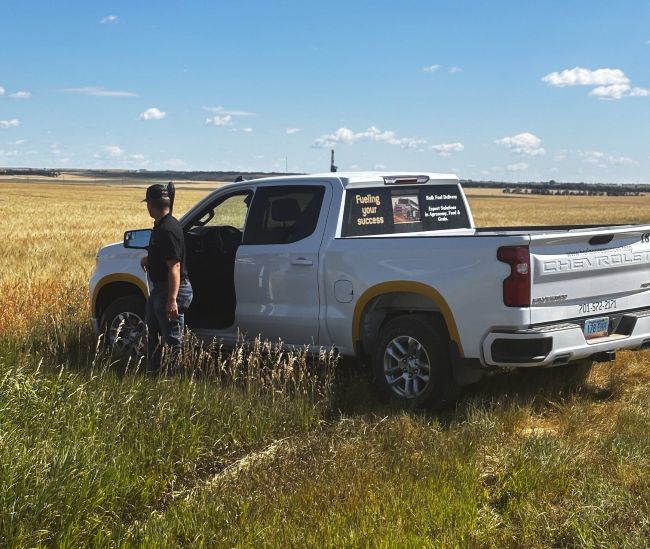
Shaun staging durum for pre-harvest weed control
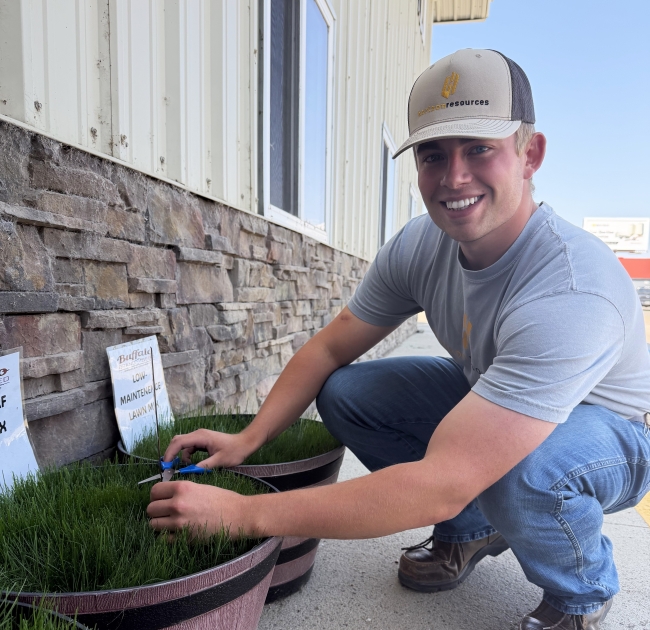
No job is too big or too small! Shaun took precision to the next level in the care of our Buffalo Brand turfgrass.
The Bindweed Battle
Many fields in our region are struggling with bindweed and, in addition to the yield loss it can cause due to competition, it is a headache to deal with during harvest.Bindweed, also known as creeping jenny, is a really tough weed to control, especially once it has an established root system. It is a perennial weed that reproduces and spreads by seed production and rhizomes. A plant can regrow from just one inch of root left in the soil.
If left untreated and uncontrolled, the roots and rhizomes can become a mass of 2 to 5 tons per acre in the top 1 to 2 feet of soil. Roots can reach as far down as 20 feet and up to 25 feet laterally. One plant can produce up to 500 seeds which can stay viable in the soil for up to 50 years.
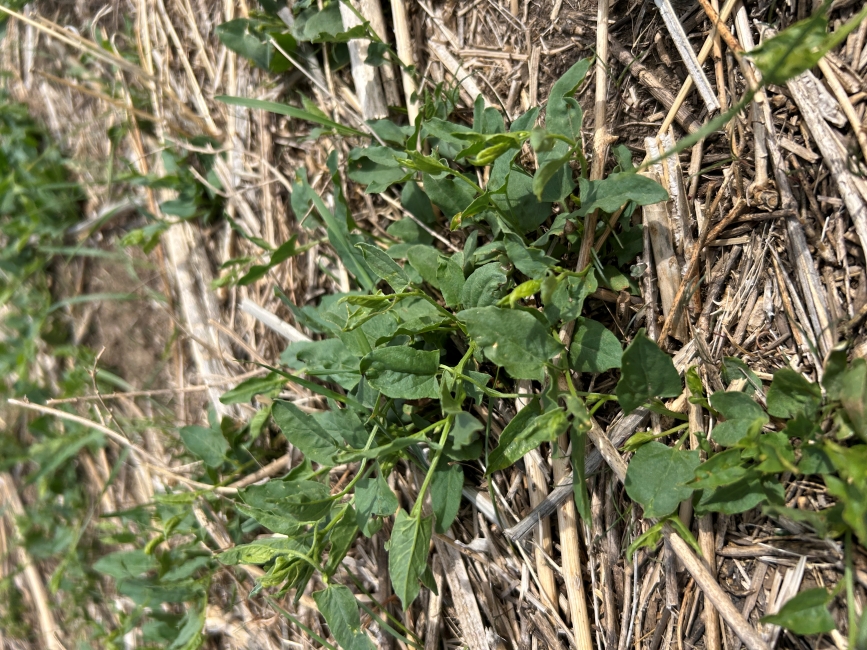
Bindweed plant. Picture taken May 27th
Most of our options post-emergence in crop in wheat or durum provide suppression only, which means you won't see noticeable reductions in bindweed patches the next season. Multiple studies (Dershceid et al; Marsalis et al) have found that longer term control of established bindweed requires consistent control for a minimum of three years in combination with vigorous crop competition, and right now is the time to start with a fall herbicide application.
We have been using a product that has been around for many years and was originally marketed by Monsanto. Landmaster BW is a combination of glyphosate and 2,4-D amine along with their surfactant load to help get the product into the plant. I can tell you exactly how many ounces per acre of glyphosate and how many ounces of 2,4-D to spray per acre to make the equivalent of the rate we are using with Landmaster BW and it just will not work as well as Landmaster BW. Maybe if we use a high-quality surfactant like Last Chance that is similar to the surfactants used in the higher tier glyphosate products like Roundup Weathermax it might perform better, but we have not been able to duplicate the efficacy we have seen with the Landmaster BW. When Monsanto originally marketed this product, it was targeting bindweed and that is what the BW referred to…..bindweed.
While the dry conditions are great for harvest, ideally we want to apply herbicides when weeds aren't drought stressed. Unfortunately we don't have a lot of flexibility in timing as it is a short application window between harvest and when bindweed starts to go dormant for the winter. In late summer and early fall, bindweed is moving carbohydrate resources down into the roots, which can help move the herbicide down into the root system as well. Unlike with canada thistle, we can't wait until late fall to make this application.
Pulse crops and bindweed are not a good combination. There are no herbicide options post-emergence and that provides bindweed an opportunity to continue to spread and produce seed. In fields where bindweed is an issue, planting a small grain, dicamba or round up tolerant crop will give you options to apply an herbicide for bindweed in June and prevent more seed production.
As you are harvesting this fall, make sure you aren't spreading bindweed to other fields. This weed can get established in new fields from pieces of plants brought in from field equipment. Tillage equipment can also spread bindweed from field to field.
Managing field bindweed requires exhausting its root system's energy reserves, limiting its spread and reducing its resprouting ability. Integrating fall and in crop herbicide applications with sanitation to limit spread and growing a competitive crop in infested fields are all necessary to get control. It will take multiple seasons, so be consistent if you want to see long term results.
If you have any questions on Landmaster BW or how to control bindweed, please contact our agronomy team and we will get you going in the right direction.
John Salvevold, CCA
Agronomy Division Manager
Dr. Audrey Kalil, CCA
Agronomist/Outreach Coordinator
NDSU IPM Wheat Disease Survey Results
NDSU Extension conducts a survey of wheat, barley, sunflower and soybean fields annually to determine which insect pests and diseases are impacting crops. This work is funded by the USDA National Institute of Food and Agriculture.Scouts working out of the NDSU research centers collect data from participating farmer fields. Below are maps from the most prevalent wheat diseases from this season. We can use these maps to plan ahead for disease management in 2027.
Loose Smut (Ustilago tritici)
Loose smut is a fungal disease which spreads by spores from diseased plants. The spores land on the wheat heads at flowering and the pathogen infects the developing seed. Infected seed appears healthy and if the seed isn't treated with a fungicide before planting, results in loose smut symptoms the following season. The affected heads have fungal spores in place of healthy spikelets (image below).There is no cure for this disease once it occurs, as there is no wheat head to save. To prevent loose smut avoid using grain from infested fields as seed, and use a fungicide seed treatment effective against this disease. Ensure good coverage of the seed to avoid escapes.
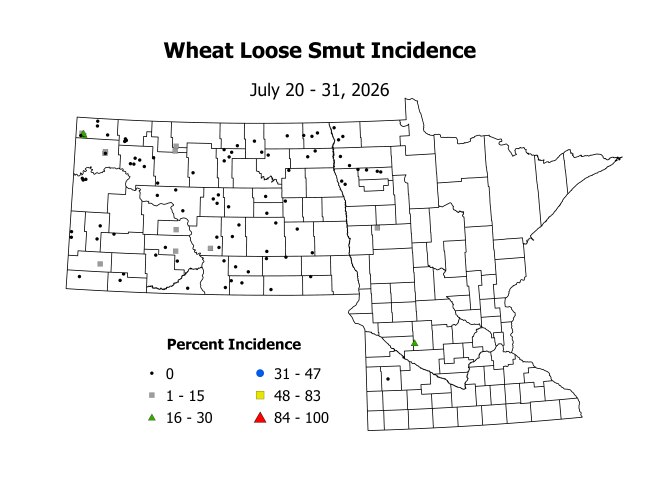
Loose smut incidence is the percent of symptomatic heads in a field. Grey boxes indicate that 1 to 15% of heads had loose smut. Green triangles indicate that 16-30% of heads were symptomatic.
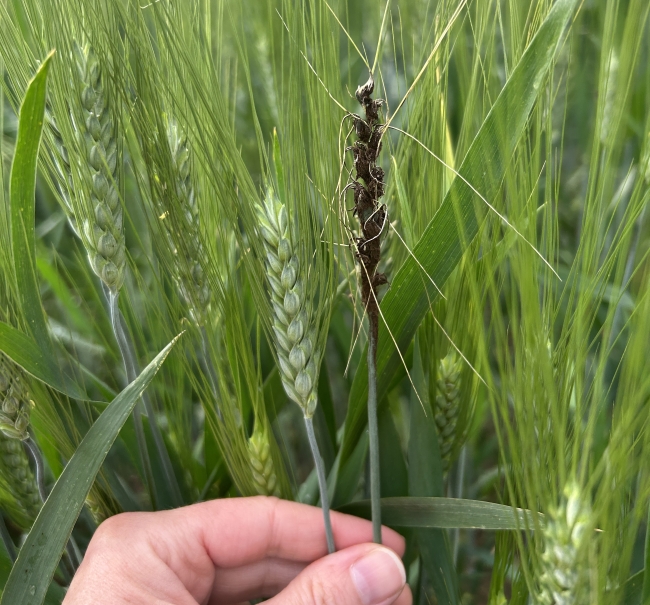
Loose smut symptoms in a durum field in Williams County this year. The picture was taken when the crop was at the flowering growth stage
Bacterial Leaf Streak (Xanthomonas campestris pv. undulosa)
Bacteria can only enter plants through wounds or natural openings like stomata. Therefore, we usually see bacterial leaf streak when wheat is wounded by high winds, rain or hail. Overhead irrigation can also increase risk.Unlike the round lesions caused by fungal diseases like tan spot, bacterial leaf streak looks like the name says - streaky (image below). Strips of yellow or brown leaf tissue that are initially confined by leaf veins can coalesce into large dead areas and when disease is severe the entire leaf can die. Infection can spread to wheat heads causing a disease caused black chaff which can impact grain quality (image below).
The IPM survey found fields with anywhere from 1 to 30% incidence for leaf symptoms caused by bacterial leaf streak. Black chaff was not detected, suggesting symptoms did not progress to the head.
To prevent this disease, avoid planting seed from infested fields and grow a more resistant variety. Bacterial leaf streak resistance ratings for wheat and durum varieties are available in the NDSU variety selection guides. Foliar fungicides are not
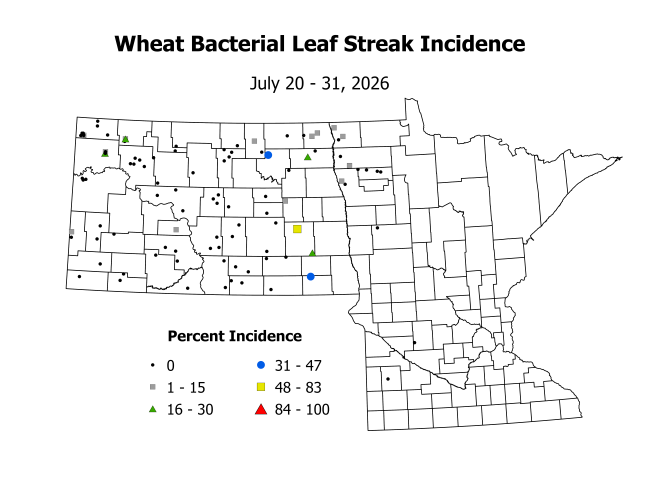
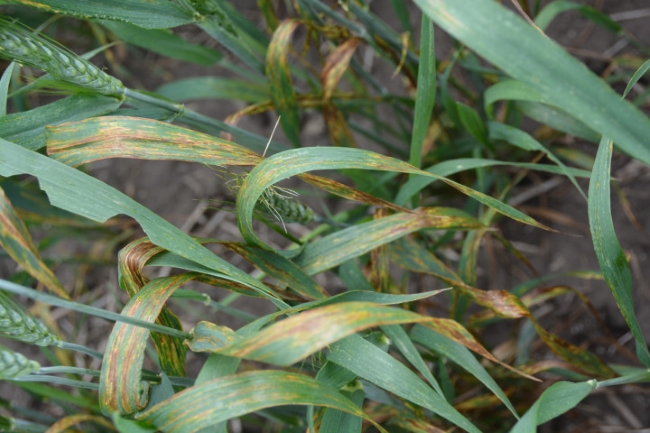
Bacterial leaf streak symptoms on wheat. Image credit: E. Byamukama, M. Burrows, and J. Marshall
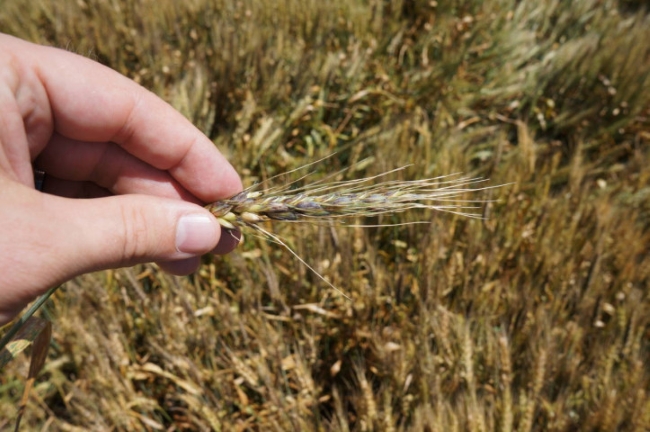
Black chaff symptoms on head. Image credit: E. Byamukama, M. Burrows, and J. Marshall
Fusarium Head Blight (Fusarium graminearum)
When the durum and wheat crops were flowering in mid to late June, conditions were conducive for Fusarium Head Blight (head scab). However, dry and hot weather in July likely limited disease development in much of our growing region.Fusarium head blight symptoms were observed in the participating fields at low levels. Unfortunately, we don't know if the farmers used a fungicide and/or planted a moderately resistant variety which would have reduced symptom severity.
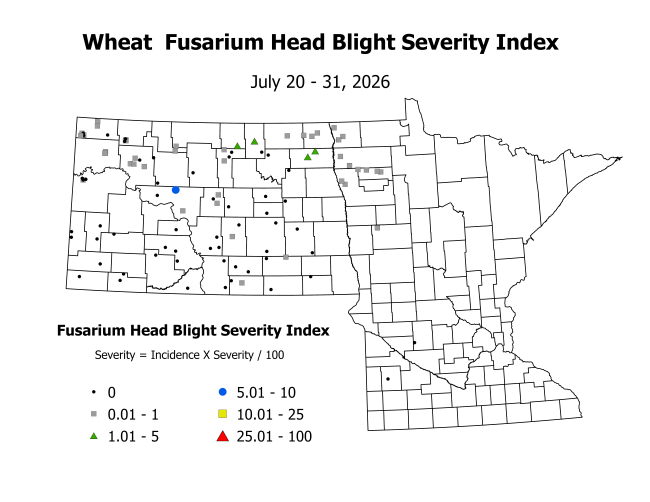
IPM survey map indicating FHB severity index. The severity index indicated on the map above is a measure of the severity (how much of the wheat head was infected on average) x incidence (percent of wheat heads infected in the field) divided by 100. So if 100% of the wheat heads in a field were infected, and the entire head was diseased on all of the heads you'd get a value of 100 for the severity index.
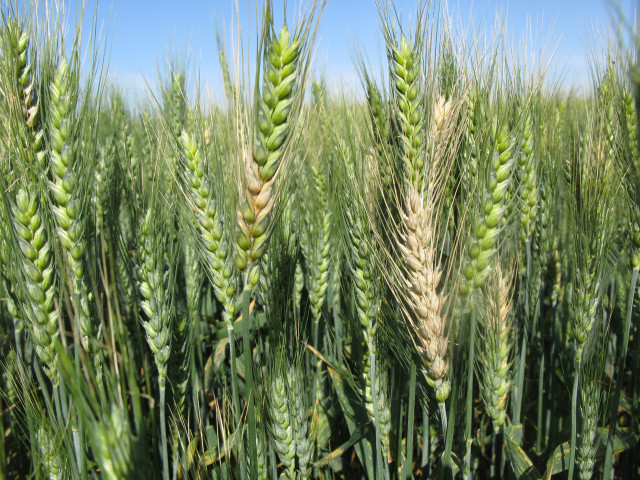
Infected spikelets are bleached and disease spreads upward and downward by sequentially infecting spikelets. Image: M. Burrows
Scabby seed lots usually have lower germination rates, so make sure to test seed from affected fields and adjust plant populations accordingly. Cleaning can help remove the lighter kernels and improve germination. We have seed testing envelopes in our office if you'd like to submit a sample to the ND State Seed Department.
Dr. Audrey Kalil, CCA
Agronomist/Outreach Coordinator
Farmers for Soil Health Program Q & A with Dr. Alexis Correira
The deadline to enroll in the Farmers for Soil Health Program is August 31st.Dr. Alexis Correira (Extension Specialist Conservation Agronomy, NDSU Dickinson REC) oversees this program for North Dakota and below she answers some questions about the enrollment process and program requirements.
How do farmers enroll?
Click "enroll" on our website, then you will be directed to DTN. You'll make an account and apply to enroll for 2026. I will then be in contact within a couple of weeks. Farmers can reach out if they will be planting sooner.What information will growers need to provide to participate?
FSA Maps, 578, 156ez, and subsidiary prints, as well as a completed W9, are necessary for the program and payment. Maps are the most urgent, as I need them for CPA-52 completion, which must be done prior to cover crop planting.Holding onto seed receipts and planting records will be key to verifying you planted a cover crop and at an appropriate seeding rate.
What plant species can be planted?
We've had farmers do complex mixes or simple monocultures. You can even use saved seed (brown bag laws apply). We just recommend writing yourself an invoice to note the amount of seeds for the acreage you enrolled. If you plant between September 6 and October 1, the species planted should be winter annuals according to NRCS guidelines.Can cover crop be grazed in the fall?
Yes, as long as it does not interfere with the purpose of a cover crop. Don't graze it down to soil. Farmers could graze as a termination method in the spring.If you have any more questions on the program, reach out to Dr. Correira:
701.456.1114
alexis.correira@ndsu.edu
If you are interested in cover crop blends, Buffalo Brand Seed has several options for fall, or we can order a custom mix.
See this guide for more information or check out the Buffalo Brand Seed website.
With the dry conditions, there is the possibility that the cover crop seed won't all germinate this fall. Make sure whatever species is planted now, can be controlled in the 2027 crop if it volunteers.