Agronomy Update
Fertilizer Decisions: Don't Start Next Year Guessing
With fertilizer costs still elevated, it is important to consider having your fields soil tested this fall for next year's cropping decisions. This is by and large the least expensive way to know where your soil's fertility is sitting so you don't start the year guessing where your crop's fuel tank is at. Composite or precision zone based, it is an inexpensive baseline to have on your farm. With mostly a drought year for the farms I work with in my area, we are seeing a wide swing in residual nitrates, so giving a blanket recommendation will leave some fields under fertilized and others potentially over fertilized. Even within zones on fields I am seeing variability in nitrates.
To put real numbers behind that, here are early fall results from one operation I sample — roughly 4,000 acres, 27 fields, three management zones pulled in every field, each one split 0-6" and 6-24".
Across that whole farm, nitrate-N ran from 4 lb/acre on the low end to 118 lb/acre on the high end. Same grower, same neighborhood, same growing season.
Field to field is one story. Within the field is the one that catches people. Three fields off that same farm:
-
Field A, wheat stubble: 118, 17 and 66 lb of nitrate across its three zones
-
Field B, wheat stubble: 49, 48, and
-
Field C, pea stubble: 4, 5, and
Field B is about as uniform as you'll ever see and is sitting on a nice chunk of free nitrogen. Field C has essentially nothing left and will need every pound you plan for it. Field A can't be handled with one number at all. Nothing you could see from the pickup window would have told you which field was which.
Previous crop is a starting point, not an answer. On this farm the wheat stubble ran a median around 40 lb and the pea ground around 15. That tracks — dry weather cut wheat yields and left applied N behind, while the peas got little to no N up front. But the ranges overlapped. Some pea ground tested in the 40s and some wheat stubble came back in single digits. Cropping history narrows the guess; it doesn't replace the test.
One more thing worth saying: nitrate is the headline in a year like this, but it isn't the only thing the test buys you. On that same farm, 16 of 27 fields had at least one zone testing below 6.0 pH, and close to a third of the samples came back under 10 ppm Olsen P. Those move slower than residual nitrogen, but you only catch them if you're pulling samples.
The bottom line is that the test is one of the cheapest decisions you'll make this fall, and it puts your fertilizer dollars on the acres that will actually pay you back. With swings like these, guessing costs you in both directions — leaving yield out there where the tank is empty, and hauling product onto acres that didn't need it.
Get on your agronomist's schedule now. Sample after harvest and before freeze-up, pull the full 24" profile, and sample the same way every year so you can trend it.
Then walk into spring with a plan you can defend on paper.
Kyle Okke, CCA
Agile Agonomy LLC.
Agronomists Happy Hour Podcast
Anthem® Flex: A Tool for Managing Resistance in the West
Growers planning for the 2027 planting season should be thinking now about how to manage troublesome and herbicide-resistant weeds. With herbicide resistant kochia, green foxtail and wild oat, relying on post-emergence herbicides alone is becoming a greater challenge.
A more effective approach is to prevent weeds from emerging in the first place. Building a program that includes soil-residual herbicides can help reduce weed populations and take some of the pressure off post-emergence herbicides.
The Weed Science Society of America recommends using multiple herbicide modes of action with overlapping weed spectrums in rotations, sequences, or mixtures as part of a resistance-management program. For growers dealing with PPO (Group 14) resistant kochia, Group 1- and Group 2-resistant green foxtail and wild oat, and other annual grasses and broadleaf weeds, layering different effective modes of action and active ingredients is an important part of protecting herbicide performance for the long term.
Anthem® Flex herbicide from FMC is an important tool in the resistance management toolbox. Powered by pyroxasulfone, a long-lasting Group 15 herbicide, this product adds a mode of action to our herbicide rotations that has been underutilized in Western ND and Eastern MT.
In research conducted by North Dakota State University and in company field trials, we have found that a fall application of 3.5 – 4.5oz/A of Anthem® Flex will provide increased residual control of problematic weeds such as kochia, green & yellow foxtail, downy brome, pigweeds and barnyardgrass well into the next growing season.
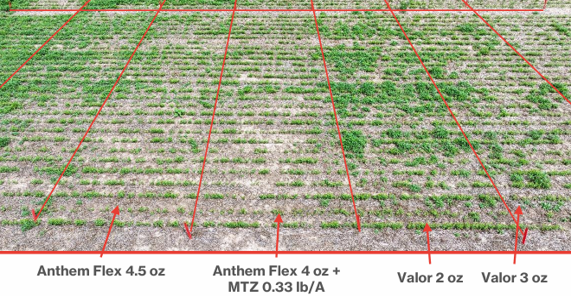
All treatments were applied in fall 2024 when soil temperatures were below 55 °F but above 32 °F. Photos were taken on June 17, 2025 to document early-season weed control. Planted to lentils following spring as a labeled crop to follow fall application of Anthem Flex.
Crops that may be planted following a fall application of Anthem® Flex include lentils, field peas (including chickpea), sunflowers, soybeans, field corn and spring/winter wheat (excluding durum). Application rate differs based on soil characteristics and crop. Refer to label for rates and specific crop instructions.
Best results and control are seen applying Anthem®Flex when soil temperatures are lower than 55 F and declining (but not frozen) to prevent herbicide degradation.
Anthem® Flex is not degraded by sunlight on the soil surface. Instead, microbial activity plays an important role in its breakdown. Cooler soil temperatures slow microbial activity, helping preserve herbicide activity into the spring when it is needed to control emerging weeds.
That residual activity can be particularly valuable when wet or windy spring conditions, or planting season logistics make timely burn down applications difficult.
It is important to use at least 10 GPA when treating fields with heavy crop residue or weed populations for better coverage. Additional labeled products for your planned crop are encouraged to be tank mixed to help improve control of emerged weeds and get additional modes of action on the field.
For growers facing increasing resistance challenges, the goal is to start controlling weeds before they emerge and use multiple effective modes of action whenever possible. Adding Anthem® Flex to a well-planned fall residual program can help reduce weed pressure, diversify herbicide modes of action, and help protect other at risk chemistries growers will need for years to come.
Trey Balvitsch
Field Sales Representative
FMC – Western / Central ND
Horizon Resources Joins the For the Farmers Tour
I had a great time representing Horizon Resources at the Northern Ag Network’s fourth annual For the Farmers Tour in Culbertson on August 25. This event brought local farmers, agricultural businesses, and community members together for a day focused on Montana agriculture.
The day started at C&B Operations with breakfast and a live broadcast of Voices of Montana. Then we headed out to visit five different farms in the Culbertson area. At each stop, the farmers talked about the growing season and some of the challenges they have dealt with this year, including the “Great Dirt Storm,” drought, and the rising cost of equipment and fertilizer.
One thing that stood out was the wide range of yields farmers are seeing. Wheat yields discussed during the visits ranged from about 10 to 50 bushels per acre.
We delivered lunch to each of the five farms, along with goodie bags for the farmers, their families, and harvest crews. It was a busy day, but it was a good opportunity to meet new people and hear directly from farmers about what is happening in the area.
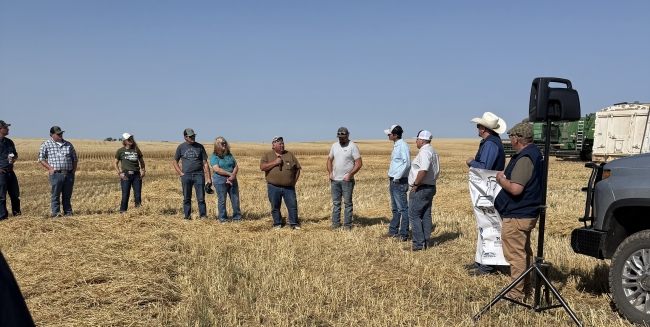
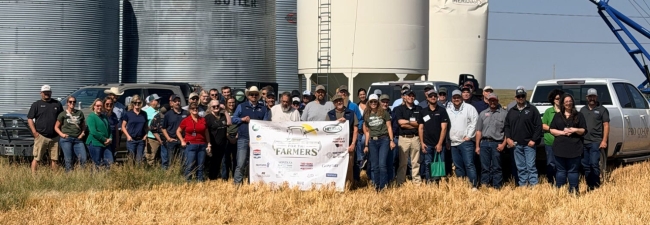
The day wrapped up with an after-party at the Stagecoach Bar and Grill, where about 50–60 people gathered for supper and door prizes provided by the event sponsors, including Horizon Resources.
Overall, it was a fun experience and a great way to spend the day getting to know farmers and others involved in agriculture around Culbertson.
Kylee Janz
Agronomist
Fairview Location