Agronomy Update
White Mold Management in Soybean and Dry Bean
As soybean and dry bean enter reproductive growth stages, they become susceptible to infection by Sclerotinia sclerotiorum, the pathogen that causes white mold also know as Sclerotinia stem rot. Other crops that we grow which can host this pathogen include canola, peas, lentils and sunflower. Each infection cycle results in the production of black sclerotia which are the survival structures of the pathogen. They can remain viable for several years in the soil, so tight rotations of these host crops will increase risk of severe white mold.
The life cycle of the pathogen starts when the sclerotia germinate to form a mushroom-like structure called an apothecia (picture and diagram below).
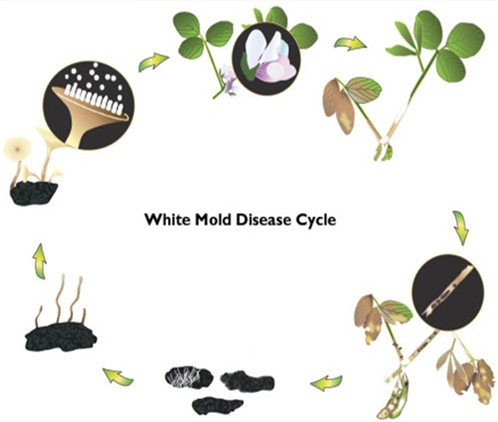
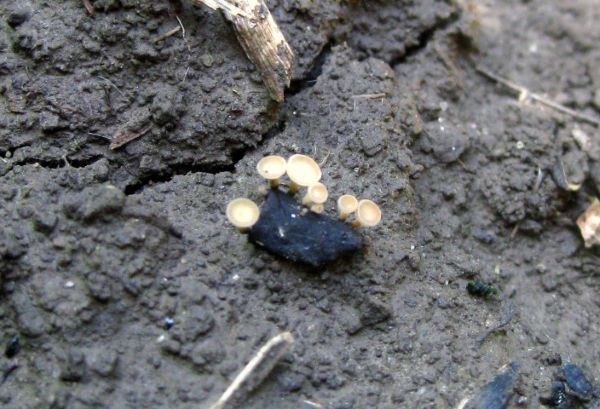
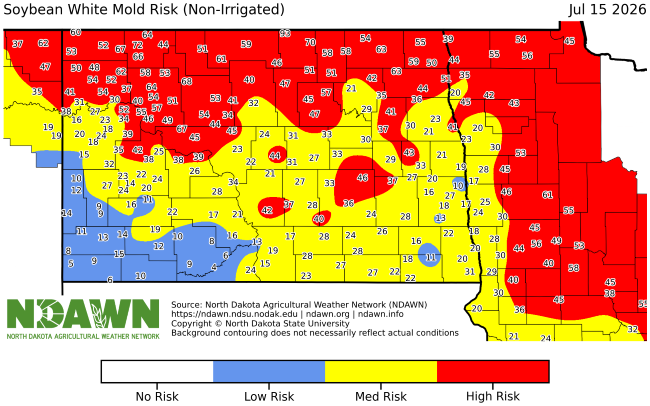
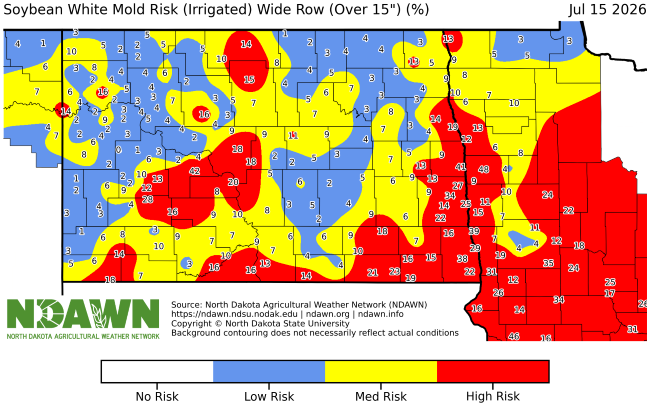
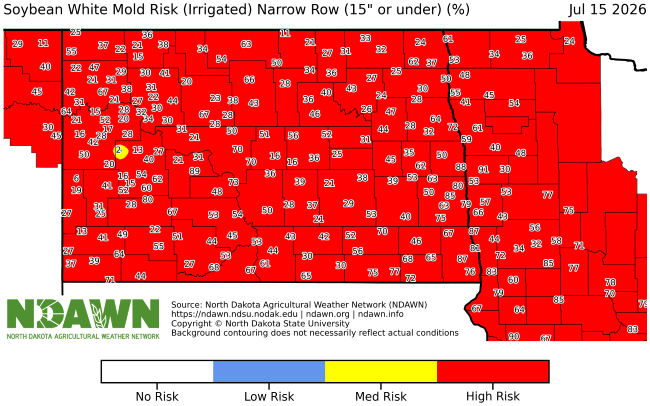
Sclerotia can germinate under a wide range of conditions but prefer moist soil conditions and temperatures in the 60s to mid 70s. Despite recent warm temperatures, the NDAWN soybean white mold risk prediction tool is still predicting areas of high risk in both non-irrigated and irrigated production systems. Narrow rows (15" or less) increases risk.
Keep in mind that these models are still being validated, so make application decisions based on conditions in your fields.
Each apothecium can produce millions of ascospores which land on host plants and infect under conducive environmental conditions, namely, high humidity, long periods of leaf wetness and moderate temperatures. While mid 70s are ideal, the disease can spread even when temperatures reach 90°F. Senescing flowers and leaves are the first tissue to be infected, so that is why we target fungicide applications to the reproductive stages. Prior to flowering, the pathogen is unable to infect the host plant.
Proper fungicide application timing is critical to maximize efficacy, especially since only a single application is usually made in our region. Research led by Dr. Michael Wunsch at the NDSU Carrington Research Extension Center shows that the optimal application timing differs between soybean and dry bean, and in soybean is relative to canopy closure. Canopy closure increases relative humidity and leaf wetness inside the canopy and aids in the development of white mold disease.
Soybean
If the canopy is open, apply a fungicide for white mold when 100% of plants reach the R2 growth stage. R2 is when there is an open flower at one of the two uppermost nodes.
If the canopy is closed at R1, which is when plants have at least one open flower on any node, fungicides should be applied when 60-80% of plants have reached this stage.
If the canopy is closed at early R2, apply the fungicides at that stage.
Essentially, apply a fungicide at 100% R2 or when canopy closure coincides with flowering, whichever comes first.
Dry Bean
Disease reduction and yield benefits of a fungicide application are maximized when you apply a fungicide when 60-80% of plants have initial pin pods (R2). This is regardless of canopy closure. The charts below are from Dr. Wunsch’s fungicide studies where he applied 30-40 oz./ac of Topsin when the canopy closed when either 70-85% (top graph) or 10-20% (bottom) of plants had initial pin pods.
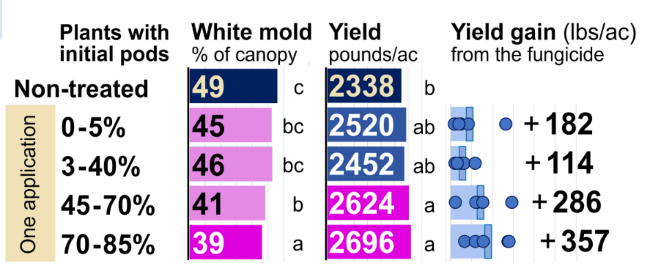
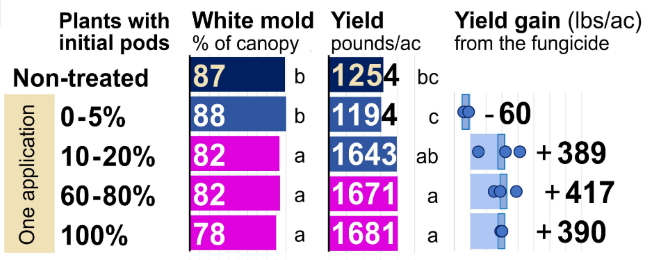
Fungicides protect the tissue they contact and do not protect new growth. Given that dry bean undergoes significant growth during early bloom, a later application time point makes sense.
However, this timing sacrifices some early protection. We make this gamble knowing that normally our very hot and dry summers suppress white mold disease. If you are going to make two applications, you can shift that first application a few days earlier to protect against earlier infection as well.
Application Technique and Droplet Size
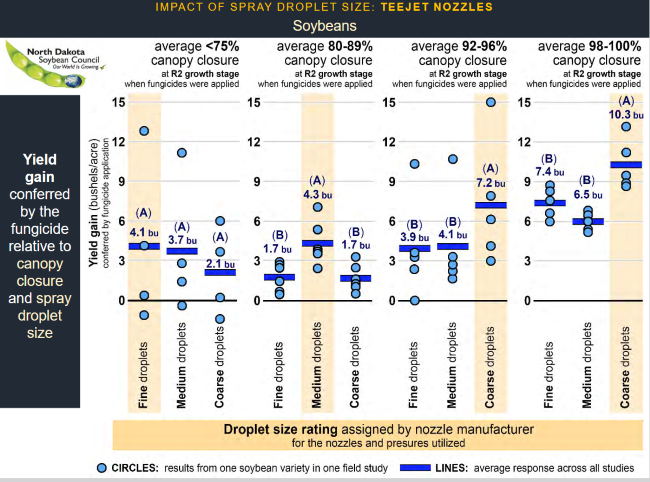
Droplet size matters when controlling white mold. This disease starts at the bottom of the canopy where the apothecia are producing spores. Fine droplets may provide excellent coverage of the top most leaves, but don’t have the necessary weight to penetrate a canopy. If the canopy is nearing closure when the fungicide is applied, Dr. Wunsch showed that applying a medium to coarse droplet can improve the response to fungicide in soybean. When the canopy was closed at the time of application the coarse droplet performed best.
In these studies he was applying 5.5 to 8 oz/ac of Endura 70WG in 15 gal/ac of water. The chart below summarizes these findings. The optimal droplet size for each canopy stage is highlighted in tan.
Fungicide Selection
Dr. Michael Wunsch has evaluated several products for white mold control in both dry bean and soybean and these results can be found on the NDSU Carrington Research Extension Center Plant Pathology website.
Another resource is the The Crop Protection Network, a collaboration of University Extension faculty. They publish a guide every year with ratings on fungicide efficacy for control of foliar diseases in soybean. These ratings are based on field trials conducted across multiple locations and years.
Be proactive—applying an effective fungicide as soon as your crop hits the critical application window is the best way to achieve white mold control and help protect your yield potential. Reach out to our agronomy team to discuss fungicide product options and schedule aerial fungicide application.
Dr. Audrey Kalil, CCA
Agronomist/Outreach Coordinator