Agronomy
Jul 28, 2026
Current Soybean White Mold Risk
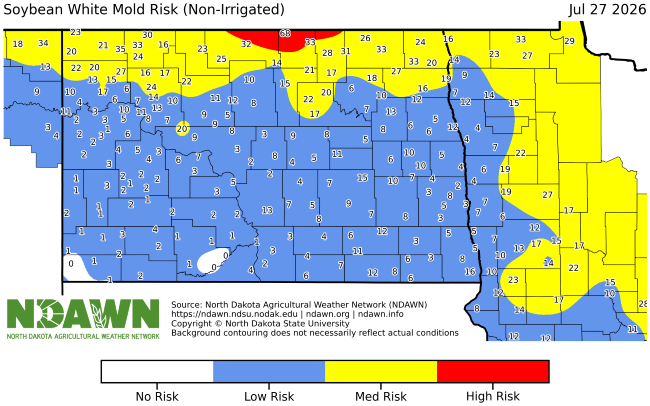
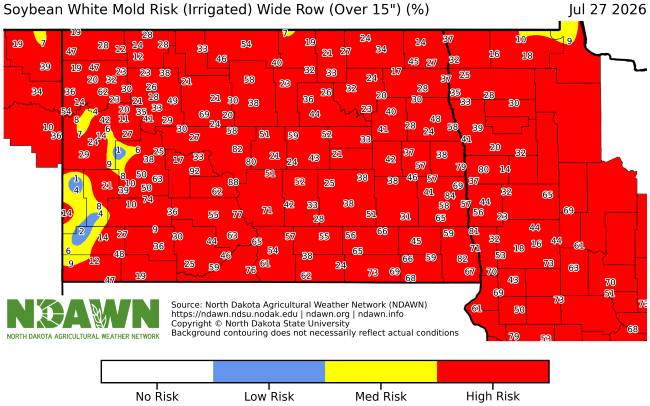
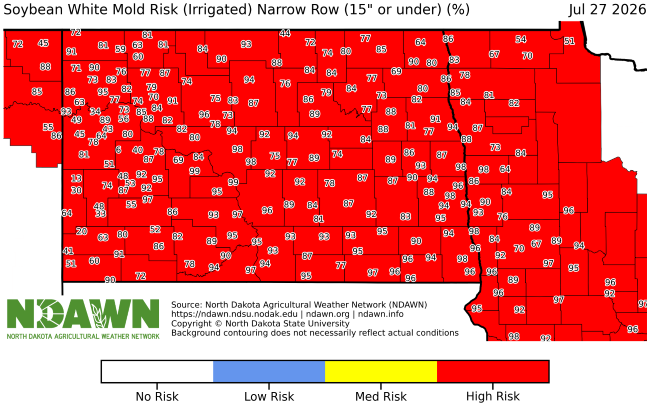
The soybean white mold risk prediction maps indicate the probability that white mold mushrooms, called apothecia (image below), will form. These apothecia are the source of spores for the white mold disease and they grow under specific environmental conditions such as moderate soil temperatures (50-70F), moist soils, and the humid environment produced by a closed crop canopy.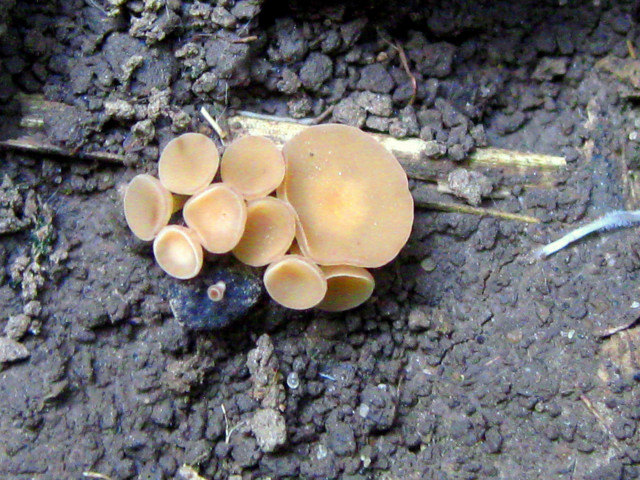
White mold apothecia growing from sclerotia on soil surface. Image: Dr. Craig Grau
Research on soybean, funded in part by the North Dakota Soybean Council, has demonstrated that these models have an accuracy of 78% in North Dakota.
They have not been validated in other crops, so caution is advised if trying to extrapolate risk maps to other white mold susceptible crops like canola, dry beans, and sunflowers.
The maps below are only relevant if flowers are present on the soybeans and canopy closure has occurred. If neither of these conditions are present, then the risk of disease development is significantly reduced.
Blue = low risk
Yellow = moderate risk (susceptible varieties might benefit from a fungicide)
Red = high risk (fungicide recommended)
Pulse Crop Desiccation: Dialing It in for a Smoother Harvest
Harvest is coming fast, and most pulse fields aren't going to cooperate by maturing all at once. That's normal. Desiccation is still the best tool we have for pulling a field together and getting the combine rolling on your schedule instead of the crop's.Lentils and field peas run on nearly the same playbook here with the same products, coverage rules, and timing logic. Where they differ, it's usually about seed quality and market, and those differences are worth knowing before you fill the sprayer.
Why Desiccate?
Even maturity in pulses is the exception, not the rule. Without desiccation you're chasing green spots, stretching the harvest window, and taking losses on both yield and quality. We can end up with shatter on the ready acres while waiting on the rest to mature.Peas add their own wrinkle. Once the crop lodges into a mat, an uneven field is even harder to run through. A well-timed application evens things out and lets you harvest once.
Timing Is Everything
Don't make this call from the pickup. Get out, pull plants, and work top to bottom.Lentils: The field should be shifting to an overall tan-brown. Bottom third of pods brown, seeds rattling and detached from the membrane. Middle third mature and yellow, splitting under a thumbnail. Top third can still show green as long as color change has started.
Field peas: You're looking for roughly 80 percent of the field turned buckskin brown. Bottom third of pods dry and translucent with seeds rattling loose. Middle third yellow, full-sized, and firm. Top pods still fleshy but turning from green to yellow.
Target 25 to 30 percent seed moisture.
For both crops there will still be green spots — low areas, field edges, and wherever it stayed wet. Waiting for those to catch up usually costs you more in shatter across the rest of the field than you gain by evening them out. That's a judgment call, and it's one worth making on foot.
Spray too early and you lock in immature seed and cut yield. Spray too late and you're paying for something the weather was going to do anyway.
The Go-To: Paraquat
Paraquat (Gramoxone 3L, Helmquat and other generics) remains the workhorse in both crops. Fast dry-down, broad weed control, and a 7-day PHI (though fields often look combine-ready sooner).Success comes down to three things: timing, water volume, and adjuvant choice.
Application Timing: Spray in the last few hours of daylight. Paraquat disrupts photosynthesis and works fast. This can be too fast if applied in bright sunlight, to move through the plant before it burns the tissue it landed on. Evening applications allow deeper absorption and generally give you better delta-T, which means less evaporation and better deposition.
Water Volume: 15 gallons per acre, minimum. Both crops carry dense canopies, and lodged peas are the toughest coverage situation you'll face all year. This is a contact product — anything it doesn't touch, it doesn't kill. Coverage is the whole game.
Adjuvants: Use a Non-Ionic Surfactant to get droplets spreading and holding. Not all NIS products are built the same, so ask your agronomist before you grab whatever's on the shelf. High Surfactant Methylated Oil Concentrates (HSMOCs), which carry at least 40 percent NIS, have consistently performed best. Straight MSO on its own is a step backward with paraquat.
One caution regardless of product: cool, wet weather behind a desiccation pass can trigger regrowth from the base of the plant. That's not a product failure, it's a weather problem. Plan your harvest window around the forecast, not just the calendar.
A Word on Paraquat Compliance
Worth repeating every year, because it catches people. Paraquat is a Restricted Use Pesticide (RUP), and it carries requirements beyond your standard applicator license: EPA-mandated paraquat-specific training that has to be renewed every three years, and closed-system transfer for the smaller container sizes.That training is separate from your private or commercial applicator license. Check your renewal date before you need the product, not after. Paraquat is also under federal registration review with a decision deadline this fall, so watch for label changes coming out of that.
And the obvious one that's still worth saying out loud: a single swallow of concentrate can kill a person. Never transfer it to an unlabeled container
Other Options
Glyphosate: The right call when you've got grassy or glyphosate-susceptible weed pressure to clean up. Understand what it is, though: a pre-harvest weed control tool, not a desiccant. It won't speed maturity, and you should expect 10 to 14 days before the field is fit, even though the PHI is 7 days.Two things to sort out before you go this route. First, don't apply until the least mature part of the field, including any late regrowth setting seed, is under 30 percent moisture. Going early is where residue problems start. Pea trials have shown reduced emergence when glyphosate went on above 40 percent seed moisture.
Second, call your buyer, particularly on green lentils and food-grade peas. MRLs are established in the major markets, but some end users still carry restrictions on pre-harvest glyphosate. That conversation costs you a phone call. Finding out at the elevator costs a lot more.
Sharpen (saflufenacil): Quick dry-down and it picks up weeds paraquat can miss, wild buckwheat and bindweed in particular, which are harvest nightmares in both crops. Just a 2-day PHI.
Note that Sharpen wants the opposite conditions from paraquat: saflufenacil needs sunlight to activate, so it goes on during daylight hours under clear skies, not at dusk. It also isn't labeled for green lentils, which takes it off the table on those acres but it's a live option in peas.
Valor (flumioxazin): A strong desiccant on the crop itself, but weak on weeds. Save it for clean fields. Like paraquat, it wants high water volumes and an end-of-day application.
Important Notes
Keeping your own seed: You cannot save seed from acres desiccated with glyphosate or Sharpen which can both reduce germination. If you're planning to bin-run seed for next year, paraquat is the choice.Green pea bleaching: This one is peas-only and it's real money. Combine green peas before seed moisture drops below 18 percent, or you risk bleaching and a drop out of the food-grade market. Desiccation is what gives you the ability to hit that window instead of guessing at it.
Pea harvest moisture is a narrow target: Combine at 17 to 20 percent. Above 20 you pick up earth tag; below 16 you start cracking seed coats and splitting.
Bleached, split, cracked, or earth-tagged peas generally means the feed market, and that's a different check.
Market sensitivity differs: Green lentils draw more scrutiny on pre-harvest glyphosate than reds do. Confirm before you spray, not after.
Final Word
Desiccation isn't a chore at the end of the season — it's a harvest management decision, and it sets up everything that follows it. Get the timing, the coverage, and the tank mix right and you'll harvest a uniform field once instead of a patchy one twice. If you want help sorting adjuvants or building a plan for your lentil and pea acres, give us a call. We'll help you finish strong.Kyle Okke, CCA Agile Agronomy LLC
Agronomists Happy Hour podcast
Resources for Staging Pulse Crops for Desiccation
Manitoba Field Pea Desiccation and Harvest Guide
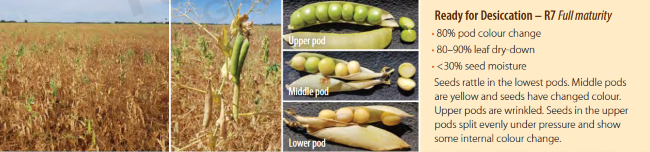
Lentil Reproductive and Maturity Staging Guide
- Moisture content of 30% or below.
- 80% of the plant is yellow to brown in
- bottom third: seeds are tan-brown, hard, and pods rattle when shaken
- middle third: seeds are full size and firm with 100% color change (light green to tan-brown)
- upper third: seeds have 50-75% color change with no immature, shiny green seeds
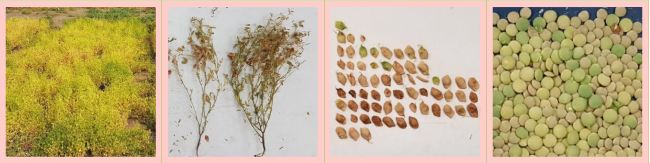
Saskatchewan Pulse Growers Chickpea Harvest Guide
Alberta Pulse Growers Chickpea Production Guide: HarvestingAnthracnose Detected in Montana Lentil Fields
Anthracnose was detected in lentil fields in Daniels, Sheridan, and Roosevelt counties in the pulse crop survey conducted by Dr. Marie Dorval-Celestin and Dr. Frankie Crutcher (MSU EARC). The images below provided by Dr. Dorval-Celestin show the symptoms observed.This survey was funded by the Montana Pulse Crop Committee.
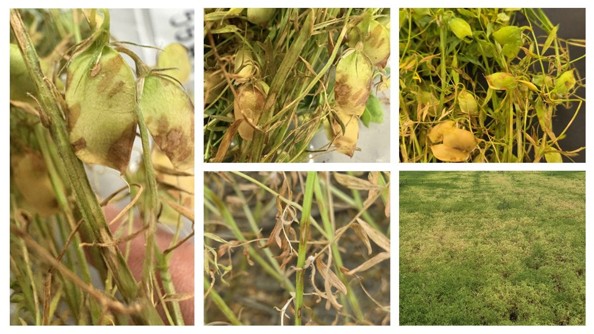
Anthracnose is a fungal disease caused by the pathogen Colletotrichum lentis. This disease is normally managed through a combination of crop rotation, partially resistant varieties and fungicides. Fungicides are typically applied at or shortly after flowering begins, so with the crop rapidly maturing we are beyond that time frame.
Once disease occurs in a field, the pathogen survives as microsclerotia on the infected crop residue (image below). A three-year break in between lentil crops (four-year rotation) is recommended to allow sufficient time for the residue and these survival structures to decompose. Research has shown that no-till practices can accelerate the breakdown of microsclerotia, as burying infected residue may protect the pathogen from weather extremes and prolong its survival.
Anthracnose can also be spread by wind to neighboring fields. Where possible, avoid planting lentil fields adjacent to fields that were heavily infected the previous season.
There are two races of Anthracnose, race Ct0 and Ct1. Several lentil varieties with partial resistance to race Ct1 have been released by the Crop Development Centre including many small green varieties such as CDC Viceroy and the large green variety CDC Grimm. Currently all of the medium green varieties grown in our region are classified as susceptible or moderately susceptible. Information on variety resistance can be found in the 2026 SaskSeed Guide.
Anthracnose races Ct0 and Ct1 are both present in Saskatchewan. Although surveys have not been performed in North Dakota, an evaluation of lentil varieties for anthracnose resistance conducted at the Carrington REC by Dr. Michael Wunsch, suggests that both races likely occur here as well. There are no varieties available which have resistance to race Ct0. Where this strain of the pathogen is present, crop rotation and fungicides are our only management tools.
After harvest, consider submitting samples to the Regional Pulse Crops Diagnostic Laboratory to determine if anthracnose is present on the seed. While research has shown that seed-to-seedling transmission is not a major source of field infection the following season, seed testing can help confirm whether the pathogen was present in your fields this year and may aid in future disease management decisions. Try to submit seed samples in the fall, to get tests results back in time to adjust planting plans.
Dr. Audrey Kalil, CCA
Agronomist/Outreach Coordinator
Northern Corn Leaf Blight
As irrigated corn hits the tasseling growth stage, be on the lookout for foliar fungal diseases like Northern Corn Leaf Blight (NCLB). Caused by the fungal pathogen Exserohilum turcicum, this disease was found at high levels in North Dakota corn fields in 2025 (NDSU Crop and Pest Report). Because the pathogen survives on crop residue, corn planted on corn ground will be at the highest risk. Overhead irrigation can further favor disease development by increasing canopy humidity and extending periods of leaf wetness.Look for symptoms (pictures below) on the lowest leaves and determine if they are moving up the plant. Yield loss can occur when the top 8 to 9 leaves above the ear are infected, because these leaves produce over 70% of the energy (carbohydrates) required by the ear. If symptoms are not present check back again the following week through R1 (silking).
If a fungicide application is warranted, generally the greatest benefit comes from a single application at tasseling (VT) through silking (R1) growth stages. Plants are most vulnerable to yield loss at tasseling through early grain fill, and less susceptible to yield loss due to foliar disease as the crop begins to mature.
Check your corn hybrid for resistance to NCLB, as susceptible hybrids have the greatest potential for yield gain from a fungicide application. Fungicide efficacy information can be found in the 2026 Corn Foliar Fungicide Efficacy table from the Crop Protection Network.
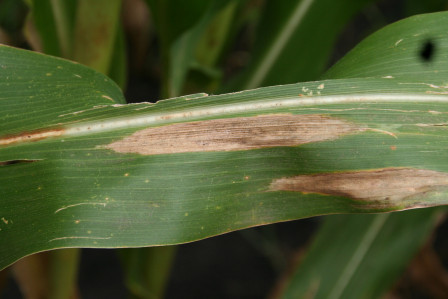
"Cigar-shaped" northern corn leaf blight lesions. Image: D. Mueller
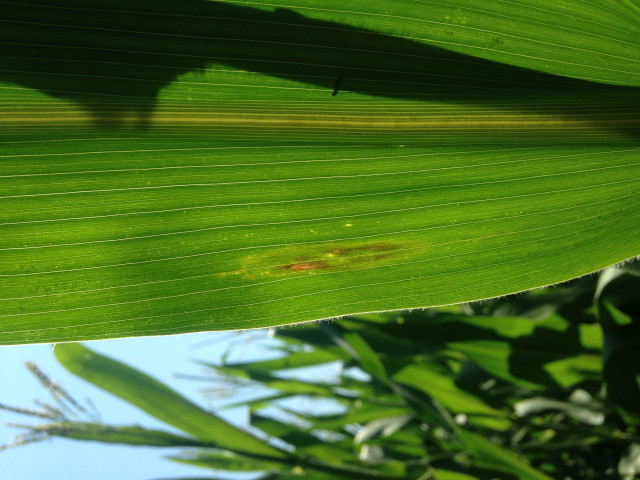
Northern corn leaf blight symptoms on resistant hybrids are smaller and may not be as easily recognizable. Image: A. Robertson
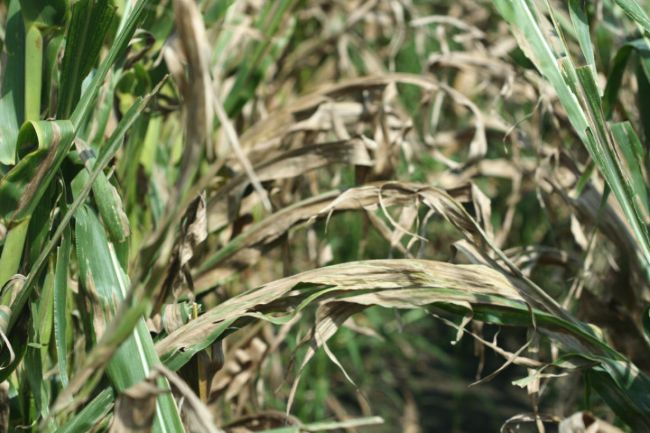
When symptoms are severe individual lesions coalesce to blight entire leaves. Image source: C. Grau, K. Wise, A. Robertson, A. Sisson, and D. Mueller