Agronomy Update
In Crop Herbicide Timing for Canola
Canola fields scouted last week were at the cotyledon to 4-leaf stage. Weeds have taken advantage of the recent moisture with significant pressure observed in spots, and kochia reaching up to 4 inches. Now is the time to scout canola fields to determine growth stage, weed density and to determine if a flea beetle application is needed.
Use the guide below to growth stage canola. The first leaves to emerge are the cotyledons (small kidney shaped leaves) and the leaves that emerge after that are considered true leaves. Plants with 2 true leaves are at the 2-leaf growth stage, and so on.
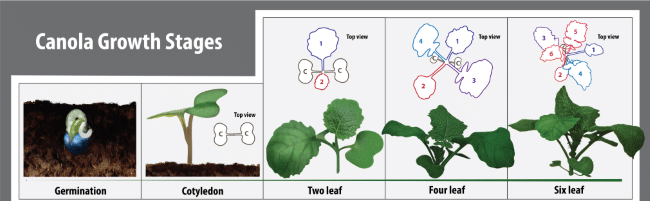
Canola seeding growth stages (Canola Council of Canada).
Weed control should occur before the 6-leaf stage. If weeds are present now, don't delay control. Even if more weeds emerge later, it is better to make a second pass than delay your first. Weed competition during early canola growth stages will cost you yield (Figure 1).
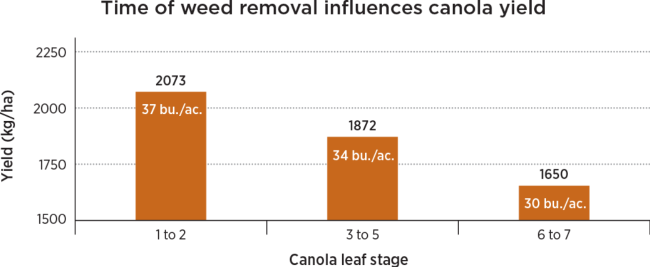
Figure 1. Yield by stage at which weeds were removed. Yield was highest when weeds were controlled at the 1 to 2 leaf stage (Harker et al, 2008).
If you want to add Stinger (clopyralid) to the tank mix to control Canada thistle (image below), the label requires that you wait until the 2-leaf growth stage. In fields where canola growth is uneven you might consider a two pass system if weed pressure is high. Stinger can be added to the second pass to ensure all canola seedlings are at the correct growth stage. Unlike most weeds, waiting until the Canada thistle plants are 6 - 8" tall can actually improve control. Applications cannot be made after canola has reached the 6-leaf stage, however.
Keep track of which fields are sprayed with this product. Stinger has an 18 month rotation to soybean, peas, lentils, dry beans, and sunflower. Under irrigation with soil organic matter above 2%, rotation length to dry bean, soybean and sunflower can be shortened to 10.5 months. Wheat, flax, barley, corn or oats can all be planted the following season.
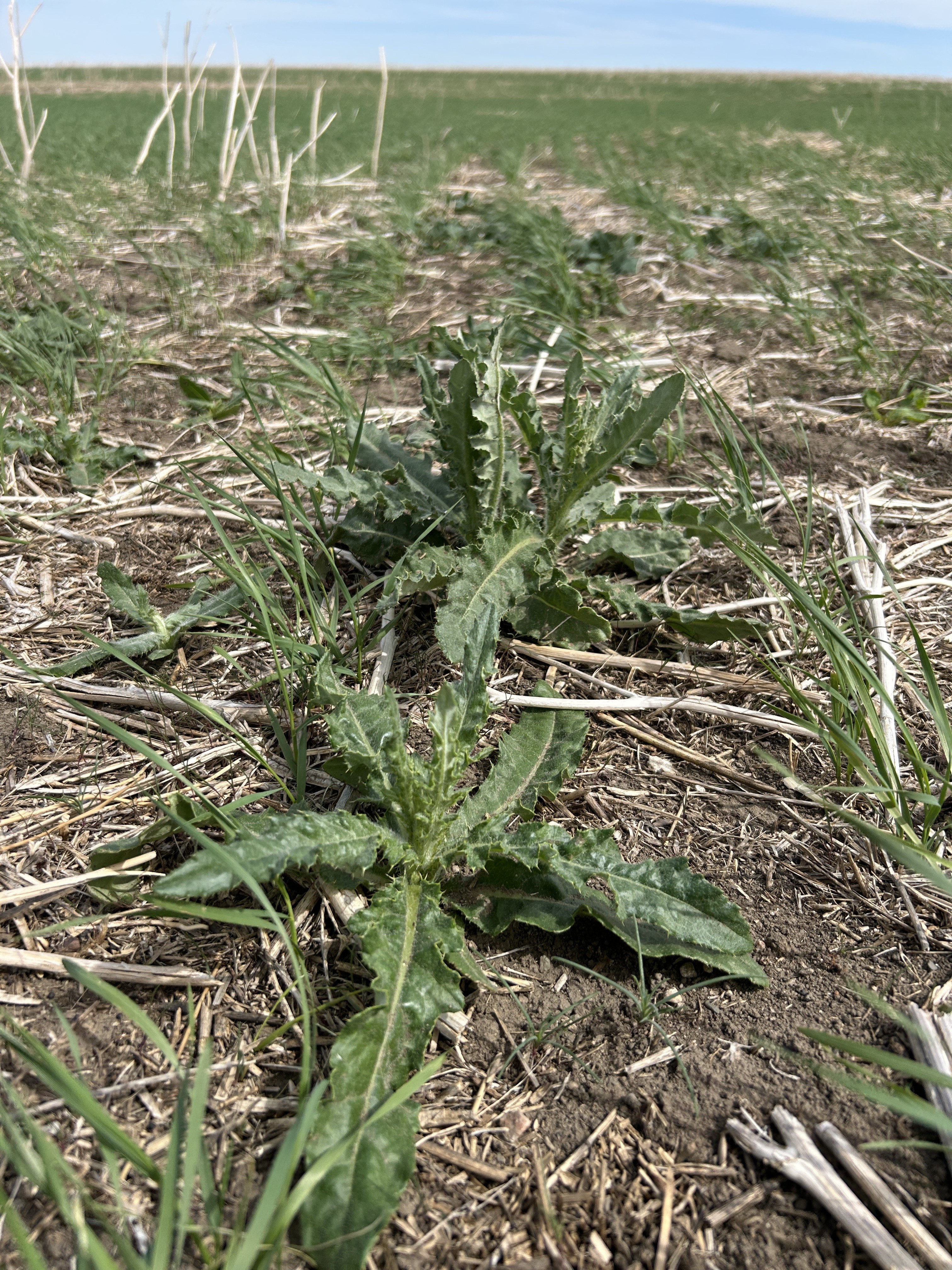
Canada thistle on May 28th.
Similarly, damage from flea beetle feeding occurs rapidly so a delay in spraying insecticide reduces the yield benefit realized from the application. Dry and hot conditions have been conducive to flea beetles and significant injury, particularly around field edges, has been observed (picture below). Flea beetle pressure varies from field to field, so its important to scout fields before making an insecticide application. Scout field edges first, and if damage is observed check the field interior as well.
If there is heavy flea pressure only along one side of a field, spraying just that area can be enough. However, that requires spraying quickly after scouting. Within a day, flea beetles can spread throughout the field.
Flea beetle populations should begin to decline after mid-June and by then most of the canola planted will have reach the 6-leaf growth stage or beyond, after which flea beetle feeding is unlikely to cause yield loss.
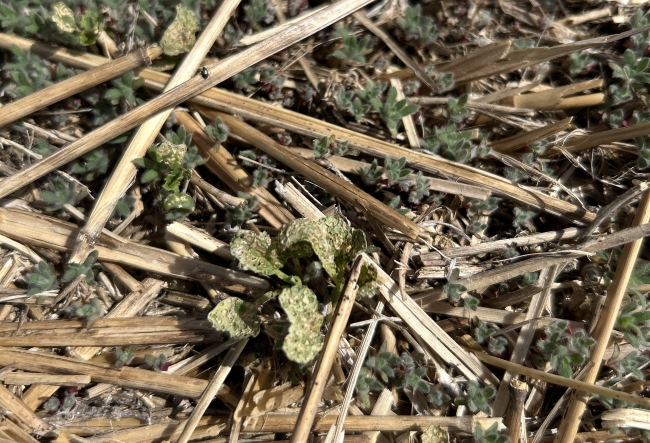
Flea beetle feeding damage and heavy kochia pressure observed May 28th.
Kochia has documented resistance to herbicides in Groups 2, 4 (2,4-D, dicamba, and fluroxypyr), 5 (atrazine), 9 (glyphosate), and 14. Genetic testing has confirmed group 2, 9 and 14 resistance is widespread in our area of the state. It is essential that we are good stewards of Liberty so that we can maintain its effectiveness long term. The label recommends a minimum of 15 gallons per acre of water and while this might slow you down, reducing water volumes reduces weed control. This is especially true when weeds are drought stressed, like they are now. Keep application and AMS rates high. Repeated, low doses of herbicide where weeds survive application are what leads to the development of resistance.
Dr. Audrey Kalil, CCA
Agronomist/Outreach Coordinator
Agile Agronomy Update: Hold Onto Your Hats!
If I could sum up last week in one word it would be WINDY (I have other single-word descriptions for last week, but let's keep this appropriate). As far as planting progress goes, we are so very close to the finish line here with just a few more acres to go, mostly sunflowers.
We made a lot of planting progress this past week after we dried out from a nice rain the week prior, but because of the wind we have done virtually zero spraying.
Combine a nice rain, very warm weather (highs in the 90's all last week), full-tilt planting, and parked sprayers, and you've created a very interesting dilemma on our end. Weeds have definitely flushed on us, crops are taking very minimal time to get out of the ground, and in some circumstances the clients I work with have missed their burndown window for some fields. This is less than ideal, but I do like to have a plan B ready to go in case of these situations. So I want to share what I suggest in wheat and sunflowers when we have to switch to plan B.
Wheat/Durum
This is the one I sweat the least about if we miss burndown. The only weed I really get concerned about is cheatgrass; for most other weeds we do have some effective options. I am by no means giving you a comprehensive list, but rather a few favorite options I utilize.
- Huskie/Huskie FX: These have a wide application window from 1 leaf all the way up to flag leaf emergence. Both products contain Bromoxynil (Group 6) and Pyrasulfotole (Group 27). Huskie FX has the addition of Fluroxypyr (Starane Ultra, Group 4), which will give you extra horsepower on kochia.
- Tolvera: A Group 6 + 27 combo of Bromoxynil and Topyralate, Tolvera is a relatively new player in the game with a wide-open rotation window. With this product you gain some green and yellow foxtail (pigeon grass) control, so if you have that up at the time of needing it, it's a great option.
- Wolverine Advanced: This is a combination of Huskie + Fenoxaprop (Puma). I've had situations where burndown was missed and wild oats were emerging at the same time as the wheat. You can use this from 1 leaf up to flag leaf emergence, and as long as you don't have group 1 resistant wild oats, this is a great broadleaf and grass combination to use if burndown was missed.
Sunflower
If we miss burndown here, this can get to be a lot more difficult, especially if you're seeing a lot of weeds already. But let's pretend you burned down 2 weeks ahead of planting and have at least that initial flush of winter annuals taken care of. In this case, you're just contending with missing the residual you wanted to apply for extended broadleaf weed control into the season.
Many don't utilize Zidua (Group 15, Pyroxasulfone) to its fullest extent. The beauty of this product is that it's a strong residual that can be applied post-emergence to the crop. In sunflowers you can apply Zidua from the first true leaf all the way up to the 8th leaf stage. It provides an excellent residual on grasses and small-seeded broadleaves like pigweed, and while it isn't the best for kochia, it works pretty well (plus, remember, you ran out of other options at this point).
The kicker is it takes a good 0.75" of rainfall to get fully activated and working, so this is where you'll get mixed experiences from different farmers who have used it. Some love it, some have been disappointed and it all depends on who got rain and who didn't.
You can tankmix Express with Zidua, but be careful with Clearfield-tolerant sunflowers; they are rather sensitive, and only Clearfield Plus sunflowers can have Zidua tankmixed with Beyond Xtra.
When it comes to rates, everything is so region-, crop-, and situation-specific. You have a really good crew of agronomists at Horizon Resources to work with, so make sure you're utilizing them and reaching out if you do find yourself in a missed burndown situation.
Kyle Okke, CCA
Agile Agronomy LLC
Agronomists Happy Hour Podcast
Sulfonylurea (SU) Herbicides: History, Uses, and Role in Modern Weed Management
If you are in our offices or talking to our agronomists, you will often hear the term "SU" when discussing herbicide tank mixes. An SU is a sulfonylurea herbicide. Many long-time growers will remember some of the early SU products, such as Amber and Ally. These herbicides provided excellent weed control at extremely low use rates and offered very long residual activity.
Amber was sold in what was called a 'shoe box' that had 4 bags and, in each bag, there were 8 soluble pouches that each had 1.4 ounces of Amber that treated 8 acres. Each bag in a shoe box treated 64 acres so a shoe box would treat 256 acres. With 6 shoe boxes in a case, a grower could treat 1,536 acres out of just one box the size of a 2 x 2 ½ case of liquid chemical.
At a rate of just 0.175 ounces per acre, Amber worked extremely well. However, there were two main issues with the long residual herbicides. They stayed in the soils for several years eliminating the ability to raise alternative crops and secondly, they were the same mode of action (Group 2) of most of the sterilant products that had been used year after year on industrial sites and railroad right of ways. The continued use of the Group 2 products on industrial sites caught up to us. Kochia became tolerant and eventually resistant to Group 2 herbicides, including the SU herbicides.
Cheyenne was a co-pack herbicide for both broadleaves and grasses, which included an SU herbicide. We sprayed this product in the irrigated spring wheat in the Trenton/Buford and Yellowstone Valley irrigation districts and could see kochia in a straight-line path where a plant containing resistant seed rolled across a field. The Cheyenne had killed all the kochia in that field except the resistant plants, that more than likely came from the railroad right of way. Within a year, the resistance exploded to the point that we could not kill any kochia with SU herbicides in all our trade territory.
While we don't spray the the long residual SU’s like Amber or Ally in our trade territory anymore, we have continued to use SU herbicides in many tank mixes for weeds other than kochia. The main products we are using now include Express (Tribenuron) and Harmony (Thifensulfuron), available as either straight products or in many different combinations of the two products. Express has been very good for burning the top growth of Canada thistle and is excellent for dandelion control in cereals. Harmony is a great for wild buckwheat. Both of these products are good on winter annuals including narrowleaf hawksbeard, tansy mustard, and other winter annuals.
Premixes of Express and Harmony like Affinity Tank Mix (Audit 4:1) and Affinity Broad Spec (Audit 1:1) are marketed as tank mix partners to broaden the weed spectrum. The other products in the tank will dictate which Affinity/Audit product we use, and that is why there are multiple combinations of Express and Harmony available.
Group 1 herbicides are antagonized by 2,4-D Esters and Express (Tribenuron). When a Group 1 like Puma/Tacoma or Discover are in the tank, we use Affinity Tank Mix or Audit 4:1. These products are 4 parts Harmony to 1 part Express, and with that low ratio of Express we avoid the Group 1 antagonism.
Affinity Broad Spec or Audit 1:1 is one part Express to one part Harmony so they will work as a tank mix partner with any of the group 2 grass herbicides like Everest 3.0 or Varro but has too much Express and will antagonize group 1 grass herbicides.
Panoflex is a reverse of the Affinity Tank Mix as it is 4 parts Express to 1 part Harmony. This is a very good tank mix partner for burndown ahead of seeding cereal crops especially with dandelions or winter annuals.
Most of these products have come down in price substantially since they first came out and we have kept them in our tank mixing toolbox for certain weed problems in burndown or in crop applications in cereals. As we see more tolerance and resistance to our herbicide products, it is much more important to use multiple modes of action in each tank mix, instead of relying on one product or mode of action for weed control.
Older farmers always talk about using only 2,4-D to kill all the broadleaf weeds and most if not all our products worked in this way when first introduced. After using many herbicide products for decades now, we need to learn to use them in different ways, and we must try to kill every weed to eliminate resistance. With more complicated tank mixes, issue of compatibility and antagonism can arise, so ask our agronomists if you need help coming up with a mix that will tackle all your weed issues.
John Salvevold, CCA
Agronomy Division Manager