Agronomy Update
Agronomy Intern Update
Shaun Branham
So far during my internship at Horizon Resources I have been busy in the warehouse and out scouting fields. In crop spraying is starting up, so I have been putting chemical orders together, and learning rates and mixes that fit the farmers situation the best. I enjoy being a part of this process because I can interact with farmers throughout the day.
When I'm not in the warehouse, I am out scouting fields. I stage the crop, look at how the crop stand is, and look for weeds so when we make a recommendation to the farmer we know what chemistries to use to control their problematic weeds. Below are some pictures from being out in the field.
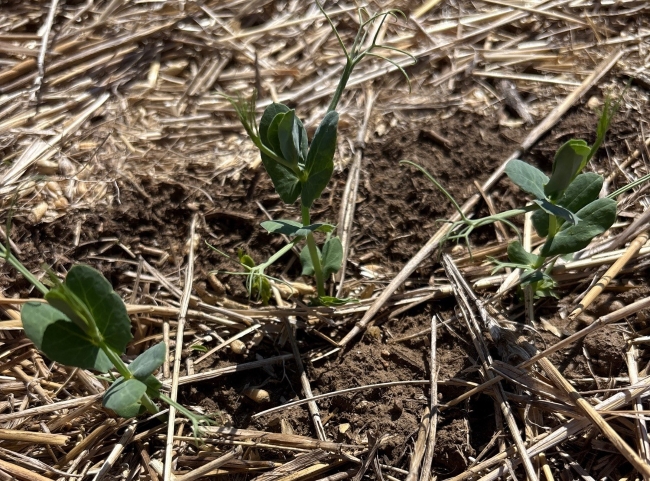
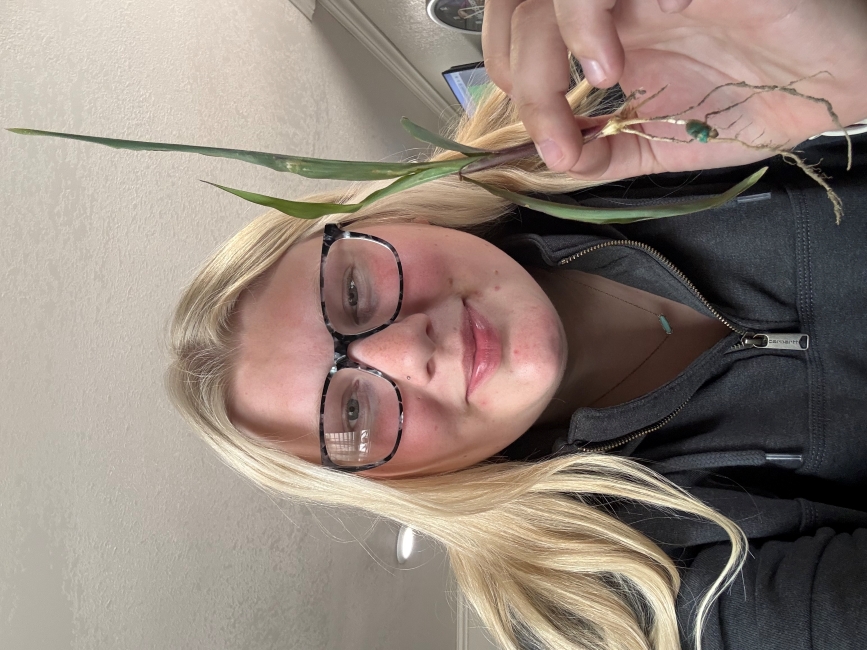
2 to 3 leaf (4-5 node) stage peas
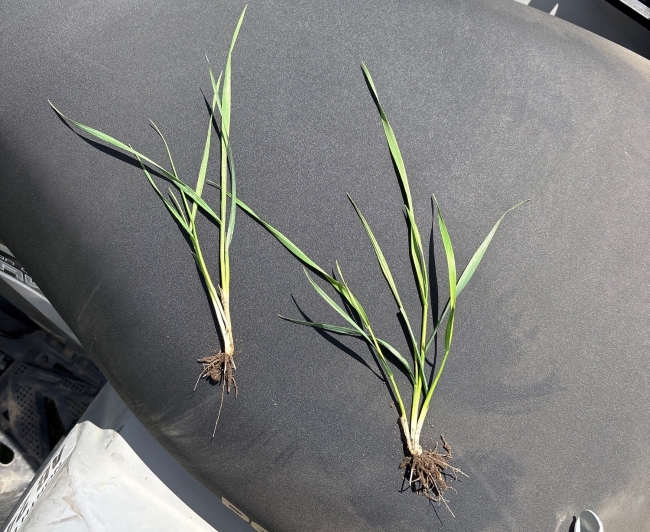
5-leaf durum (tillering)
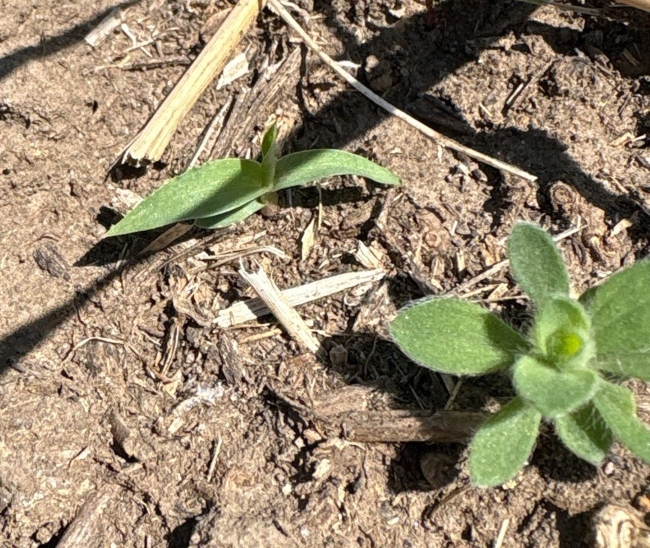
Green foxtail and kochia seedlings
Kylee Janz
Lately I have been learning how to scout and determine growth stage for different crops. I collected soil samples for nutrient testing and weed tissue samples for herbicide resistance testing.
One of my favorite parts of the internship so far has been getting out in the fields and meeting all the customers. Every day I am learning and growing in my confidence.
In Crop Residual Herbicides for Corn
If I were to give an update for the way last week went, I could sum it up in one word: WINDY. I'm pretty sure I've said that before, and the way this year is shaping up, I'm sure I'll say it again. Still, it served as a good reminder that you can have the best-laid plans in place and still get dealt a hand that shows you where those plans have holes.
That's especially true when it comes to corn herbicide programs. We have so many effective and relatively inexpensive options available that it's easy to fall into the mindset of, "If the weeds flush again, we'll just spray them again when needed." Then the wind shows up and says, "hold my beer."
Most of my farm clients grow four different crops, so juggling timing and getting every field sprayed at exactly the right moment is already a challenge. Last week was a good reminder of that reality.
Enter green foxtail and barnyard grass. They're not difficult weeds to control in corn —glyphosate does an excellent job. But we had sprayed those fields only 10 days earlier, and then we caught a rain. The kochia was vaporized, the thistle and buckwheat was banged up, but the grass that emerged after the application basically thanked us for removing it's competition.
Again, getting control it isn't the issue. The problem is timing. With the wind delaying applications, we're now 10-plus days away from getting back into the other three crops with their in-crop herbicides. Looking back, I wish I had pushed harder for adding a residual product to those corn applications to help bridge the gap until a return visit.
So let's talk about some options.
They all happen to be in the Group 15 mode of action:
- Dual II Magnum (S-metolachlor)
- Harness (acetochlor)
- Outlook (dimethenamid)
- Zidua (pyroxasulfone)
Rarely do you use these products solo, and for good reason — they're residual only, with no post-emergent weed activity. They round out a tank or premix for their ability to provide excellent grass residual along with some small-seeded broadleaf residual once you've controlled what's already up. That generally gets you to corn canopy, and then life is good.
The reason I'm listing these as single products with their active ingredient is that in the corn herbicide world there are so many pre-mixes using these ingredients that I'd need a small book to give you the full list of products they show up in. So the key is to pay attention to the active ingredients as I keep sharing here!
Ranked by what needs the most water to activate versus the least:
Pyroxasulfone → S-metolachlor → Acetochlor → Dimethenamid
In terms of relative residual efficacy across a broad spectrum of weeds, from most to least (none bad, just less!):
Pyroxasulfone → Acetochlor → S-metolachlor → Dimethenamid
So there you have it: your strongest residual that can be applied to corn post-emergent needs the most rainfall to activate, and the one that takes the least rainfall to be soil-activated is generally the weakest of the bunch. Being last on this list doesn't make that active a bad choice, we're only comparing them to each other in this case. All of these active ingredients are very good on the primary grasses we are worried about: green foxtail, yellow foxtail, and barnyard grass. This reflects roughly 90% of the grasses that flush after an in-crop spray.
The group 15 products have activity on broadleaves too, generally the small-seeded ones like pigweeds and mustards. This includes some residual on kochia, a contribution that often gets overlooked. Each active ingredient has its own particular control spectrum when it comes to broadleaf weeds, but that's a topic deep enough for an article of its own. I'll leave the detailed comparisons for another day and encourage you to dig into the labels and weed control guides to find the best fit for your operation, or contact your Horizon Resources agronomist.
The takeaway here:
#1. this wind sucks and screws up everything
#2. PLAN for the wind to screw things up
Add some type of residual to your corn post herbicide so you don't end up like me, having to tell those farmers they need to get back to those fields sooner than anticipated to spray out grasses, when they've already got a long list of fields to spray before they even get there!
Kyle Okke, CCA
Agile Agronomy LLC
Agronomists Happy Hour Podcast
Narrowleaf Hawksbeard is Back
Our Agronomists that are crop scouting have noticed more Narrowleaf hawksbeard this year than we have had in the last few years. This is likely due to a combination of management and environmental conditions. A wet, mild fall allowed germination to continue for months, potentially past when a fall burn down was applied but before the residual went on. Come spring, cool conditions could have allowed rosettes to escape the burndown and additional seedlings likely emerged after burndown was applied. Fields that did not get a fall burn down or fall applied residual will be hit the hardest.
Narrowleaf hawksbeard was not a problem in North Dakota until about 2018, but had been in northeast Montana for several years prior. This is an annual weed that can germinate late in the fall like a winter annual but also germinate early in the spring and all the way into the middle of summer. The seed is like a dandelion seed and can travel in the air with the wind for quite a distance. I am sure that the plants that we first dealt with were more than likely blown in from northeast Montana and it has exploded from there.
It is common to see it start on field edges and along tree rows. Basically anywhere that can catch the seeds and stop it from blowing in the wind. Even in town, the first year we had Narrowleaf hawksbeard issues, we had plants germinating along the entire edge of our concrete at our office after it stopped the seed as it blew into the area.
The rosette stage of Narrowleaf hawksbeard looks like a dandelion plant and the main distinguishing difference is that the dandelion leaves will have pointed lobes facing towards the center of the rosette and the narrowleaf hawksbeard has pointed lobes that point straight outward.
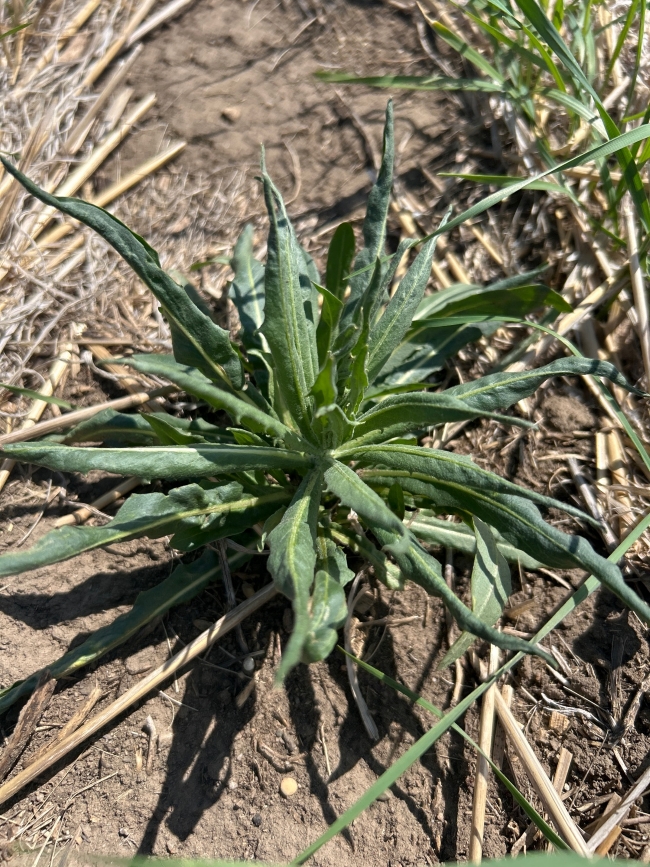
This is not a perennial weed, so it will not reproduce from the roots or rhizomes and would be easy to control with tillage. Since we have limited tillage in northeast Montana and western North Dakota, this has become a weed that has thrived when not controlled.
If you missed controlling this weed in the fall, it is very important to control it with your spring burndown. The damage will be done once it has bolted and is producing seed. Express and Sharpen are probably the best products to use for burndown and both have labels for several crops for burndown applications. Once bolted, the hawksbeard can choke out your crop, and you will not have much for yield in those areas.
We have some options for post-emerge herbicides in cereals that can control it, but there are really no options in pulse crops or canola. Talinor is one of the best products for post-emergence control in wheat, durum and barley. We helped Syngenta get a control label for narrowleaf hawksbeard with Talinor in 2018 with the work we did in cereals. Corteva has a few products with flurasulam that have good activity on this weed also. Starane Flex, Goldsky and Quelex all have good activity on narrowleaf hawksbeard.
If you apply Talinor in durum or wheat, then its a 10 to 15 month rotation to pea and 15 months to lentil. I had someone tell me that Talinor does not fit in a lentil rotation, and I told him that neither does narrowleaf hawksbeard. This weed can produce 30,000 plus seeds per plant so don’t ignore it and make sure you clean it up before seeding a crop with no options for weed control.
We had very little issues with this weed up until 2017 and in 2018 it was the weed of the year in the NDSU weed guide, so that kind of sums up how it appeared overnight. If you can control this weed for a couple of years, the seed does not stay viable in the soil for very long, so you can eliminate it quickly, but it can cause severe crop loss in the year or years you do have a problem.
If you have any questions, ask any of our Agronomists at Horizon Resources and we can help you with a plan to eliminate the problem.
John Salvevold, CCA
Agronomy Division Manager
Broadleaf Weed Control in Peas, Soybean and Dry Bean with Varisto® Herbicide
In northwest North Dakota, growers know every season brings its own set of challenges—from unpredictable rainfall and cooler spring temperatures to persistent weed pressure from kochia, lambsquarters, and ragweed. Staying ahead of these issues is critical to protecting yield potential in field pea, dry bean and soybean acres across our region.
That’s where BASF’s Varisto® herbicide (Group 2 + 6) comes into play as a practical, reliable solution designed to meet the specific demands of our local growing conditions.
Built for Northern Plains Conditions
Shorter growing seasons and variable early-season weather in northwest North Dakota mean crops can’t afford early competition. Varisto® herbicide delivers fast, effective post-emergent control, even when conditions aren’t ideal.
With its strong activity on hard-to-control broadleaf weeds, Varisto is particularly valuable in this region where:
- Kochia resistance continues to expand
- Late flushes of weeds compete for limited moisture
- Rapid growth windows require timely, efficient control
Key Advantages
1. Control of Problem Weeds
Varisto helps manage the broadleaf weeds that are problematic in our geography including:
- Waterhemp and pigweeds
- Common lambsquarters
- Volunteer canola
- Ragweed species
Controlling these early keeps your crop competitive during critical growth stages.
2. Flexible Timing for Busy Operations
Between planting, fertilizing, and managing livestock operations common in the region, flexibility matters. Varisto offers a broad application window, allowing growers to spray when conditions and schedules align.
3. Protecting Yield Potential in Limited Moisture Environments
Moisture is often the limiting factor in northwest North Dakota. Every weed removed means more available water for your crop. Varisto helps:
- Reduce early-season competition
- Maximize water-use efficiency
- Support stronger crop development
A Smart Tool Against Resistance
Herbicide resistance—especially in kochia—is a growing concern across western North Dakota. Varisto provides a valuable mode of action (Group 6) that can be integrated into resistance management plans.
To get the most out of it locally:
- Rotate herbicide chemistries year to year
- Consider tank-mix partners suited to your weed spectrum
- Scout fields regularly, especially after application
A layered approach is key to staying ahead of resistant populations.
Local Application Tips
For best results in North Dakota conditions:
- Spray early when weeds are small and actively growing
- Target application during warmer daytime temperatures when possible
- Use proper spray coverage, especially important in thicker canopies
- Watch wind conditions to reduce drift
- Spray injury may occur to field peas at higher rates. I generally recommend reduced varisto rates and supplemental Basagran 5L to the tank mix
I have included a chart below breaking down the rate structure for Varisto.
|
Varisto |
Beyond Xtra (Imazamox) |
Basagran 5L (Bentazon) |
|
11 oz/A |
2 oz/A |
9 oz/A |
|
16 oz/A |
3 oz/A |
13 oz/A |
|
21 oz/A |
3.9 oz/A |
17 oz/A |
Adjuvant Recommendation:
NIS @1 qt/100 PLUS either AMS @ 12-15 lb./100 gal or UAN 2.5 gal/100 gal. MSO can be used @ 1% v/v IF 11 oz/A is used.
Timing:
Field Peas – Apply POST from 3 leaf to bloom stage.
Working closely with your Horizon Resources agronomist can help fine-tune timing and rates based on the crop and conditions in your specific fields.
Final Thoughts
Farming in northwest North Dakota requires adaptability, efficiency, and the right tools at the right time. Varisto® herbicide offers a strong fit for the region—helping growers manage tough weeds, protect limited resources, and maximize yield potential in a challenging environment.
As weed pressure continues to evolve, solutions like Varisto play an important role in keeping your fields clean, productive, and profitable season after season.
Always read and follow label directions. For more detailed recommendations and questions, contact your Horizon Resources Agronomist.
Chris Binstock
Business Rep Western ND
BASF Agricultural Solutions US LLC.
Research Driven Head Scab Management Best Practices
The U.S. Wheat and Barley Scab Initiative (USWBSI) is a federally funded program tasked with developing effective control measures for Fusarium Head Blight (FHB), also known as Head Scab, in wheat and barley. Funding for wheat and barley FHB research is authorized and allocated at $15 million/year through the U.S. Farm Bill. These funds have supported the development of resistant/tolerant varieties, evaluation of fungicides and fungicide timing as well as the wheat head scab risk prediction tool. Recently the USWBSI sent out a newsletter with some top tips for FHB/Head Scab management (shared below). If you'd like to receive the newsletter subscribe here.
Head scab risk in non-irrigated systems is largely driven by rainfall and associated humidity. The risk prediction model is based on the relative humidity in the days prior to wheat flowering. As we get closer to flowering, I'll share the risk maps in the newsletter to help you make head scab fungicide decisions. Note that durum wheat does not have the same genetic resistance to head scab as spring wheat, so even the most tolerant varieties are still very suscpetible.
Dr. Audrey Kalil, CCA
Agronomist/Outreach Coordinator

Spring wheat and durum will be heading and flowering soon in the U.S. Now is the time to start thinking about managing Fusarium head blight (FHB), and its associated mycotoxin deoxynivalenol (DON). While making management decisions, here are some helpful tips to keep in mind.
1. The best application window for FHB and DON suppression in spring wheat and durum begins at early-flowering and extends up to seven days later. Our research efforts through the USWBSI have indicated that this is the best timing to suppress FHB and DON, while protecting yield. The USWBSI’s fungicide timing postcards can help correctly identify growth stages in spring wheat and durum.
2. If your field contains multiple stages, the best fungicide application timing is 5 to 7 days after the earliest growth stages begin flowering. For example, if 40% of your field is at early flowering today, 40% is at full-head, and 20% is at half-head, applying a fungicide in 3 to 5 days may be your best option. This will increase the chances of gaining adequate fungicide coverage on most of the heads in the field.
3. Durum varieties with the highest levels of resistance / tolerance should be viewed as moderately susceptible. When using the FHB Risk Tool, change the susceptibility of your variety by clicking the bulleted list icon button located in the top left corner of the map.
4. Should I use two fungicide applications to manage FHB and DON? Research suggests that two applications using different fungicides will generally result in greater disease reduction in spring wheat and durum. However, in several studies one well timed application of a good fungicide was just as effective as two fungicide applications. Given the additional input costs associated with a second fungicide application, it may be best to apply a fungicide once during the seven-day application window. Reminder: Not all fungicides registered on small grain crops are effective in managing FHB. See the Fungicide Efficacy Guide for Control of Wheat Diseases on the Crop Protection Network to help pick the best fungicide options for managing FHB.
5. A pattern of rainy weather with mild temperatures during spring wheat flowering may not necessitate a fungicide application. Farmers are encouraged to use crop growth stage, field cropping history, variety susceptibility, and the FHB Risk Tool to determine the risk of FHB. It is common for FHB risk to be low in many spring wheat growing regions due to the genetic resistance that occurs in most of the varieties.
6. If you planted your spring wheat or durum following corn, consider fungicide application a standard practice. Hard white spring wheat and durum are the most susceptible to infection by F. graminearum. Even with the least susceptible varieties of hard white spring wheat, growers should consider standard applications of effective fungicides at anthesis. That risk increases when corn production occurs locally.
7. Consider shutting off irrigation. Where soil moisture reserves can be built up in finer textured soils, shut off the irrigation for 5-7 days during anthesis and apply an effective fungicide particularly to the circle surrounding the first tower of the center pivot where the highest duration of irrigation and disease occurs.
Weather Update
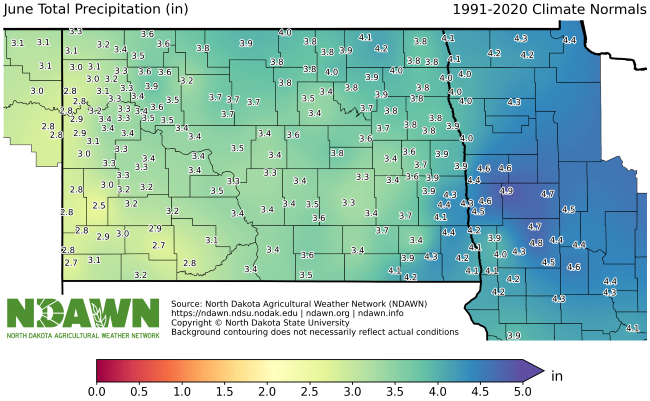
We continue to get much needed rain showers. Despite the headache it's creating for our in-spray herbicide pass, we still need some additional moisture to bring us closer to normal.
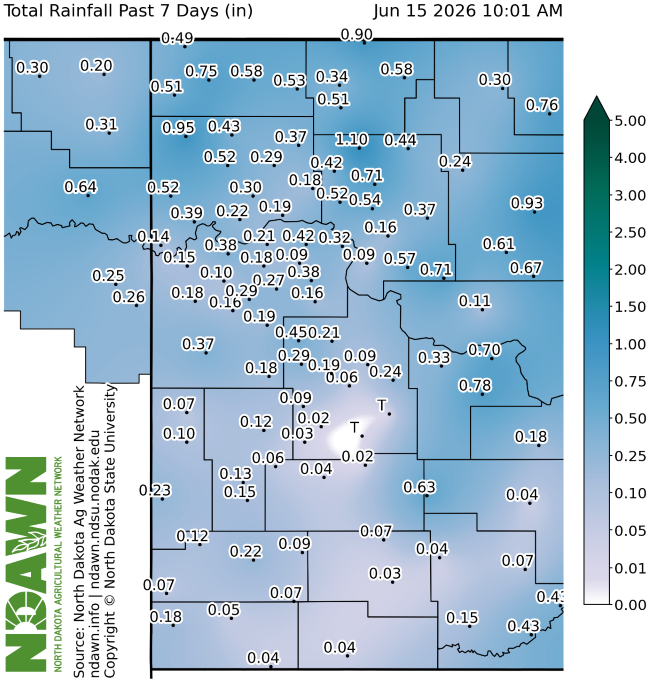
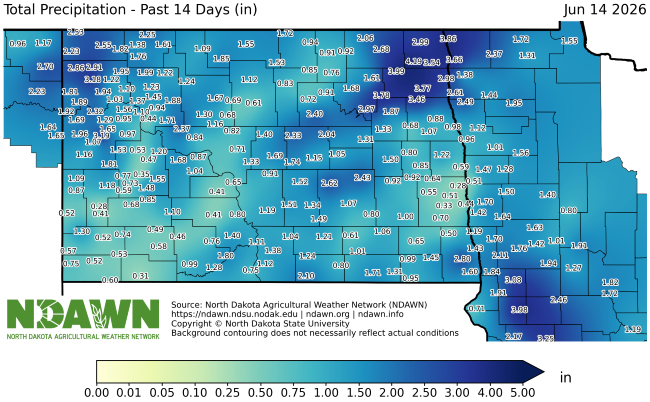
The map below shows normal June precipitation based on weather data from 1991 - 2020. We are at or below (by roughly 1-2") normal precipitation for June as of today, depending on the location. With rainfall in the forecast, hopefully we get can closer to normal or above, and make up for the April and May deficit.