Agronomy Update
Fusarium Head Blight (Head Scab) Risk
With early planted wheat and durum at or approaching heading, now is the time to make fungicide application decisions for control of Fusarium Head Blight (FHB), also known as head scab. For wheat and durum we want to make FHB applications when the majority of the crop has started to flower, or within seven days after this time point. For barley the fungicide application timing is when the full head has emerged, or again, within seven days after that time point.
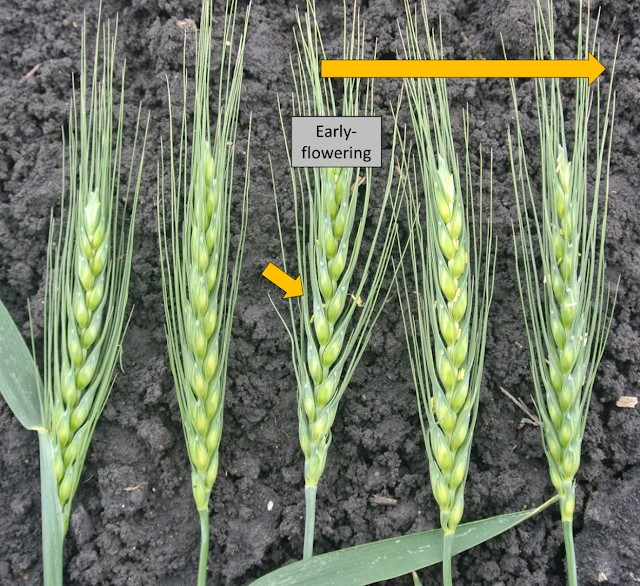
Head scab fungicide timing in wheat.
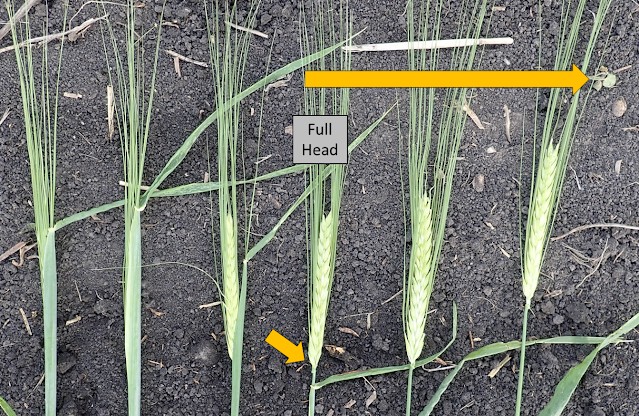
Head scab fungicide application timing in barley.
There are two models we can use to gauge FHB risk for wheat, and right now they differ substantially. The national model is reporting high levels of risk for very susceptible varieties of wheat, including durum, across the state, whereas the NDSU model is currently reporting moderate risk in our geography.
Both models are based on relative humidity but differ in the weather data sources they use and the time period over which humidity is evaluated. The national model assesses relative humidity during the 14 days preceding the selected date, whereas the NDSU model uses a 7-day evaluation window.
Past experience has shown that these models are useful tools, but they are not foolproof. If conditions have been rainy and humid for several weeks in your area, the risk of infection is likely elevated. Conversely, dry weather and low relative humidity reduce the risk of disease development.
The severity of FHB and the potential for vomitoxin (VOM) accumulation are also influenced by weather conditions during grain development after fungicide application. Because we do not yet know what weather conditions July will bring, there is an inherent degree of uncertainty in FHB fungicide management decisions.
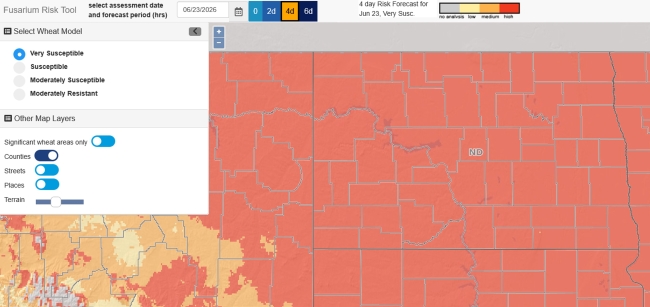
National model 4 day risk prediction on 6/23 for very susceptible varieties of spring wheat, which would pertain to all varieties of durum.
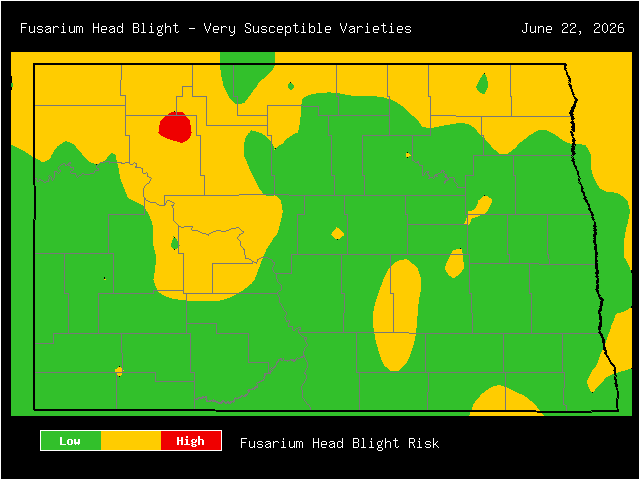
NDSU risk prediction for very susceptible varieties of wheat as of 6/22.
If you are growing spring wheat, check the susceptibility of your variety in the North Dakota Hard Red Spring Wheat Variety Selection Guide to evaluate risk. Unlike durum, hard red spring wheat varieties have been developed which have good genetic resistance to FHB. As a result, moderately resistant varieties (ratings of 4 or 5) are generally at lower risk of disease development. When using either risk model, you can select the "moderately resistant" category to evaluate risk at flowering.
Crop rotation can also influence disease risk because the pathogen that causes FHB, Fusarium graminearum, overwinters on infected crop residue. The greater the amount of pathogen present, the higher the potential for disease. Small grains and corn are host crops, with corn residue creating the highest-risk scenario.
I frequently get asked if the early season fungicide applied with the herbicide pass will reduce FHB risk and the answer is no. That application protects the leaves from foliar fungal pathogens and reduces the risk of yield loss from diseases like tan spot. Fungicides only provide protection to the tissue they touch, and this lasts just a couple of weeks. Fusarium graminearum infects the head, so an application at flowering (wheat) or heading (barley) will still be necessary to reduce risk of VOM and yield loss due to FHB.
The Crop Protection Network provides efficacy ratings for wheat fungicides and the document in the link lists the products which provide "Fair" to "Good" control. There isn't a fungicide on the market that will give you 100% control of FHB and the best products available reduce VOM by 40-60%. Improved FHB control is achieved through stacking management techniques like crop rotation and resistant or tolerant varieties with a well timed fungicide application.
If you have any questions, feel free to reach out.
Dr. Audrey Kalil, CCA
Agronomist/Outreach Coordinator
Staging Small Grains: Don't Judge by Size Alone
It seems no two seasons are the same, and it's been hard to peg any one of them lately as "normal," but this season has been far from it, to say the least. Most of you have probably noticed by now that our small grains, especially spring wheat and durum, have been heading out on the shorter side. I'm no plant physiologist, but if I had to guess, it has to do with the abnormally dry, hot May we had, even though June has been favorably cool. Regardless, this phenomenon of the crop being "more advanced than it first appears" is real this year, and you need to keep a careful eye on what stage your wheat or durum is actually at to ensure crop safety when making your in crop herbicide application.
Timing of Herbicide
Disclaimer: there are far too many products and combinations to list everything here, so the products mentioned are just examples.
Ultimately, the label holds your information. We do our best as agronomists to give you everything you need to know before you head out the door, but we know the real world happens. Sometimes there can be a significant time lag between when you pick up chemistry and when you actually apply it. With the number of wind delays we've seen this season, it's important to know what the labels of the products in your tank actually say, because what you were told back then may not apply by the time you're in the field spraying.
You'll see verbiage such as "1-leaf up to jointing," "3-leaf to 5-leaf," "3-leaf up to flag leaf," or "2-leaf up to boot." It's important to find those statements on the label so you know the allowable timing for that particular product. If you're tank mixing multiple products, you must follow the most restrictive label. Also take note that even if you're using an active ingredient with a wide window of application, the presence or absence of a safener in the formulation is often what changes that range. Pay attention to the label on the exact product you are using and don't make assumptions.
A good example is GoldSky, OpenSky, and PerfectMatch. The GoldSky and PerfectMatch labels state timing from 3-leaf up to prior to jointing, while OpenSky has a less restrictive label allowing 3-leaf up to prior to flag leaf emergence. So even though each product shares the same grass herbicide component, which is usually what restricts timing the most, the window of application differs because of the safener.
It can be frustrating to see products this similar, differing only in some broadleaf components, carry different timing windows but it's a great reminder that reading the label to understand your use parameters is important!
Staging Small Grains
There are several official staging systems for small grains, like Feekes, Haun, or Zadoks, but on most labels you'll see a general leaf stage listed.
Here's how I stage small grains: count the collars. Where the leaf meets the stem, you'll find a leaf collar, and the number of collars on the plant is the leaf stage it's currently in. Simple, right? Just make sure you're counting on the main stem, because once tillers form it gets tougher to count.
In early growth, collars are easy to count up to the 3rd leaf stage. From the 3rd leaf stage on, the plant starts to form tillers, so finding the main stem becomes more muddled as those develop. There will be 5 leaf collars before jointing begins.
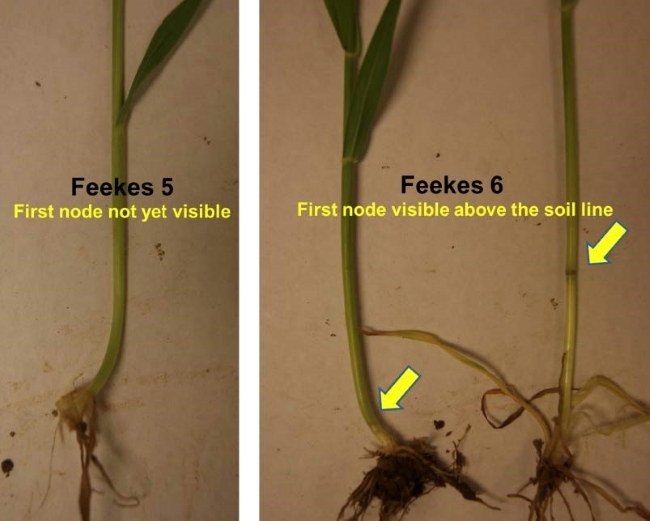
Wheat before and during the jointing stage when nodes/joints are present.
Once jointing starts, you'll see visible bumps or nodes on the main stem (image above); they start below the soil line and push upward, with a total of 3 nodes emerging from the base of the plant. This is generally when the crop canopies. Each node that moves above the soil line marks a new leaf stage where a new collar will form, so jointing covers the 6th, 7th, and 8th leaf stages.
The flag leaf (image below) can appear any time after jointing is complete. It's generally the 9th or 10th leaf (this varies by variety), but under drought conditions it can emerge with the last joint, so as early as the 8th leaf stage. The flag leaf is easy to identify because it's the last leaf to form and no new leaf will emerge above it.
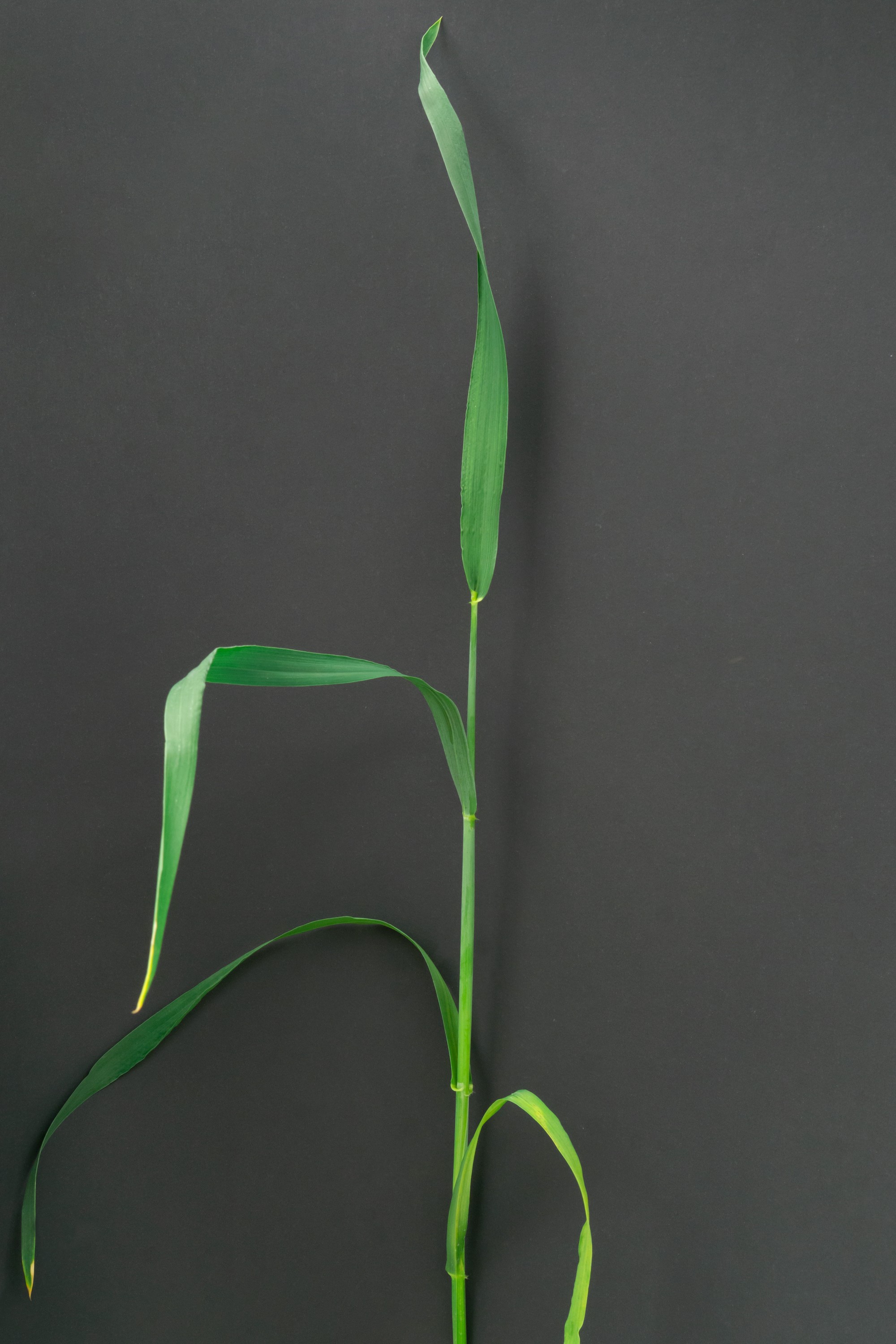
Flag leaf growth stage.
Boot stage is when the head swells in the stem below the flag leaf. Even if some beards are sticking out, it's still considered boot stage until the head pushes up above the flag leaf. A few beards poking above the flag leaf is still boot, but as soon as any spikelets push above it, you're officially in heading stage.
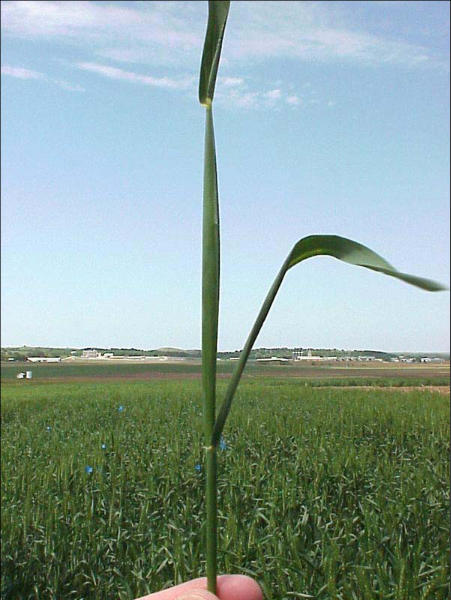
Boot stage. The head is still within the leaf sheath.
So here's my takeaway: don't judge small grains by size alone. Know your window of application by reading the label, and properly stage your crop when you're out with the sprayer to make sure you're in the correct window. This year's small grains have been running smaller than normal, so this is especially important this season.
Kyle Okke, CCA
Agile Agronomy LLC
Agronomists Happy Hour Podcast
Growing Pulse Crops Podcast: Risks and Rewards with Adjuvant Selection
Codee Lee is a technical specialist for CHS. Half of his job is research on their fertility, biological, crop protection and adjuvant products. The other half is communicating about that research with customers and growers in general. Lee shares the purpose of adjuvants and the advantage they provide producers especially when facing adverse environmental factors.

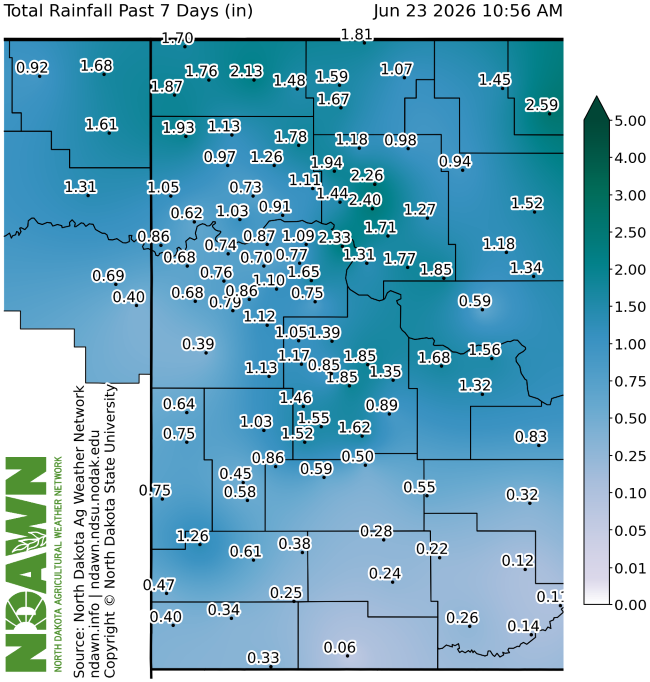
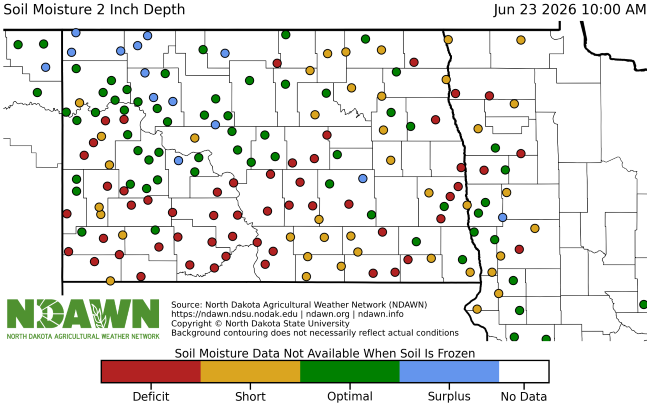
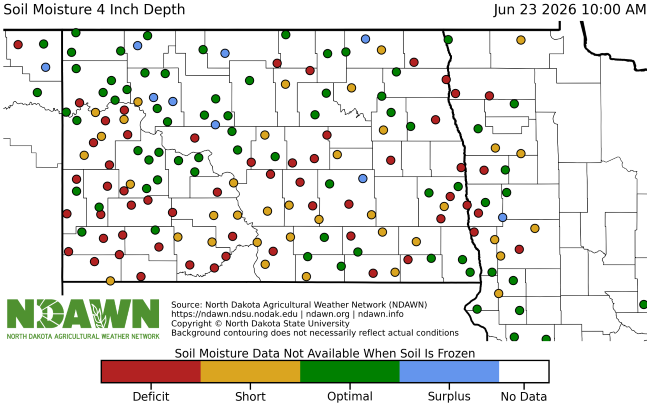
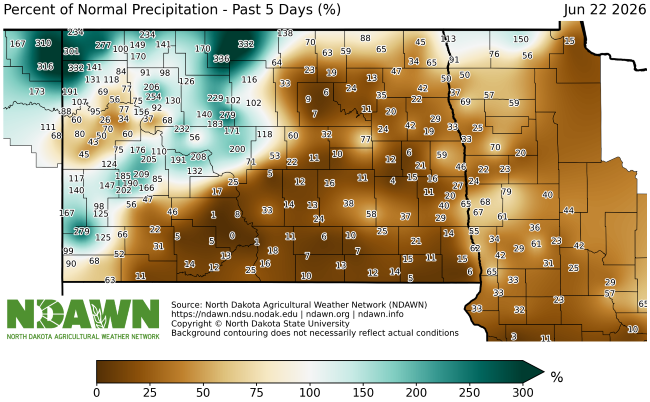
Weather Update
|
|
|
Estimated |
|
April 15 |
3.57 |
Head Emergence |
|
April 20 |
3.57 |
Boot Complete |
|
April 25 |
3.56 |
Boot Swell |
|
May 1 |
3.53 |
Boot Swell |
|
May 5 |
3.53 |
Flag Leaf Emerged |
|
May 10 |
3.52 |
Flag Leaf Visible |
|
May 15 |
3.52 |
6-Leaf |
|
May 20 |
3.17 |
6-Leaf |
|
May 25 |
3.05 |
5-Leaf |
|
May 30 |
3.05 |
3-Leaf |