Agronomy Update
Foliar Fungicides for Disease Management in Pea and Lentil
With the recent rainfall events and saturated field conditions, we are at elevated risk for Ascochyta blight (pea and lentil) and Anthracnose (lentil). These pathogens overwinter on crop residue and can also infect seedlings from infested seed.
The expansion of pea and lentil production in recent years has potentially increased the amount of pathogen inoculum present in the environment. Prior to harvest last summer, I observed stem lesions characteristic of anthracnose in several lentil fields.
Making fungicide application decisions can be challenging, particularly during times of low commodity prices. Below I address some considerations for making foliar disease management decisions in peas and lentils.
Fungicide Application Timing
Foliar fungicides must be applied preventatively. They protect healthy plant tissue but cannot cure tissue that has already been infected. Therefore, fungicide application decisions should be based on disease risk, including weather conditions, disease history, crop rotation, and stand density.
Ascochyta blight and anthracnose are spread when raindrops or physical contact move spores from infested residue or diseased tissue onto healthy plants. Once spores infect the plant, symptoms typically take several days to develop. By the time symptoms become visible, additional healthy-looking tissue may have already been infected. While a fungicide application will still protect the remaining healthy tissue at that stage, delaying treatment until we observe significant levels of diease doesn't maximize the benefit from a fungicide application.
Early-planted peas are now flowering, and lentils will soon reach that stage. Early flowering is generally the optimal timing to apply a fungicide for management of Ascochyta blight (pea and lentil) and anthracnose (lentil) because it often coincides with canopy closure. These diseases typically begin in the lower canopy and progress upward. Applying a fungicide before or near canopy closure helps ensure the fungicide reaches the lower canopy, where infection begins, while maximizing the amount of healthy tissue that is protected. Be sure to confirm specific timing restrictions on the fungicide label.
Fungicide Selection
Montana State University Extension has a table highlighting fungicides which are labeled for foliar diseases in pulse crops (scroll down for the PDF version). You can also refer to the North Dakota Disease Management Guide. While products might be labeled for control of a disease, it is important to note efficacy can differ and fungicide resistance in pathogen populations has been documented.
Ascochyta in Pea
Three pathogens cause Ascochyta blight in field pea: Ascochyta pisi, Didymella pinodes, and Didymella pinodella. Didymella pinodes is the most prevalent species in North Dakota and has shown reduced sensitivity to the active ingredients in Headline (pyraclostrobin) and Proline (prothioconazole) (Fonseka et al., 2023).
Fungicides are classified according to FRAC groups which stands for Fungicide Resistance Action Committee. Headline falls into the FRAC 11 (QoI) group and Proline falls into the FRAC 3 (SDHI) group. Reduced fungicide sensitivity means that a pathogen is less effectively controlled by a fungicide. Once resistance or reduced sensitivity develops to one fungicide within a FRAC group, other fungicides in the same group are also likely to provide reduced control.
For management of Ascochyta blight in field pea, consider selecting products that also contain a FRAC Group 7 mode of action. Examples include Priaxor/Everlon (FRAC 11 + FRAC 7) and Miravis Top (FRAC 3 + FRAC 7). Using fungicides that combine two effective modes of action can improve disease control while also helping slow the development and spread of fungicide resistance/insensitivity.
Anthracnose in Lentil
Anthracnose is the most common disease of lentils in Saskatchewan, where it was present in 92% of surveyed fields in 2019. At the end of the 2019 growing season, insensitivity to FRAC 11 fungicides was confirmed in Saskatchewan. We currently do not have comparable survey data on anthracnose prevalence in North Dakota, nor has fungicide resistance been confirmed here.
FRAC Group 11 fungicides, particularly Headline, continue to be widely used in North Dakota for management of both anthracnose and Ascochyta blight in lentil. The most recent North Dakota field trial data available are from studies conducted in 2012 and 2013. In those trials, two applications of Headline at 6 oz/A provided excellent disease control and a significant yield response (graph below). The first application was made shortly before canopy closure, followed by a second application 10 to 14 days later.
Repeated use of Headline, both within a growing season and across multiple years, increases the risk of reduced fungicide sensitivity developing. Priaxor combines Headline with fluxapyroxad (FRAC 7), adding a second effective mode of action.
This second mode of action will contribute to Ascochyta control, which could also be present in lentils when conditions are conducive to disease. Priaxor applied twice at 4 oz/A provided similar levels of control to Headline, with the 6 oz/A rate showing a slight yield advantage at one location.
Tank mixing with Bravo/Praiz (chlorothalonil) is also an option for reducing risk of fungicide insensitivity and improving control.
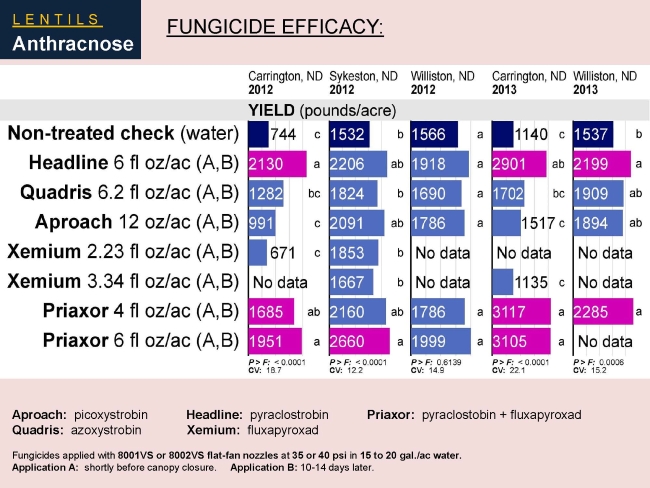
Table above was generated by Dr. Michael Wunsch based on data from trials conducted in collaboration with staff at the NDSU Carrington and Williston Research Extension Centers.
Using integrated disease management practices like crop rotation, and variety selection alongside sound fungicide stewardship will help preserve fungicide product efficacy and improve long-term disease control in peas and lentils. Ascochyta and anthracnose can both be seed transmitted, so consider pathogen testing for crop intended for use as seed in the 2027 season.
Dr. Audrey Kalil, CCA
Agronomist/Outreach Coordinator
Early Post-Emergent Residual Herbicides in Soybeans and Dry Beans
Remember a couple weeks ago when I gave some information on residual herbicides applied post-emergent to corn, where most of those active ingredients fell in the Group 15 mode of action?
Did you know you can apply most of those same active ingredients to soybeans, and even a couple of them to dry beans?
If that's news to you, go back to the newsletter from two weeks earlier and you'll find some important information on these Group 15 herbicides. Specifically how they compare on weed control and how much moisture is needed to incorporate them.
In general, this class of chemistry gives very good residual control of grassy weeds and some broadleaves, especially pigweed and mustards. It does have some activity on kochia, although not great.
The following is what I want to add for those of you with soybeans or dry beans.
Group 15 Herbicides Labeled for Early Post-Emergent Timing in Soybeans
S-metolachlor (Dual II Magnum)
Timing: Crop emergence up to 75 days before harvest, so the application window is wide open for the most part. Many folks dealing with waterhemp apply as late as possible, just before row closure.
Crop injury can occur if oils or fertilizers like 28-0-0 UAN are in the tank — which is sometimes needed for other tankmix partners like clethodim to control volunteer corn. The injury is best described as a "drawstring" effect: it looks like someone pulled the mid-vein out of the soybean leaf and dragged the rest of the leaf veins with it, leaving a scrunched-up leaf. In my experience the crop grows out of it, and it's never been a yield detriment.
Dimethenamid (Outlook)
Timing: Emergence through 5th trifoliate
You can see some leaf speckling here, but in my experience Outlook has the least issues with crop response.
Acetochlor (Warrant or Enversa — specifically the microencapsulated, or "ME," formulations)
Timing: Emergence through R1 (up to full flower)
Generally, acetochlor is a corn-only product, but because of the way Warrant and Enversa are formulated, you can apply them post-emergent to soybeans with no crop response issues. The only watchout is to not apply with any liquid fertilizer products like 28-0-0 UAN.
Pyroxasulfone (Zidua)
Timing: Emergence through 6th trifoliate
Zidua can leave some visible crop injury when applied post-emergent on soybeans, mostly showing up as speckling. By itself the crop response is minimal, but when there are other tankmix partners in the mix, especially ones that like AMS and MSO, the response is more pronounced. Again, as the other Group 15's go, some crop response can happen, but it rarely ends in yield loss.
Group 15 Herbicides Labeled for Early Post-Emergent Timing in Dry Beans
S-metolachlor (Dual II Magnum)
Timing: 1st trifoliate to first flowers
Even though it can be less expensive than Outlook, you see less of this used. Generally I see more crop response here than with Outlook. It tends to show crop response more in two scenarios: first, when tankmixing other herbicides and adjuvants with it; second, with frequent watering events or heavy rains.
Dimethenamid (Outlook)
Timing: 1st to 3rd trifoliate
I've used a lot of this in pinto beans specifically for extended control of Eastern black nightshade. Leaf speckling and stunting can occur, but I've never experienced yield loss.
So there you have it. A little more than you knew before (I hope) about some early post-emergent residual options in both soybeans and dry beans. My goal was to let you know there are options to lay down some residual later into the growing season, keeping those pesky weeds from popping up after it's too late to do anything about them. Make sure to consult the labels for rates and full tankmix restrictions.
Kyle Okke, CCA
Agile Agronomy LLC
Agronomists Happy Hour Podcast
Fusarium Head Blight Risk Prediction
Rainfall and elevated relative humidity have increased FHB risk over the past week. The maps below from the NDSU model and the National model show risk for very susceptible and susceptible wheat varieties.
The latest NDSU Crop and Pest Report contains an article by Dr. Andrew Friskop providing some guidance on using the resistance ratings in the Hard Red Spring Wheat Variety Selection Guide and the Durum Variety Selection Guide.
According to Dr. Friskop, "very susceptible varieties have FHB ratings of 7 or higher, susceptible varieties are rated a 6, moderately susceptible varieties are rated a 5, and moderately resistant varieties are 4 and lower."
These ratings are not available for the AAC varieties developed by Agriculture and Agri-Food Canada such as AAC Stronghold and AAC Spitfire, or CDC varieties developed by the Crop Development Centre such as CDC Defy or CDC Vantta. I conducted research, sponsored by the ND Wheat Commission, comparing the NDSU varieties to these Canadian varieties in 2022.
In that trial, we analyzed VOM in grain samples from variety trials conducted in Garrison, Minot, Mohall, Rugby and Wilton. AAC Spitfire performed similarly to ND Grano which is considered susceptible. Both AAC Stronghold and CDC Vantta had higher VOM levels than AAC Spitfire and so would likely be considered very susceptible. CDC Defy performed similarly to ND Riveland at most locations and so could be considered moderately susceptible.
The NDSU Crop and Pest Report article referenced above also contains some helpful guidance on fungicide selection for management of FHB. Please feel free to reach out with any fungicide questions.
Recent conditions have also been conducive to development of foliar fungal diseases like tan spot (see risk prediction table below). Early season fungicide applications made with the herbicide pass protect existing leaf tissue, but normally this is prior to flag leaf emergence. Fungicide does not translocate through the plant, so protecting the flag leaf from foliar disease requires a second application. A fungicide application at early flowering for FHB provides protection of the flag leaf.
Yield loss due to infection of the flag leaf by fungal pathogens can be anywhere from 10 to 40% (MontGuide MT200913AG, 2013).
Dr. Audrey Kalil, CCA
Agronomist/Outreach Coordinator
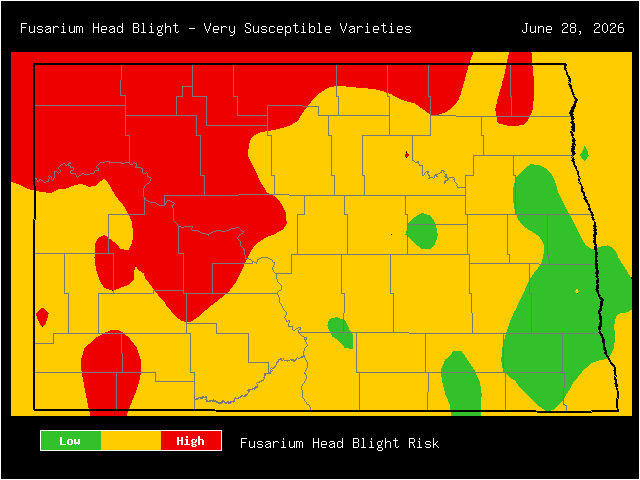
NDSU FHB risk map for very susceptible wheat varieties. June 28 2026.
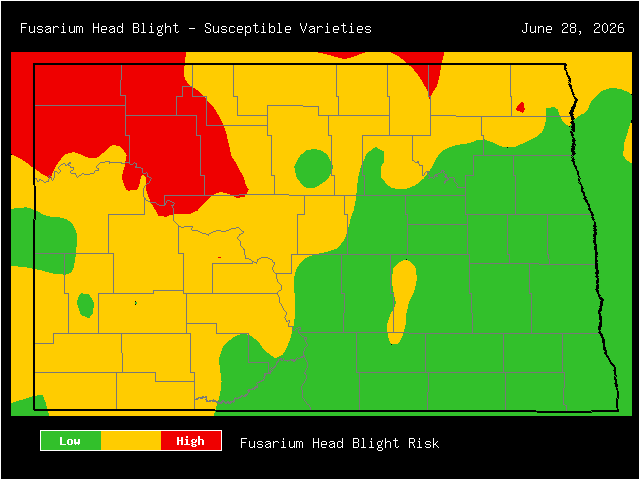
NDSU FHB risk map for susceptible wheat varieties. June 28 2026.
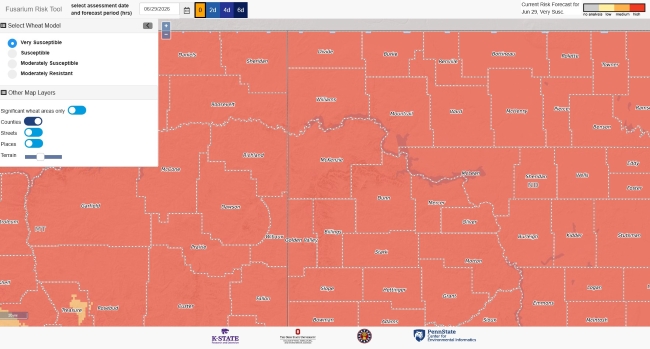
National model FHB risk map for very susceptible wheat varieties. June 29 2026.
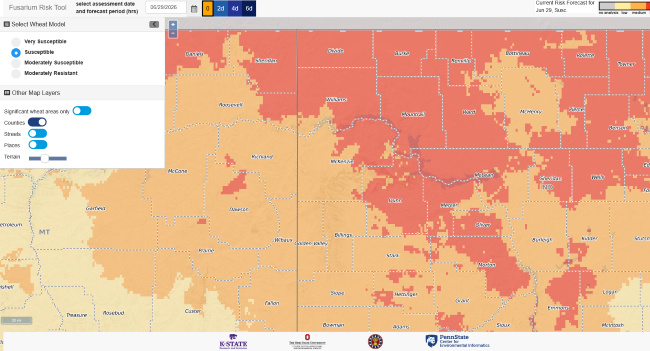
National model FHB risk map for susceptible wheat varieties. June 29 2026.
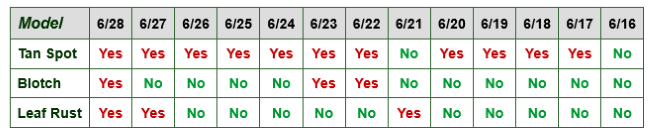
NDSU wheat foliar fungal disease risk prediction for Pioneer, ND weather station. June 28 2026. Interpretation: Yes = infection likely, No = infection unlikely. Consider a fungicide when 6-8 infection periods ("Yes" days) have accumulated, and the flag leaf is symptomatic.