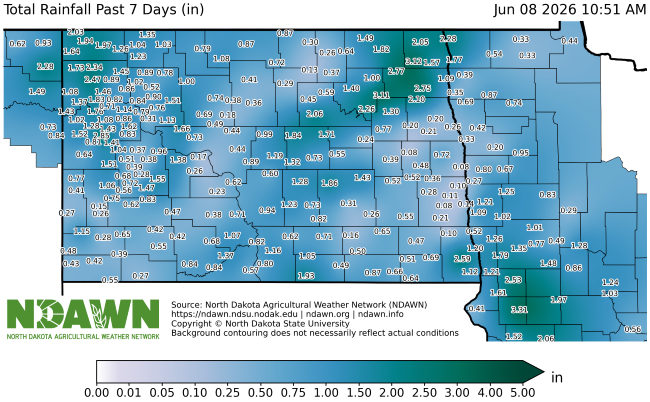
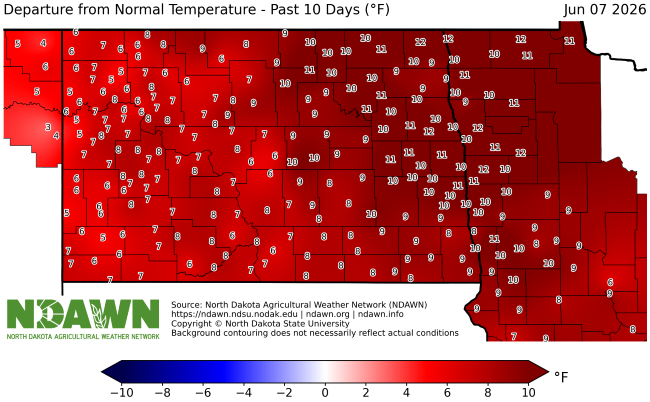
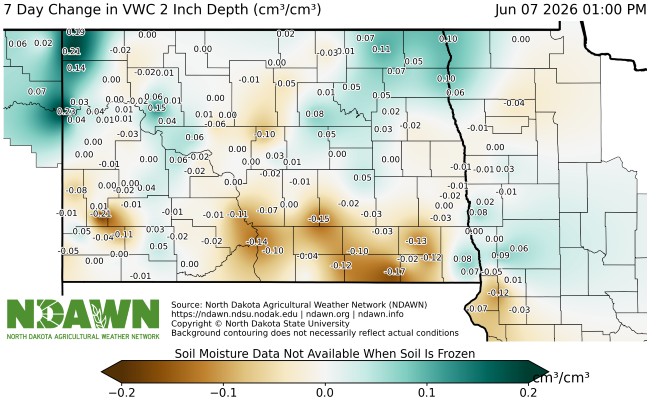
Agronomy Update
Q and A with Dr. Brady Goetll, NDSU Extension Soil Scientist
Drought, heat, and high winds have made for a challenging spring from both fertility and soil management perspectives. In many situations, there seem to be more questions than answers. I reached out to Dr. Brady Goetll, NDSU's new Extension Soil Scientist, to see if he had any thoughts on how drought is going to impact fertility this season and how we can rebuild soil health for future crops.
Q1: What were some of the approaches used historically to reduce wind erosion?
Going back to 1935 and the creation of what is now the NRCS, they were tasked with the control and prevention of soil erosion in the United States. In our region, and the rest of the dust-bowl plains, they were predominately concerned with stopping wind erosion. The most notable practice they used on the landscape was planting trees and windbreaks, with the purpose of slowing the windspeed at the soil surface, an effect also achieved by planting grass strips, or strip cropping. Given the lack of widespread herbicide use, no-till was not a viable option “back in the day,” but reduced or conservation tillage certainly was—keeping as much residue on the surface as possible and create ridges (a chisel plowed field with ridges and furrows will erode significantly less than a smooth, moldboard plowed field, for example). Additionally, it was recognized some land was simply not fit for farming annual crops and was planted to hay.
Q2: To what degree can we prevent soil loss?
Is wind erosion preventable, absolutely yes, but even when everything is done “right” some erosion may occur if the cards are stacked against us. If conditions were not so dry this spring, the erosion would have been significantly reduced, but remember, we live in a semi-arid climate, this should be expected! A point which needs to be reiterated after the significant erosion we saw this spring is the absolute necessity of stacking practices.
While no-till works great for erosion prevention when high-residue crops are grown, it's effectiveness is significantly reduced following low-residue crops. How many no-till soybean fields blew this spring? Too many. But still less than the smooth tilled fields!
As soybeans continue to move into rotations with more intensity, strip cropping, planting into standing stubble (I am a big proponent of stripper headers) or the reinstallation of shelterbelts will become increasingly necessary.
Q3: What practices would you recommend that protect soil from wind erosion?
Of course, no-till is the first line of defense against soil erosion by keeping the soil covered and retaining moisture. In addition to no-till, conscious decisions need to be made about residue management and crop rotations. Before planting a low-residue crop, ensure there is previous crop residue to carry it through.
Also consider practices which will keep crop residue attached to the soil—park those chopping heads and high-speed discs, they only create confetti to blow in the wind. Another practice to consider is strip cropping. By alternating high and low residue crops in varying width swaths depending on soil type, erosion can be reduced substantially.
Check out the resource Methods for Controlling Wind Erosion for more great information on wind erosion control practices.
Q4: What practices would you recommend for growers trying to help fields recover from wind erosion?
There are two angles we need to look at when considering how to address the
eroded field: conservation and agronomy. From a conservation (stabilizing what soil is left) standpoint, the goal is to get something growing in the field as quickly as possible, the higher biomass-producing the better (I know, easier said than done).
Determine to what extent the field or areas of the field eroded. Are there areas where all the topsoil is gone? These areas may not be fit for economical crop production and may best be seeded to a perennial grass or enrolled into a conservation program (if available). From an agronomic perspective, we need to consider what fertility was lost. Soil sampling will be necessary to evaluate nutrient levels and replace what has been lost, predominately P and K.
Lastly, what do we do with the soil in the ditch or drifted in the field? If a soil-applied or residual herbicide was applied prior to the erosion event, spreading the eroded soil back in the field may lead to crop damage. Also consider weather conditions before spreading the sediment back out. Is it still dry and windy? The sediment will just blow again. Are heavy rains forecasted? The sediment is powder, so crusting can be expected. In an ideal world, the sediment (without potential for herbicide contamination) should be thinly spread back on the eroded areas and planted to hold it in place and remediate the areas as quickly as possible.
Q5: What would you recommend growers do next growing season for affected fields?
In addition to what I mentioned in question 4 and using stacked soil conservation
practices, next year will be a good time to measure and address the variability across the field, which developed as a result of the erosion and possible soil return from the ditches. If zone sampling and management was being used, these zones will need to be reevaluated and new soil samples collected. Using the updated samples, variable rate spreading can be used to address some of the variability of nutrients.
Another point to consider is sulfur fertility. Sulfur is highly tied to organic matter so if organic matter has been stripped with the lost topsoil, there will be an increased likelihood of S deficiency. Consider applying a base rate sulfate-S to prevent deficiency.
Q6: With the drought this spring, what percentage of loss should we expect from urea applied this spring? How much would urease inhibitors have helped?
In an ideal situation, a gentle rain of greater than ¼ inch following the application of urea would dissolve the prill and move it into the soil profile, minimizing losses from volatilization. The other end of the spectrum would be to receive only enough precipitation, heavy dew, or high humidity to make the fertilizer “melt” but not actually move into the soil. When this happens, the soil enzyme urease begins to rapidly convert the urea to carbon dioxide and ammonia, which is then lost directly to the atmosphere.
Unfortunately, urea broadcast on fields which received the spotty rain, is likely undergoing this volatilization loss. Based on previous North Dakota research, 10-30% of the N is lost per week in situations similar to this year. If a urease inhibitor was used (such as NBPT) the urea is effectively protected for 10-15 days.
Fields where the urea has been sitting on the dry soil surface and not dissolving are of less concern. The minimal soil contact limits the extent to which the urease enzyme breaks down the urea, therefore reducing losses due to ammonia volatization.
Q7: How do anhydrous, surface applied and incorporated urea compare in terms of N loss in drought conditions?
This is an “it depends” type answer… When thinking about anhydrous application, the most critical time for preventing loss is at the time of application. If the anhydrous was being knifed in when the soil was dry, there is a very good chance the row did not close well and some of the gas escaped the furrow and was lost. If moisture conditions were adequate at application time and there was acceptable row closure, there is a good chance most of the N was retained in the soil as ammonium, and is not a particularly high concern for loss at the current time.
Regarding urea, this will fully depend on conditions following application for broadcast or the depth of incorporation. Assuming NBPT (urease inhibitor) was not used and no rain was received for 1-2 weeks after application, urea incorporated deeper than two inches (three would be better) would have the lowest volatilization risk. Surface broadcast or incorporated less than 1 inch both have a much higher risk of loss, depending on the amount of precipitation received. Between between
0.25 and 0.5 inches of rain is needed to reduce the risk of volatization.
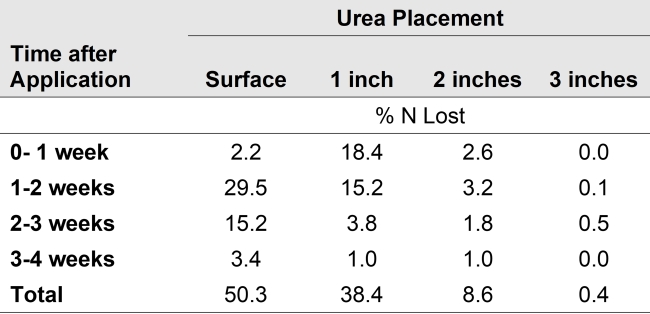
Example of the amount of N lost to volatilization based on placement depth of urea not treated with a urease inhibitor. Approximately 0.2 inches of rain was received 7, 14, and 21 days after application. Data from Rochette et al. (2013).
Q8: Can foliar applied N help increase grain protein where applied nitrogen was lost?
Yes, foliar N applied later in the growing season can help to increase grain protein in wheat, regardless of the original N rate/availability. Unlike fertilizer applied earlier in the growing season, N applied post-anthesis (flowering) serves only to increase the grain protein content, not increase yield. Post-anthesis N application studies in the North Dakota region and elsewhere indicate and average 0.5% increase grain protein content when 30 lb N/ac is applied. However, this practice does not come without risk of crop injury. To reduce the chances of leaf injury, 10 gal/ac of 32% UAN diluted with 10 gal/ac of water applied during cooler parts of the day is an effective approach.
Dr. Brady Goetll, CCA
Extension Soil Scientist/Assistant Professor
North Dakota State University
brady.goettl@ndsu.edu
(701) 367-2241
New Cover Crop Cost Share Opportunity
Enrollment is now open for the Farmers for Soil Health cover crop cost share program for North Dakota. This cost share program, funded in part by Soy Checkoff, Pork Checkoff, and the National Corn Growers Association, offers a flat $35/acre rate for planting cover crops with a 2,000 acre cap. The program is a single-year enrollment with no transition requirements, meaning you don’t have to be new to cover crops to qualify.
The program only pays for cover crops, which means it is potentially stackable with other federally funded programs like CRP or EQIP. If you are not already being paid for cover crops through those programs, then you are not “double-dipping” and could be eligible. The cover crop should also be connected to a qualifying crop, which in North Dakota includes corn, wheat (spring, durum or winter), and soybeans. This means the cover crop can be inter-seeded into a qualifying crop or that crop must be planted in the following 2027 season.
Each state within the program has its own Technical Advisor, and for North Dakota that would be me! You can reach out to me through email, phone call, or simply enroll online to contact me about the program. I am happy to answer any questions you may have about Farmers for Soil Health, or anything related to conservation agriculture – especially cover crops!
More information on cover crops can be found in our 2026 Cover Crop Summit presentations available on the DREC YouTube channel.
Dr. Alexis Correira
Conservation Agronomy Extension Specialist Dickinson Research Extension Center
North Dakota State University
alexis.correira@ndsu.edu
(701) 456-1114
Grass Herbicide Options in Wheat
As we roll into the busy season of in-crop herbicide applications for small grains, many of us are facing significant grass pressure. Choosing the right herbicide is critical for achieving season-long control—and with limited post-emergent options, selecting and rotating chemistries strategically is more important than ever.
Currently, we have only a few modes of action available for post-emergent grass control:
- Group 1 –ACCase Inhibitors
- Group 2 –ALS Inhibitors
- Group 27 - HPPD Inhibitors (new last year, with activity on foxtail and barnyard grass only—no wild oat control)
Given this narrow toolbox, it’s no surprise that resistance has become a challenge in some fields. To make the most of what we have, we need to be deliberate about how we deploy these tools.
Rotate Chemical Families Within Modes of Action
Even within a single mode of action, not all herbicides are the same. For example, Group 1 herbicides are subdivided into three chemical families:
- FOPs
- DIMs
- DENs
Each acts slightly differently, and resistance to one doesn’t always mean resistance to all. Studies have shown that foxtail or wild oat populations resistant to FOPs may still be susceptible to DIMs or DENs. Thoughtfully rotating between these families can help preserve efficacy and extend the life of these tools. Below are examples of herbicides which fall into each Group 1 chemical family:
FOPs
- Fenoxaprop – Puma, Tacoma, Parity
- Clodinafop – Discover NG
- Quizalofop – Assure II (not labeled for use in small grains)
DENs
-
Pinoxaden – Axial XL
DIMs
-
Clethodim – Select, Section (not labeled for use in small grains)
Note: Use restrictions apply—always check product labels for crop compatibility.
Group 2 Herbicides: Know Your Family
Group 2 herbicides are also divided into several chemical families, including:
- Imidazolinones
- Sulfonylureas (SUs)
- Triazolopyrimidines (TPSs)
- Triazolinones
Similar to Group 1, rotating among these families can help manage resistance. Some grass populations may be resistant to one family but not others—even within the same group. Below are examples of herbicides which fall into the different Group 2 chemical families:
IMIs
- Imazamox – Beyond Xtra (for Clearfield-tolerant varieties only)
SUs
- Metsulfuron – Ally
- Tribenuron – Express
- Mesosulfuron – part of Rimfire Max
TPSs
-
Pyroxsulam – OpenSky, PerfectMatch
Triazolinones
- Flucarbazone – Everest 3.0
- Thiencarbazone – Varro
Group 27 HPPD Inhibitors
The latest addition to our weed control arsenal is the Group 27 HPPD inhibitors, sometimes referred to as “bleachers” due to the whitening effect they have on weed growth points. The only active ingredient in this group available for small grains is topyralate, marketed under two product options:
- Tolvera (topyralate + bromoxynil)
- Shieldex (standalone
Important: Group 27 herbicides are effective only on foxtail and barnyard grass. They offer no control on wild oats, so if wild oats are a concern, you'll need to rely on Groups 1 and 2.
Also worth noting is the synergistic effect between topyralate and bromoxynil on broadleaf weeds. Tolvera often provides better tank-mix flexibility and broader-spectrum performance compared to standalone Shieldex.
Final Thoughts
Grass control in small grains is a game of strategy—especially in the face of mounting resistance. Understanding not just your herbicide’s group, but its chemical family, can make all the difference in product performance and long-term sustainability.
Rotate smart. Scout often. And don’t hesitate to reach out to your Horizon Resources Agronomist if you want to talk through options for your fields.
Kyle Okke, CCA Agile Agronomy LLC
Agronomists Happy Hour Podcast
Start Early for Ascochyta Management in Chickpea
In chickpea, the Ascochyta blight pathogen spreads readily from seed to seedling. This means that any contaminated seed can infect the plant as soon as it germinates. While we typically think about applying fungicides to pulse crops at flowering, waiting until then for chickpea might mean you're already behind.
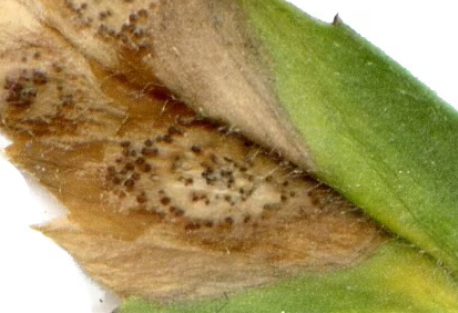
Staying ahead of Ascochyta blight is vital, as infection spreads rapidly through the canopy with each rain event. The image below shows a close-up of a chickea Ascochyta blight lesion. Those brown dots are called pycnidia and each one contains thousands of spores called conidia. Rain splash disperses the conidia from diseased to healthy tissue, which then infect and start the disease cycle all over again. Under favorable conditions this process can take as little as seven days.
With our recent heavy rain events, chickpea growers should consider including a fungicide in with the herbicide pass. In North Dakota, the chickpea Ascochyta blight pathogen is considered resistant to FRAC 11 fungicides (strobilurins) and FRAC 7 (SDHI) fungicides have exhibited reduced efficacy, with resistance suspected as the cause. Select a broad-spectrum fungicide (FRAC M) like chlorothalonil (Praiz, Bravo WeatherStik) or a product containing a FRAC 3 active ingredient (Provysol, Miravis Top, Proline) to control this pathogen.
In subsequent fungicide applications, tank mixing chlorothalonil with a FRAC 3 (Provysol/Proline) or FRAC 3 + FRAC 7 (Miravis Top) fungicide and rotating fungicide groups is essential. If the pathogen becomes resistant to the FRAC 3 fungicides as well that only leaves us with chlorothalonil which while effective, does not provide the same level of protection as the tank mixes described above on its own (graph below).
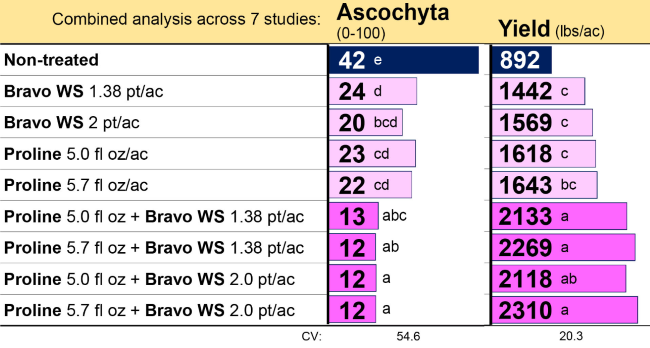
Results combined across seven fungicide trials conducted in North Dakota. (M. Wunsch, NDSU)
Managing Ascochyta effectively in chickpea can be a challenge, but a preventative approach makes a significant difference. If you have questions about diagnosing Ascochyta symptoms or fungicide selection feel free to each out.
Dr. Audrey Kalil, CCA
Agronomist/Outreach Coordinator
Learn more about seed testing and disease diagnostics
In this episode of the Growing Pulse Crops podcast Dr. Uta McKelvy, Dr. Raissa Moura and Erin Gunnink Troth explain how Montana State University’s Regional Pulse Crop Diagnostic Laboratory provides post-harvest seed testing for replanting and the Schutter Lab provides in-season plant health diagnostics for crops.

Weather Update
|
Planting Date |
Accumulated Rainfall (in) Williston |
|
|
April 10 |
2.26 |
Flag leaf emerging |
|
April 15 |
2.26 |
Flag leaf visible |
|
April 20 |
2.26 |
7-leaf |
|
April 25 |
2.25 |
6-leaf |
|
April 30 |
2.22 |
6-leaf |
|
May 5 |
2.22 |
5-leaf |
|
May 10 |
2.21 |
4-leaf |
|
May 15 |
2.21 |
3-leaf |
|
May 20 |
1.86 |
3-leaf |
|
May 25 |
1.74 |
2-leaf |