Agronomy Update
Mar 02, 2026
March Meetings
NDSU Extension is hosting the North Dakota Reclamation Conference at the Rough Rider Center in Watford City on March 3rd and 4th. The first day features discussions on the intersection of energy and ag, and the second day has a full morning of talks focused on soil health. Register at the conference website. Recordings of the 2025 ND Reclamation Conference are available on YouTube.The NDSU Western Crop and Pest School is coming up next week at the Grand Williston Hotel & Convention Center. Pre-registration is required so check the website to see if spots are still available. For further information about the content of this program, contact Barbara Nilles, 701-231-6285 or Victor Gomes, 701-456-1100.
On March 23rd at 9 am CST, Horizon Resources Williston Agronomy is hosting a Weed and Nutrient Management meeting featuring Kyle Okke and Dr. Audrey Kalil. This will be held in the upstairs conference room at the Williston office. Lunch will be provided. Contact Williston Agronomy at 701-572-5354 if you plan to attend.
Some recorded meetings from 2026 are available to watch on YouTube.
- SaskPulse Variety Update Seminar
- Swift Current Winter Pulse Meeting
- Getting It Right in Sunflower Production
- Getting it Right in Corn Production
- Getting it Right in Soybean Production
Other upcoming meetings are listed below. Click the link for the website and registration details.
| Date |
Event |
Location |
| Mar 3 & 4 | ND Reclamation Conference | Watford City, ND |
| Mar 6 & 7 | Mondak Ag Days | Sidney, MT |
| Mar 11 & 12 | Western Crop and Pest School | Williston, ND |
| Mar 19 | Getting it Right Canola Webinar | Virtual |
| Mar 19 & 20 | NE MT Farm Expo | Plentywood, MT |
| Mar 23 | Weed and Nutrient Management Grower Meeting | Horizon Resources Williston, ND |
Layering Residuals: A Better Kochia Management Strategy in Soybeans
If you ask corn and soybean producers across the Midwest what weed gives them the most heartburn, two names come up fast: waterhemp and kochia. Historically, waterhemp has been more of an eastern problem and kochia more of a western one, and we’ll take a moment of silence for the folks unlucky enough to fight both.Out here, kochia is our problem, and it’s built for trouble.
Why it is so hard to stay ahead of Kochia?
Kochia has several traits that make it one of the most frustrating weeds in row crops:- Early emergence (often before the crop is competitive)
- Dense leaf hairs (pubescence) when its small makes it hard to wet and cover the plant with herbicide spray droplets
- Ability to outcross (cross pollinating with other individuals) drives rapid evolution and spread of herbicide resistance
- Tumbling seed spread, which turns your neighbor’s kochia into your kochia in a hurry
Even when you do everything right, kochia can still show up and it doesn’t take much for it to become a season-long headache.
Why Soybeans Are Tougher Than Corn
Kochia management is generally harder in soybeans than in corn, and it’s not always because of herbicide options.Soybeans simply take longer to canopy and shade the soil, and that slower canopy development creates an opening for kochia to exploit. This is one of the main reasons resistance can escalate so quickly in soybean systems.
Glyphosate is the classic example. It used to be extremely effective, but when it became the only solution, weeds like kochia were repeatedly exposed to sub-lethal doses. Over time, survivors produced seed and resistance became widespread.
A Quick Reality Check on Dicamba and 2,4-D
Depending on where you farm, soybean trait packages and labels may look very different.In North Dakota, you have labels for dicamba and 2,4-D in Xtend and Enlist systems.
In Montana, you do not have that same legal toolbox which makes post options more limited.
Even where dicamba and 2,4-D are labeled, it’s important to remember that both are growth regulators, and their effectiveness tends to decline as weeds grow faster and conditions get warmer. In general, the later they’re used, the more risk you take on both for control failures and resistance development.
Relying heavily on growth regulators (especially paired with glyphosate) can be a fast track to resistance issues.
The Glufosinate Problem in Soybeans
For many growers, glufosinate (Liberty) is one of the most valuable in-crop tools left. But it comes with a catch:- It’s contact-only (coverage matters)
- It’s highly dependent on sunlight, temperature, and humidity
- It has no residual
So what happened? It’s not always a failure it’s biology. In soybeans, Liberty often kills 90%+ of the plant tissue, but if even a small portion of green tissue survives, the plant can recover because soybeans allow too much sunlight through the canopy early in the season.
Compare that to glufosinate-tolerant canola where you almost never hear about the same rebound issues. That is because canola canopies quickly and shades the ground aggressively. Even partially controlled weeds get suppressed.
The Fix: Layer Residuals
If you want glufosinate to stay effective in soybeans, you need a strategy that:- Prevents late flushes
- Keeps emerging weeds small
- Maintains a constant layer of residual activity
Step 1: Start with a Strong PRE
A true kochia plan starts after planting, before emergence. Common PRE options include Group 14 herbicides such as:- Sulfentrazone (Spartan)
- Flumioxazin (Valor)
- Saflufenacil (Sharpen)
One of the strongest combinations for kochia is Group 14 + Group 5 (Metribuzin). A few ways this shows up in the field:
- Authority MTZ (dry formulation)
- Preview 2.1 SC (liquid formulation)
Metribuzin is not a great solo option on kochia, but as a partner, especially with a Group 14, it significantly improves performance.
Where Group 15 Fits
Group 15 herbicides are also important for kochia control. They include:- S-metolachlor (Dual)
- Pyroxasulfone (Zidua)
Some excellent premix options include:
- Authority Elite (Sulfentrazone + S-metolachlor)
- Authority Supreme (Sulfentrazone + pyroxasulfone)
- Fierce (Flumioxazin + pyroxasulfone)
- Boundary (S-metolachlor + metribuzin)
Why I Like Saving Group 15 for the Layer
One reason I prefer starting with Group 14 + Group 5 (Authority MTZ / Preview) is because it lets me save the Group 15 chemistry for the perfect timing later.Both Dual and Zidua can be applied post-emergent to soybeans and pre-emergent to weeds. This allows you to extend residual control deeper into the season which is exactly what you need when soybeans are slow to canopy.
- Zidua timing note: labeled up to the 6th trifoliate stage.
- Dual timing note: no strict stage cutoff, but best applied before first bloom.
The same strategy works extremely well for kochia in soybeans.
A Simple Roadmap
If you want a practical, field-ready plan, here’s what it looks like:- Plant soybeans
- PRE: Authority MTZ or Preview 2.1 SC
- Post: Liberty + Zidua at 4–6 trifoliates
- Liberty as needed after that
Final Thought
Nobody said keeping beans clean was easy, especially when kochia is involved. But if you’ve struggled with late kochia flushes and “Liberty rebound,” this layering approach can make a major difference in how clean your soybean fields stay through the season.Kyle Okke, CCA
Agile Agronomy
Agronomists Happy Hour Podcast
EPA Approves Over-The-Top Application of Dicamba
On February 6th, the EPA approved three dicamba herbicide products for over-the-top use on dicamba-tolerant soybean for the 2026 and 2027 growing seasons only. The products are Engenia® (BASF), Tavium® (Syngenta) and StryaxTM (Bayer). State level registrations are in progress with updates being posted on the manufacturer’s websites.
This approval includes new environmental protections which are discussed on the EPA website. A summary of some of these restrictions is below.
1. Reduced Total Use
- Annual application rate cut in half from 2 pounds to 1 pound per acre.
- Only 2 applications allowed per season (down from 4).
2. Volatility Controls
- Required volatility-reduction agents doubled.
- Ban on mixing with certain chemicals that increase volatility.
- Completely banned at 95°F or higher.
- Severely limited between 85–95°F.
4. Weather and Timing Limits
- No spraying during temperature inversions.
- No spraying before expected rain or on saturated soil.
- Restricted time-of-day spraying windows.
- Wind must be between 3–10 mph.
- Aerial spraying banned.
- Spray height limited to 2 feet.
- Coarse droplet size required to reduce drift.
6. Buffers and Physical Barriers
- 240-foot downwind buffer required.
- Mandatory conservation practices (buffer strips, cover crops, etc.).
7. Training and Worker Protections
- Only certified applicators may use it. You can check on your certification status and register for an upcoming training on the NDSU pesticide certification website.
- Separate annual training required.
8. Recordkeeping and Enforcement
- Detailed documentation required for every application.
2025 North Dakota Resistant Kochia Survey Results
The National Agricultural Genotyping Center (NAGC) has overseen an herbicide resistant weed survey in North Dakota over the past two growing seasons. While their testing services are available nationally and internationally, this survey has made the testing free to North Dakota growers through funding from the North Dakota Soybean Council, the North Dakota Corn Utilization Council and the North Dakota Department of Agriculture. Results are confidential, shared only with the submitter, and are also used (without personal identifiers) to create county-level maps highlighting resistance hotspots.What makes the NAGC unique is that they offer rapid genetic screening to help determine whether weeds carry known resistance markers. Compared to traditional greenhouse trials, which can take one to two months, genetic testing can deliver results within days. This faster turnaround helps growers make in-season decisions when herbicide applications fail and supports longer-term weed management planning.
The survey currently tests or has tests in progress for resistance in the following weeds and herbicide groups:
- Kochia – Group 2, 9, and 14 herbicides
- Waterhemp – Group 2, 9, and 14 herbicides
- Palmer amaranth – Group 2, 9, and 14 herbicides
- Other pigweed species – Group 2 herbicides
- Green foxtail – Group 1 and 2 herbicides (in progress)
- Wild oat – Group 1 and 2 herbicides (in progress)
Below are maps from the 2025 survey indicating where Group 2, Group 9 (glyphosate) and Group 14 resistant kochia has been identified in the state. The NAGC evaluated 453 samples from 36 counties. Counties highlighted in a color were positive for the resistance market for that herbicide group (mode of action). Counties in grey had samples submitted but were negative for resistance. Counties in white did not have any samples submitted.
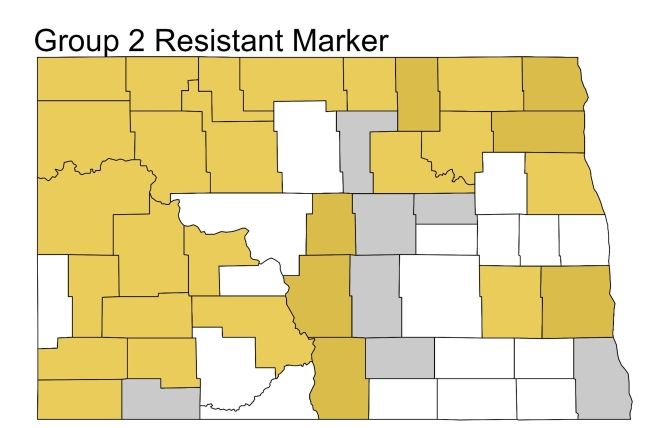
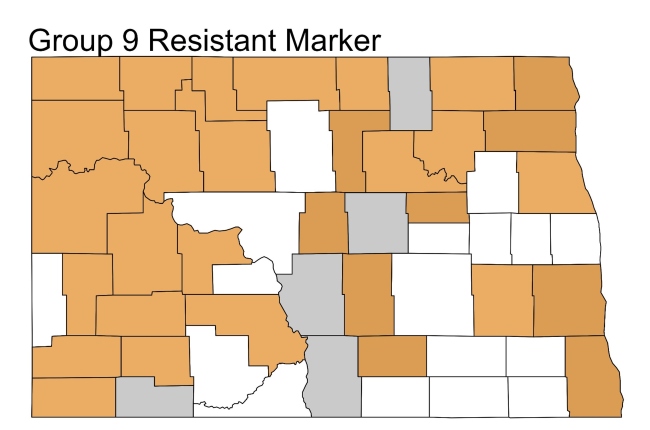
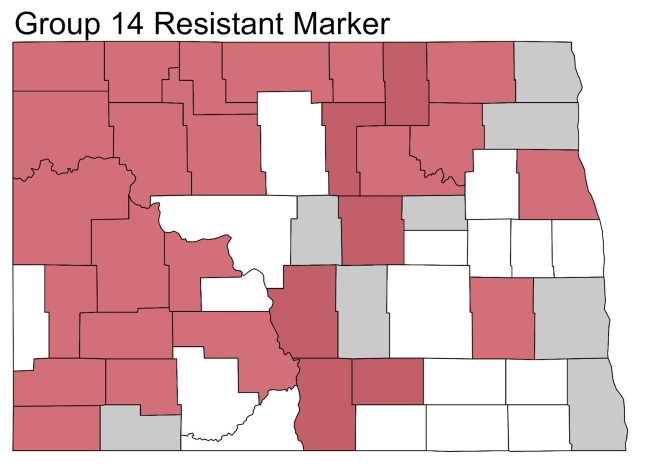
Some kochia plants had resistance to all three modes of action. NDSU weed scientists have also reported kochia populations that are resistant to Group 4 herbicides including dicamba and fluroxypyr (Starane). Similar resistance been reported on the Canadian prairies. In Saskatchewan, a 2023 survey found that 45% of individuals were resistant to dicamba. Thus far fluroxypyr resistance (44% of 314 samples) appears to be limited to Alberta; however, the most recent survey was in 2021.
Fluroxypyr/Starane is the primary kochia-controlling ingredient in many of the pre-mix products used in small grains. In a durum on durum rotation it might be applied every year. Herbicide resistance is the result of continuous application of a single mode of action, and it takes less time to generate than you think.
The figure below illustrates how after four years of applying an ALS herbicide alone, a field pennycress population that started at 5% resistance frequency went to 85% of individuals being resistant. Where they applied a tank mix of ALS/bromoxynil/MCPA repeatedly over all four years the population went from 5 to 8%, a negligible increase.

Beckie, H. J., & Reboud, X. (2009). Selecting for weed resistance: Herbicide rotation and mixture. Weed Technology, 23(3), 363-370. Cambridge University Press.
In the past 40 years, only one new mode of action has been introduced. We cannot rely on the chemical manufacturers to solve this problem and need to steward the remaining modes of action more effectively than we have in the past. That means tank mixing multiple effective modes of action when you have the opportunity. With this strategy you can kill weeds that have generated resistance to one but not both herbicide modes of action in the tank eliminating the opportunity for that plant to cross pollinate, set seed and spread.
Dr. Audrey Kalil, CCA
Agronomist/Outreach Coordinator
Growing Pulse Crops Podcast Season 7 Episode 2: Herbicide Resistant Weeds on the Canadian Prairies
In the most recent episode of Growing Pulse Crops, Dr. Charles Geddes, a research scientist with Agriculture and Agri-Food Canada based in Lethbridge, discusses the rapid rise of herbicide-resistant weeds and the implications for crop production. Roughly 70% of fields tested in the Canadian Prairies now contain at least one form of herbicide resistance, with widespread group 1 and 2 resistance in wild oat and extensive resistance in kochia, including near-ubiquitous group 2 resistance, glyphosate resistance, increasing resistance to group 4 herbicides fluroxypyr and dicamba, and emerging group 14 (PPO inhibitor) resistance. Dr. Geddes outlines how resistance develops and spreads, why kochia in particular is evolving so quickly, and emphasizes that reversing this trend will require diversified weed management strategies that integrate chemical tools with agronomic practices.Listen on the Growing Pulse Crops website or wherever you get your podcasts. This series is sponsored by Northern Pulse Growers Association.
North Dakota Legacy Soil Health and Habitat Program
The Governor’s Legacy Soil Health and Habitat Program is scheduled to begin in 2026 in North Dakota. The program is intended to support the establishment of perennial grass cover on cropland to improve soil health, water retention, and wildlife habitat. It is delivered through local Soil Conservation Districts and partner organizations.Program Details
- Open to all types of cropland
- Five-year agreement to establish and manage perennial grass
- Annual rental payment based on the county’s average rental rate
- Cost-share assistance of $50 per acre for seed and $50 per acre for establishment
- $10 per acre crop insurance premium reduction for each acre of perennial grass established
- Optional $15 per acre public access incentive through the North Dakota Game and Fish Department’s Private Land Open To Sportsmen (PLOTS) program
Seeding Requirements
Following a recent question-and-answer meeting on the program, planners were advised that seed mixes must meet NRCS specifications and be matched to soils with grass varieties considered suitable for the site.The following species are not allowed under the program:
- Sweet clover
- Smooth brome
- Crested wheatgrass
- Kentucky bluegrass
Example seed mixes discussed include combinations of green wheatgrass, intermediate wheatgrass, slender wheatgrass, western wheatgrass, and alfalfa. Final species selection should align with NRCS standards and site suitability.
Enrollment opened February 2nd so producers interested in participating should contact their local Soil Conservation District to submit an application as soon as possible. The pilot program is limited to approximately 10,000 acres.
Horizon Resources carries Buffalo Brand Seed and once you know what species and seeding rates you need to meet the program requirements we can get a custom blend ordered for you.
Aphanomyces Root Rot Tolerant Field Pea Varieties
While there are other pathogens which can cause root rot in pulse crops, Aphanomyces root rot is particularly devastating in peas and lentils. It is caused by a water mold (oomycete) native to our soils called Aphanomyces euteiches. Every time a host crop is grown in a field, the pathogen has an opportunity to reproduce. This slowly increases the pathogen load in the soil over time. Wet springs favor infection, causing a significant yield loss event and a corresponding increase in the soil pathogen population. Fields that experience severe root rot events are therefore at much greater risk of future yield loss.Previous research has shown that long crop rotations away from host crops combined with early planting may reduce yield loss due to root rot. Aphanomyces prefers warm soils and so early planting gives the crop a head start. Long rotations away from host crops allows the pathogen load in the soil to decrease over time, as the Aphanomyces spores lose viability.
Research conducted in 2023 at the Williston Research Extension Center and the Carrington Research Extension Center (Dr. Michael Wunsch) found that the yellow pea variety AAC Julius exhibited tolerance to Aphanomyces root rot. In 2024, Dr. Wunsch expanded this work and also evaluated the yellow pea variety AAC IronHorse. While both varieties demonstrated tolerance, AAC IronHorse outperformed AAC Julius under moderate disease pressure.
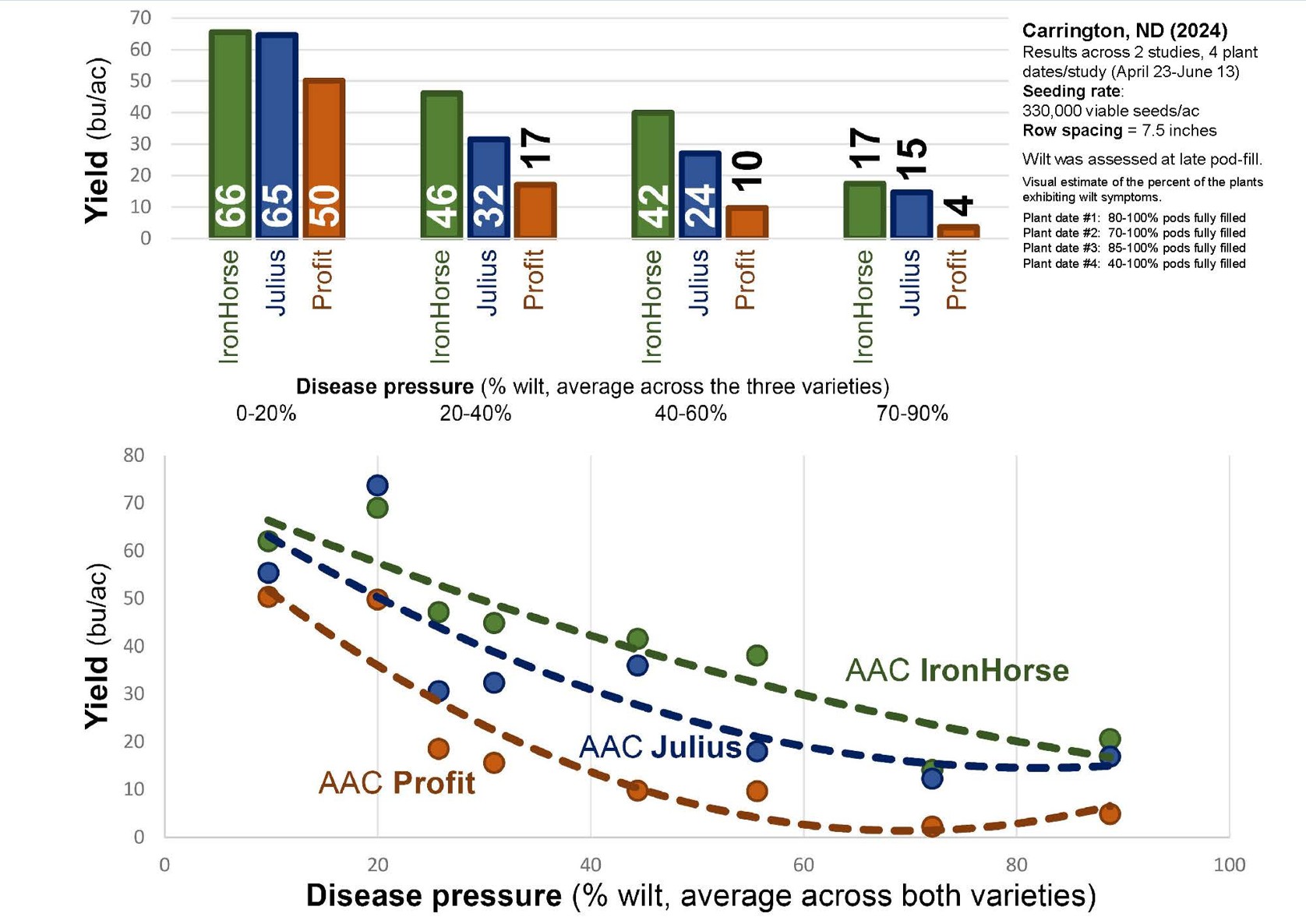
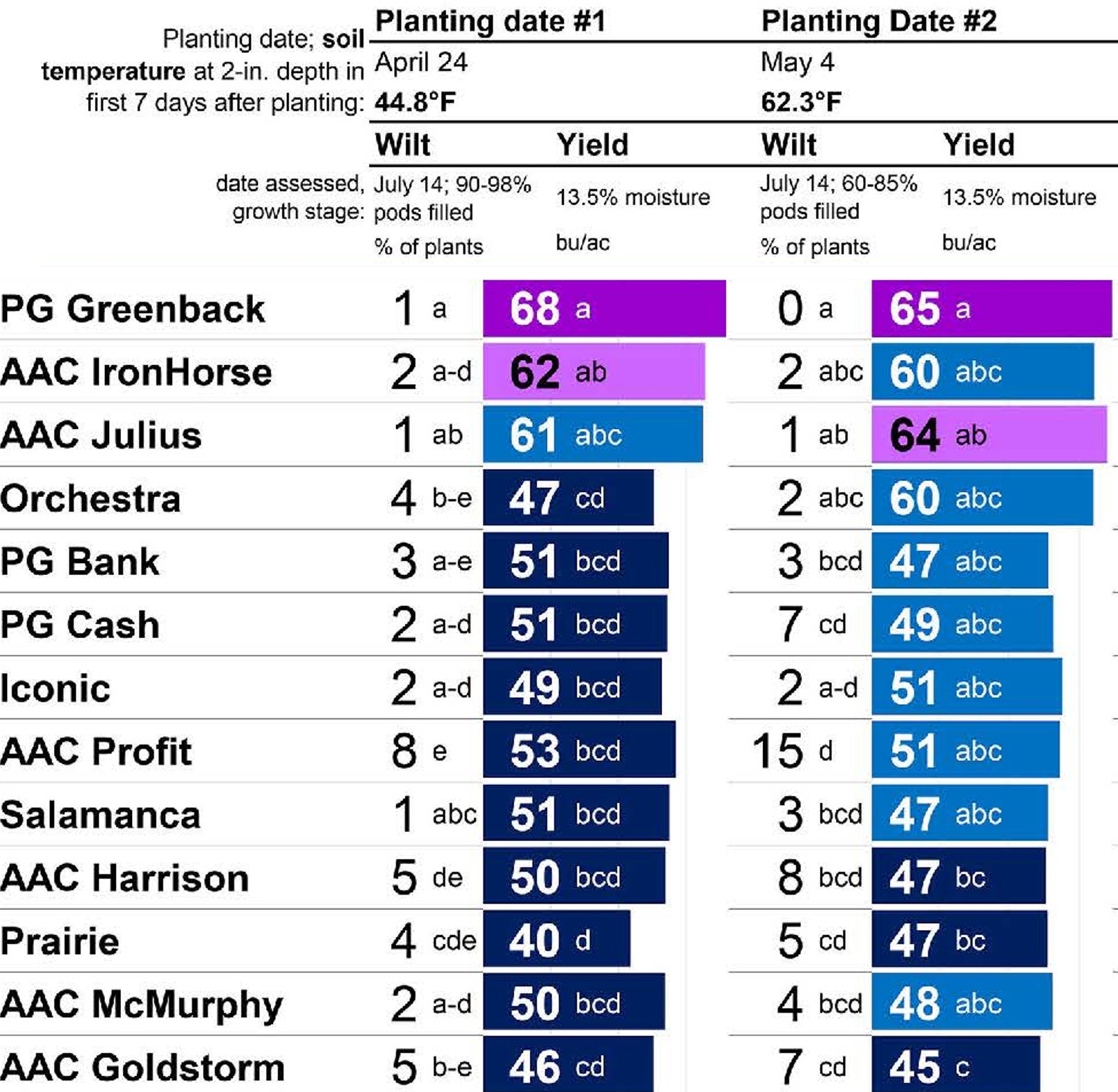
In 2025, Dr. Michael Wunsch evaluated 13 pea varieties for root rot tolerance. The trial was conducted in a field which had last been planted to peas in 2021. The field had severe root rot in 2021 and roots submitted for DNA analysis in 2025 confirmed the presence of Aphanomyces in that field.
Dr. Wunsch found that, in addition to AAC Julius and AAC IronHorse, the green pea variety PG Greenback exhibited exceptional tolerance to Aphanomyces root rot. This tolerance translated into significant yield increases across all four planting dates, with the greatest advantage observed when peas were planted from late May to early June. The trial also evaluated the impact of VibranceMaxx RTA fungicide seed treatment, which resulted in a yield response of 3-5 bu./A.

Using the DNA diagnostic test available through the National Ag Genotyping Center, I tested fields in our region for Aphanomyces in both 2024 and 2025 and identified multiple fields positive for the pathogen. While yield losses can be difficult to quantify in the absence of catastrophic damage, fields with a long history of pulse production are likely losing bushels to this disease. By adopting these tolerant varieties and using fungicide seed treatments, we will have a better shot at achieving economically acceptable yields in field pea.
If you aren't sure about your risk, reach out about getting your field tested for Aphanomyces.
Dr. Audrey Kalil, CCA
Agronomist/Outreach Coordinator
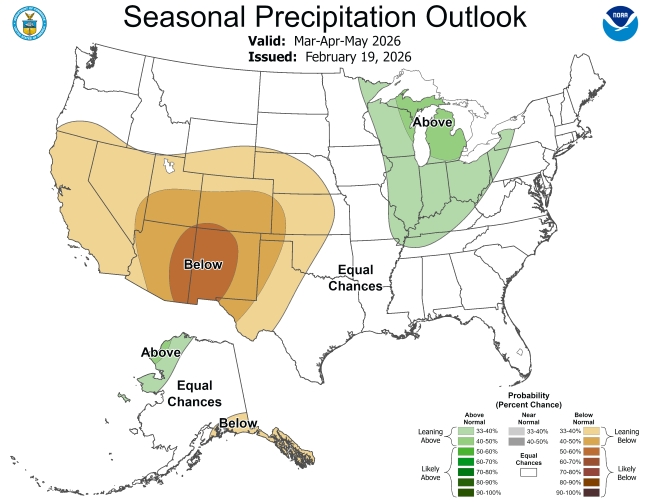
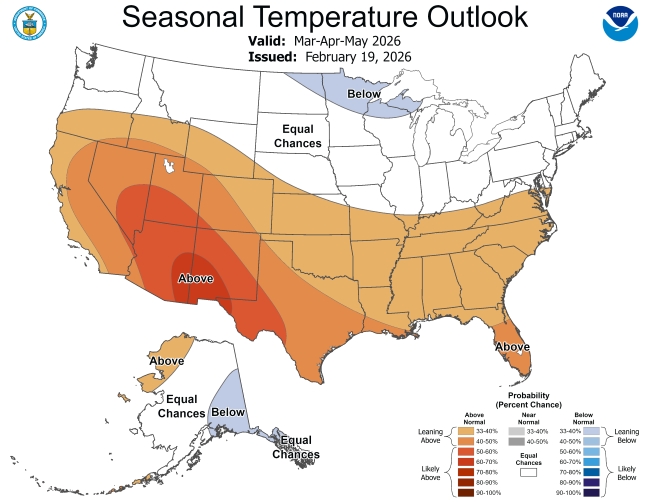
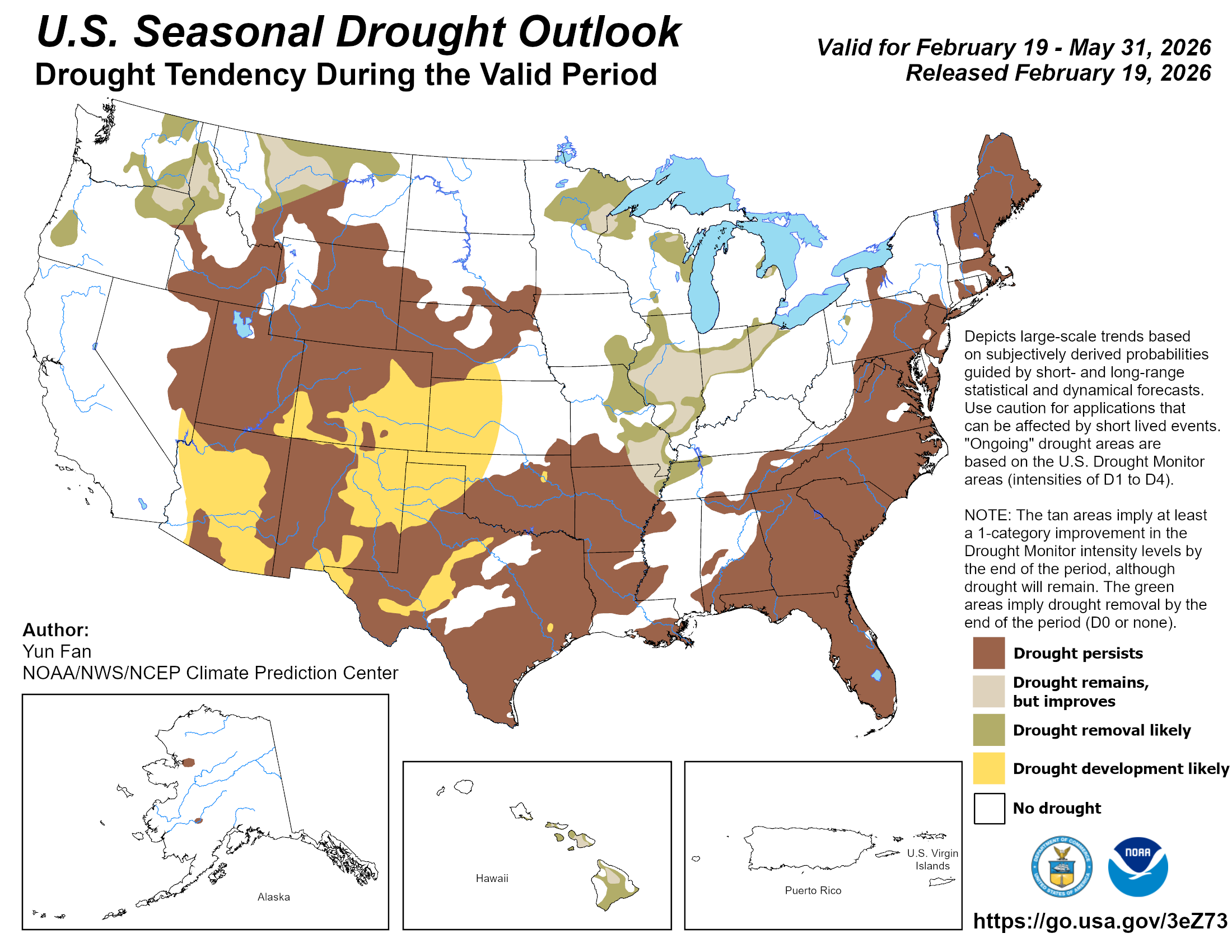
Weather Report and Climate Prediction