Agronomy Update
Corn Weed Management: Start Clean, Stay Clean
Why the First 6–8 Weeks Matter Most
Last week, I covered the foundation of a weed management program for soybeans. The concept of starting clean and staying clean is even more important in corn. Corn is highly sensitive to weed pressure during the first 6 to 8 weeks of growth, and the yield impacts from failing to control weeds in this window are very real.
A quick search will turn up countless articles on the topic, with universities across the country documenting these yield losses and explaining why they occur. So, let’s start with that as our baseline: in corn, the early weeks are non-negotiable.
The table below is from the North Dakota Weed Control Guide and shows percent yield loss as it relates to weed size at the time of removal/control.

Don’t Build the Program Around One Weed
When you accept the start-clean, stay-clean mentality, the first instinct is often to focus on the hardest-to-control broadleaf, usually kochia in our area, and pour all your resources into that. The theory seems bulletproof: load up on residuals for kochia, then clean up grasses with follow-up passes of glyphosate. In a perfect world, that works. Our world isn’t perfect.
You can do an excellent job on kochia and other broadleaves, then look up and realize how much wild oats and green foxtail your farm really has. No problem, you think, glyphosate will handle that any time. But you’re also growing other crops.
Between the logistics of in-season passes on those acres, a rain delay, and a few windy days, suddenly you’re ten days late on grassy patches in your corn and watching weed competition cost you yield.
These scenarios are real. The intent to save money with separate passes is good, but if you miss the critical early window, the yield drag lasts all season and the few dollars saved on grass control turn into far more dollars lost. The fix is simple: build a broad-spectrum residual program from the start that accounts for both broadleaves and grasses.
Pass 1: At or Just Before Planting
In our northern climate, we don’t get weeks of strong growing conditions for weeds before corn goes in the ground, so traditional early burndown passes aren’t really part of the program here. Most weeds are still a manageable size near the planting window, so the first pass for us happens at planting or slightly before.
On this pass, I focus the residual component primarily on broadleaves and save the heavy grass residuals for the post-emergent pass. The reasoning is timing. Most cool-season grasses should already be emerged, and glyphosate in this pass will catch them.
Glyphosate: Don’t Cut the Rate
Always use a strong load of glyphosate. If you’re running RT3 or another 5.4-lb glyphosate like Cornerstone 5 Plus, the rate is 32 oz/ac — every time. Don’t fall into the “it’s only grass I’m after” or “the kochia is resistant anyway” trap. Glyphosate is still providing some level of control and pulling it out only puts more pressure on the rest of your tank mix and fast-tracks resistance issues in those other modes of action. Keep the rate high. Never below 32 oz/ac.
Tank-Mix Option A: Dicamba (± Atrazine)
If broadleaves, kochia in particular, are the main target, I tank-mix dicamba (Sterling Blue or similar) with glyphosate. Rate depends on soil:
-
Over 2.5% organic matter: 16
-
Sandy ground, under 2.5% organic matter: 8 oz/ac (label maximum)
A t 8oz/ac, and especially up to 16 oz/ac, you’ll get some residual activity on broadleaf weeds to bridge into your in-crop pass.
You can add atrazine at this timing for extra residual on early-season wild oats and added broadleaf control. The rotation-friendly rate is 12 oz/ac (0.38 lb ai), and you can go up to 32 oz/ac if you’re rotating back to corn, sorghum, or soybeans (note the 10-month plant-back for soybeans).
Tank-Mix Option B: Verdict
If you don’t want dicamba or atrazine in the pre-emerge pass, Verdict is a great alternative. It’s a premix of Sharpen and Outlook, and must be applied truly pre-emergent — Sharpen will injure corn if it contacts green leaves.
Verdict at 16 oz/ac delivers 3 oz of Sharpen and 12 oz of Outlook, providing excellent broadleaf and grass residual that includes kochia. Don’t skip the adjuvant requirements to get foliar activity out of the Sharpen component: 8.5 lb AMS / 100 gal water + 16 oz/ac MSO, or 12 oz/ac HSMOC. Verdict is also rotation-friendly, which makes it a strong fit if rotation flexibility matters to you.
Pass 2: In-Crop Post at V3–V5
If the program has held up to this point, all weeds should be small and manageable when you reach the in-crop post timing — V3 to V5, roughly 6 to 12 inches of corn. The corn herbicide market is built around this window, and your options are nearly endless.
I won’t cover every choice; instead, here are three I run on the farms I work with. Baseline for every option: 32 oz of your preferred 5.4-lb glyphosate.
Option 1: Confidence Xtra + Incinerate
Confidence Xtra @ 28 oz/acre (WinField United) is an off-patent premix of atrazine and acetochlor (Harness). At 28 oz/ac, it delivers 12 oz of atrazine (the rotation-friendly rate) and 16 oz of acetochlor.
Incinerate @ 3 oz/acre (WinField United) is mesotrione (the name-brand version is Callisto), a Group 27 herbicide. On its own, mesotrione is solid on broadleaves like kochia. Paired with atrazine, it acts like an entirely different product — the synergy is excellent on kochia and similar weeds.
Together, Confidence Xtra and Incinerate are a strong one-two punch: broadleaf knockdown plus broadleaf and grass residual to carry the corn to canopy. You can run more than 28 oz of Confidence Xtra, but the atrazine load will then limit rotation to corn, sorghum, or soybeans.
Adjuvant: HSMOC such as Destiny HC at 12 oz/ac.
Option 2: Resicore REV
If you’ve run the first tank-mix and want a step up, Resicore REV is an excellent choice. It’s a premix of acetochlor, mesotrione, and clopyralid — very similar to Option 1, with the addition of clopyralid (Stinger), which adds strong activity on Canada thistle, wild buckwheat, and a long list of other tough broadleaves.
With Resicore REV, you’ll still want to add atrazine to capture the synergy with mesotrione. The advantage here is flexibility: you choose the Resicore REV rate that fits your weed pressure, and you set the atrazine rate independently — rotation-friendly if needed, or stronger if you’re staying in corn or soybeans. With Confidence Xtra, you were limited to 28 oz to stay rotation-friendly because of the atrazine in the premix.
Rates: 45 to 104 oz/ac.
Adjuvant: HSMOC such as Destiny HC at 12 oz/ac.
Option 3: Storen
Storen is a four-way premix: metolachlor (similar spectrum to acetochlor) and pyroxasulfone (Zidua) — both strong Group 15 residuals — plus mesotrione and bicyclopyrone, both strong Group 27 herbicides. The result is a heavy residual package alongside a strong broadleaf knockdown from the two Group 27 actives. As with the other two options, atrazine is a must to get the most out of the mix.
Adjuvant: HSMOC such as Destiny HC at 12 oz/ac.
Rates: 48 to 96 oz/ac.
Be sure to read the label for full rotation restrictions.
The Bottom Line
Starting clean and staying clean in corn can be as simple as a two-pass system in our northern region: one pass at or just before planting, and a follow-up at V3–V5. Match the right combination of broadleaf herbicides with strong residuals, and you can hold both troublesome broadleaves like kochia and pesky grasses at bay long enough to let the corn reach its full potential.
As always, the range of rotation possibilities and soil conditions is wider than any single article can cover. Always consult the product label to confirm that your specific use case fits what you’re trying to accomplish.
Kyle Okke, CCA
Agile Agronomy LLC.
Agronomists Happy Hour Podcast
Challenging Spray Conditions Affect Weed Control
Cold and windy conditions have made finding a good window to apply a pre-emergence burndown a challenge this spring. Limited rainfall will also impact the level of control we get with spring applied soil residual herbicides. Below are some guidelines for environmental conditions which affect herbicide performance.
Monitoring fields will be especially critical this season to ensure we perform in crop applications early enough to catch weeds while they are still small enough to control.
Rainfall
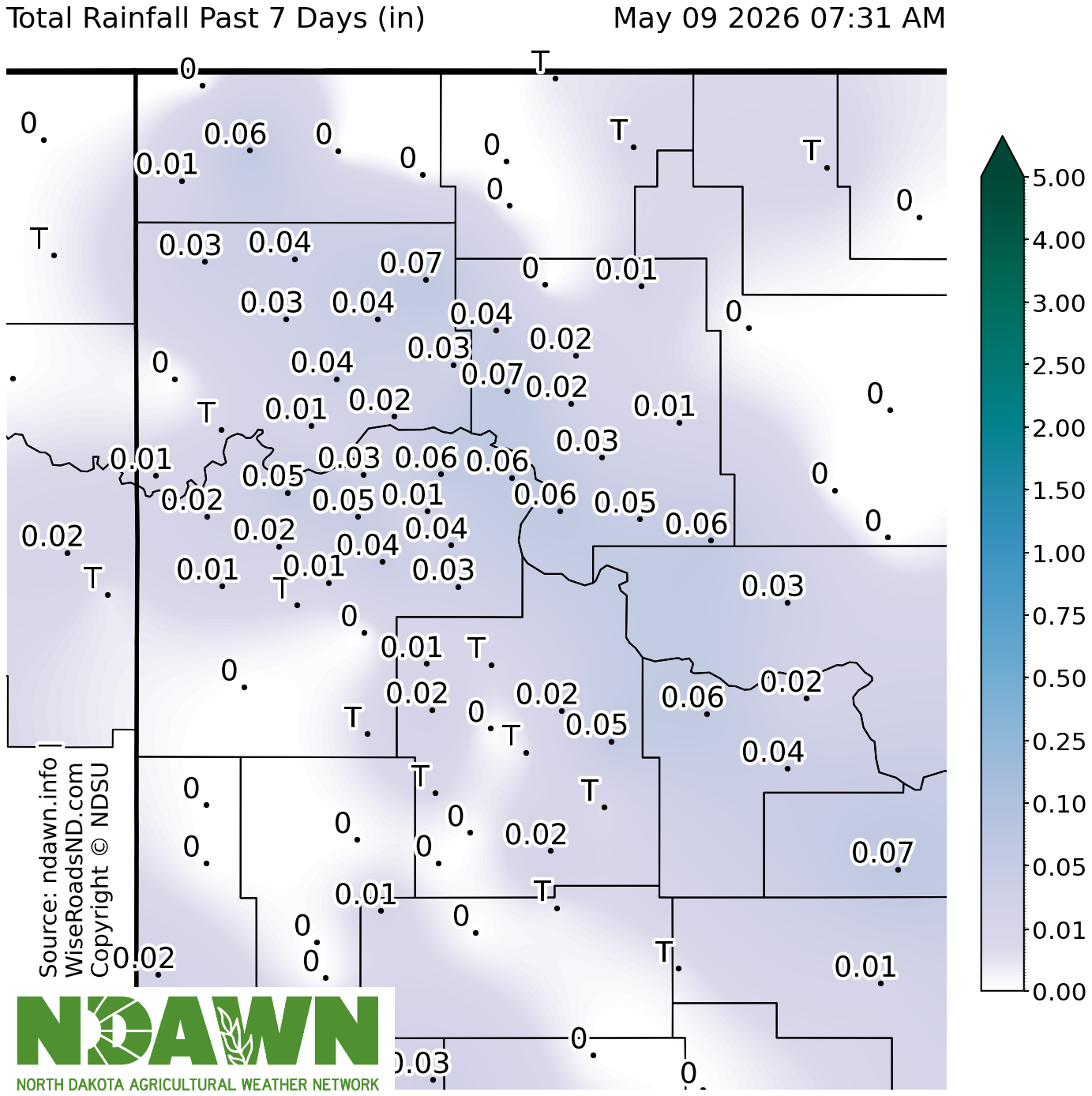
The residual herbicides we commonly use, particularly ahead of pulse crops, require activation via rainfall or irrigation. This allows the active ingredient to mix with soil water and move to where it will be taken up by germinating weed seeds. Weeds emerging after application but prior to activation will likely escape control. That is why we apply many residual herbicides, such as Sonalan, Valor or Anthem Flex, in the fall. Winter precipitation can ensure activation ahead of spring planting.
Sulfentrazone (Spartan) requires 0.5 - 1 inch of rainfall within the 7 to 10 days after application to be activated. Without rainfall, emerged weeds present at application may still be controlled because of this product’s foliar activity, but residual control will be reduced or lost. Pyroxasulfone (Zidua, Authority Supreme, and Anthem Flex) requires a similar amount of rainfall for residual weed control but does not provide foliar activity.
Prowl H2O requires rainfall for optimum activity, although the label is less specific regarding exact requirements because effectiveness depends on factors such as existing soil moisture, soil texture, and organic matter content. The label states that enough water to moisten the soil to a depth of 2 inches is normally adequate.
The amount of precipitation needed to activate a residual herbicide is a function of its solubility and how tightly it binds to soil. There are residual products that require less rainfall for activation including Valor, Metribuzin and Harness (acetechlor) which all require a 1/4 inch.
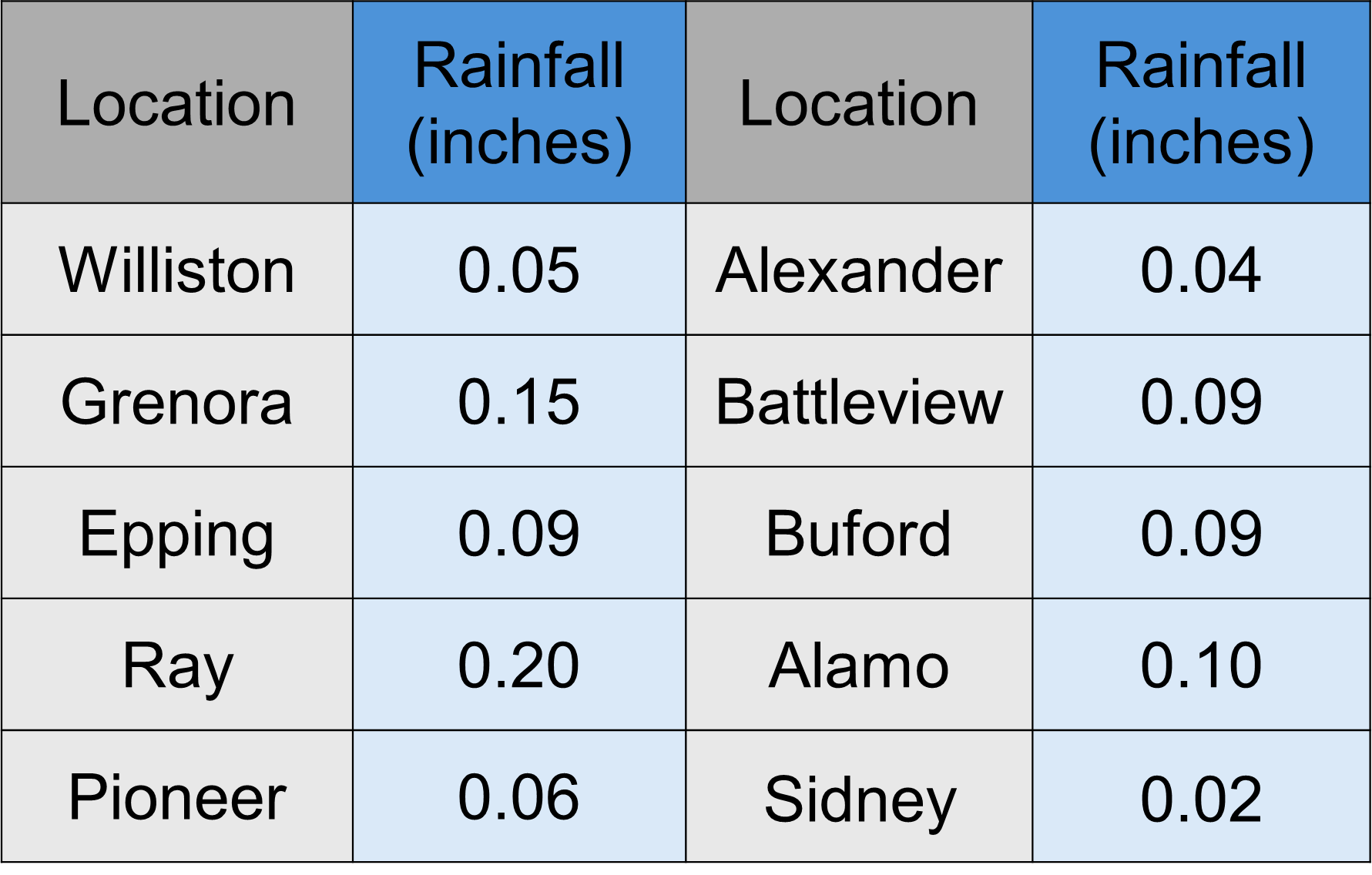
Overall, limited rainfall this spring will likely reduce the level of control provided by residual herbicides applied pre-emergence (Table 1).
Table 1. Rainfall by location from April 13 - May 8, 2026
Temperature
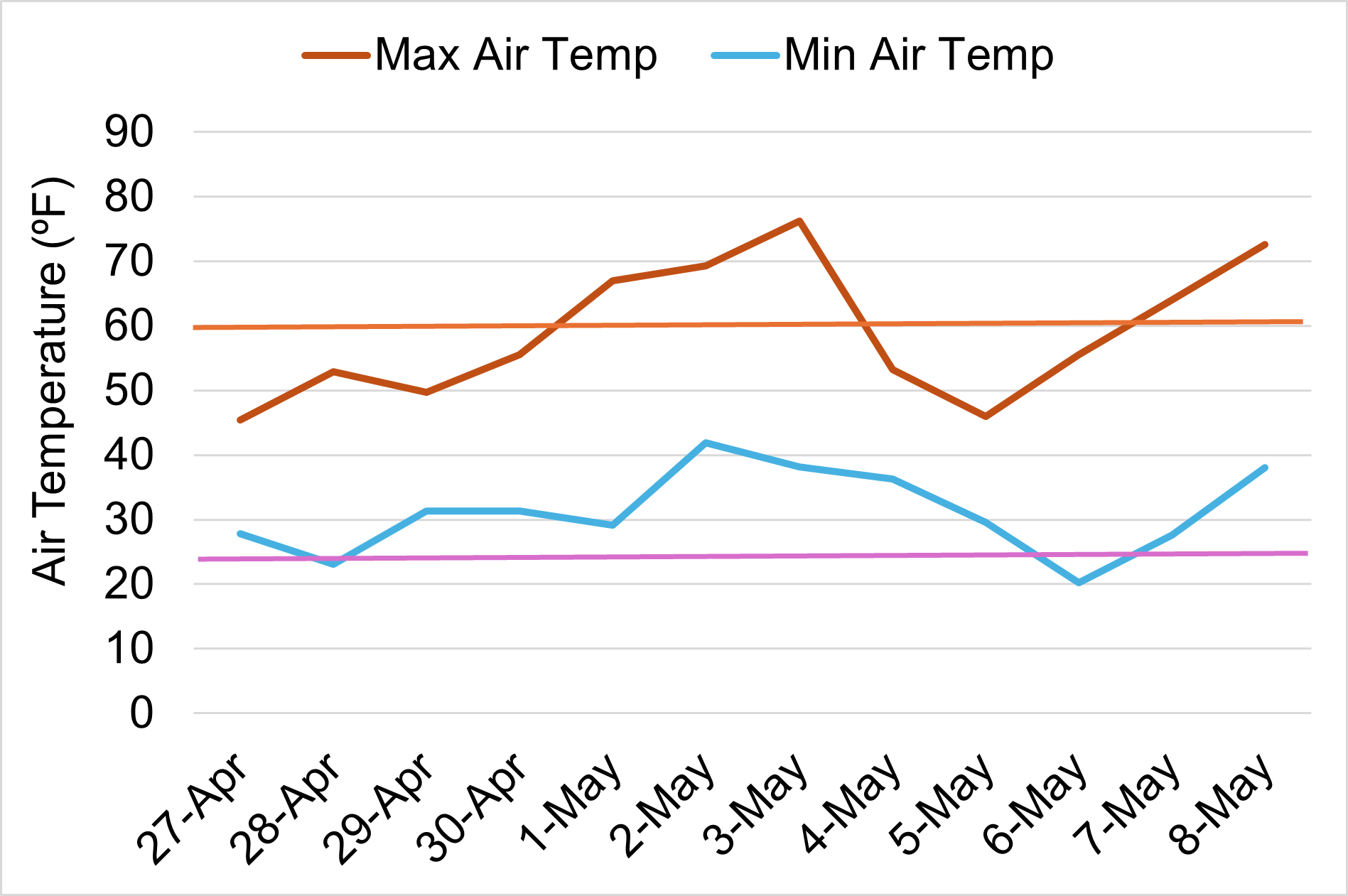
Cool conditions can impact the efficacy of burndown applications for both contact and systemic herbicides. The graph below shows temperatures in Williston from April 27 through May 8, with several nights below freezing and afternoon highs below 60ºF. Foliar herbicides need to be taken up by the plant to work. Cold temperatures or frost slow plant growth and/or kill plant tissue, reducing herbicide uptake.
Figure 1. Maximum and minimum air temperatures in Williston. Purple line is set at approximately 23 °F.
Burndown products such as glyphosate, 2,4-D, dicamba and paraquat work best at moderate temperatures above 60ºF. When temperatures drop into the 50s and 40s, absorption into and translocation through the plant will slow. Extended periods of time below 40ºF will most likely reduce control.
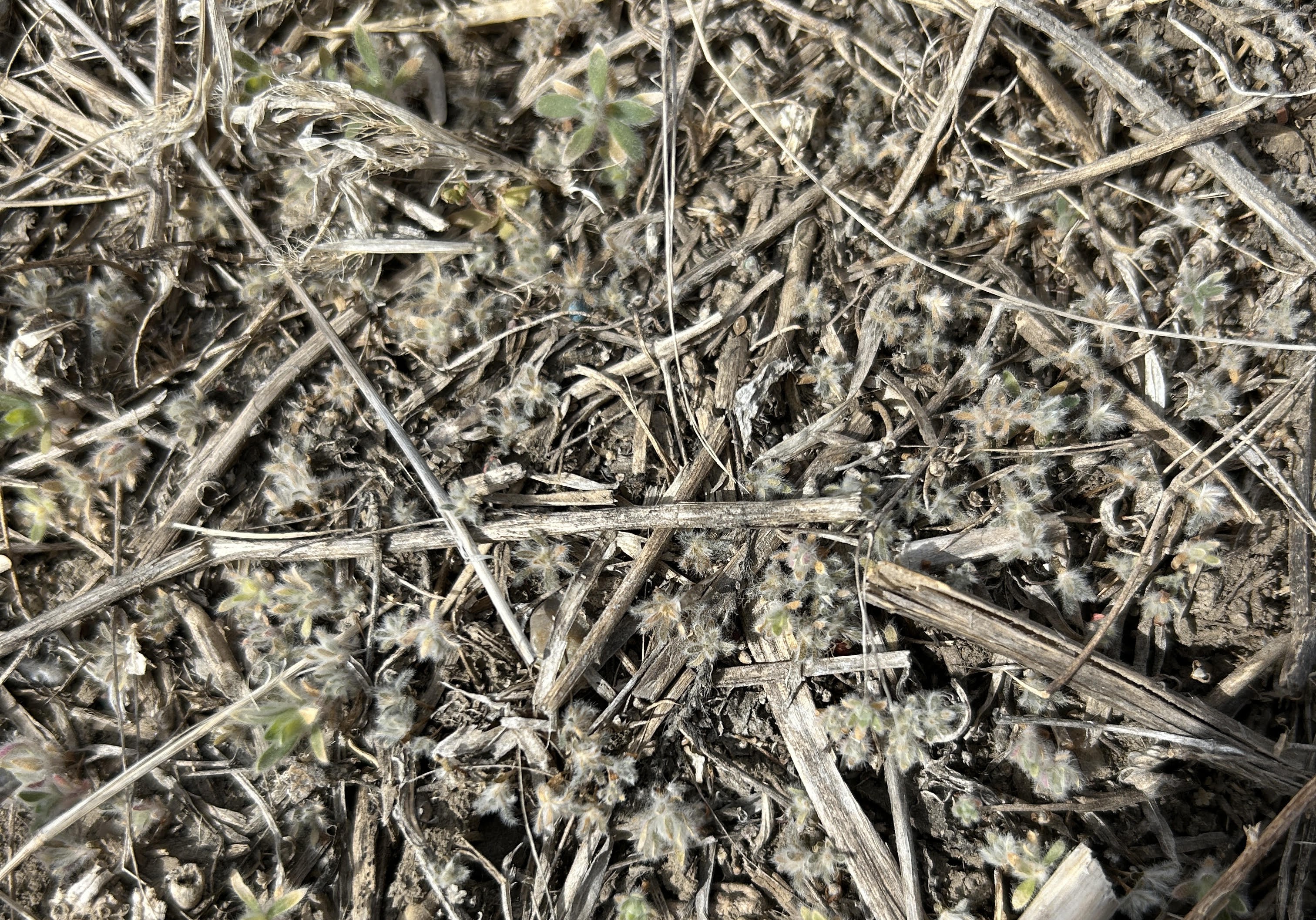
We had a short window in April with daytime highs in the 70-80s and overnight lows above 40°F. The top image below shows a kochia patch where glyphosate + Brash was applied April 21st (84°F/41°F). While there was good control on the weeds that were emerged at the time, additional plants have emerged since then (bottom image below) and will likely grow rapidly with the warm weather to come.

We had a few questions about how the frost last week would impact burndown application. The degree to which a frost will reduce herbicide activity depends on the severity and duration of the frost. For example, following a light frost of 26 to 28°F you can resume glyphosate application later in the day as long as temperatures climb to a minimum of 50 °F for several hours after the application.
A severe frost (< 23°F) causes more damage to plants and thus has a greater impact on herbicide uptake. Dead plant tissue is unable to take up herbicides, and weeds that aren't completely killed will grow new leaves once temperatures warm up.
Allowing time for the plant to recover can improve weed control. The recommendation for glyphosate is to avoid spraying for one to two days after a heavy frost. If at least 60% of the plant is still green and actively growing, and daytime temperatures have adequately warmed, you can resume spraying. Drought aggravates frost damage and could lengthen the time it takes for weeds to recover following a frost.
A frost occurring soon after a glyphosate application can also reduce control. If only a light frost occurs and temperatures rise to at least the mid-40s within a few hours, the plant can still absorb the herbicide. If warming continues into the next day, translocation through the plant will resume. However, a severe frost, such as the one we experienced on May 6th, can damage weeds, reducing absorption and translocation, ultimately decreasing control.
This spring’s weather conditions have created a narrow margin for optimal weed control, emphasizing the importance of a strong fall herbicide program. Because environmental stress can lead to inconsistent control and weed escapes, scout fields after planting and be prepared to make timely post-emergence applications while weeds are still small and manageable.
Dr. Audrey Kalil, CCA
Agronomist/Outreach Coordinator
Plan Ahead for Forages and Cover Crops
Horizon Resources carries a variety of forage crops suitable for our growing region including conventional alfalfa, sorghum-sudan, oats, hay barley and German foxtail millet. However, demand for forage products has been especially strong this spring, so availability may vary. Call or stop in to inquire about seed so we can make sure we have what you need, when you need it.
The two grass seed mixtures we keep in stock are the Dryland Pasture Mix and the ND State Land Mix by Buffalo Brand Seed. The Dryland Pasture Mix is designed for grazing and haying. It includes smooth brome, forage perennial ryegrass, intermediate wheatgrass, pubescent wheatgrass and orchardgrass. The seeding rate is 10 - 15 lb/A and we carry it in 50 lb bags.
The ND State Land Mix is a mix of native grasses for restoration including western wheatgrass, slender wheatgrass, green needlegrass, side-oats grama and a oats cover crop sold in a convenient one acre bag.
We can order custom seed mixes for restoration, food plots or cover crops. Please allow at least one week, and up to two weeks, for shipping. Whenever possible, we try to include your order with one of our bulk shipments to help reduce shipping costs.
If you are planning to plant forages this season but haven't yet secured your seed, get in touch. You can use the seeding rates below to determine what you'll need. Exact seeding rates will depend on the variety test weight. Under irrigation maximizing plant density will increase hay production.
| Type | Dryland Seeding Rate (lb/A) |
Irrigated Seeding Rate (lb/A) |
| Alfalfa | 8-10 | 15-18 |
| Golden German Foxtail | 15-20 | 20 |
| Sorghum-Sudan | 20-25 | 30-40 |
| Hay Barley | 50-75 | 125-150 |
| Forage Oats | 64-80 | 100-125 |
Dry conditions can exacerbate problems with water quality, so be sure to monitor your livestock water sources over the summer. Information on sample collection and submission can be found here from NDSU Extension and the ND Veterinary Diagnostic Laboratory.
Weather Update
| Planting Date | Wheat Growing Degree Days | Wheat Estimated Growth Stage |
| April 13 | 380 | 1-leaf |
| April 17 | 326 | 1-leaf |
| April 22 | 232 | Emergence |
| April 29 | 204 | Emergence |
| May 2 | 132 | - |
| May 7 | 62 | - |