Agronomy Update
Delta T: Why Does it Matter for Predicting Herbicide Performance?
If you're wondering if its a good time to spray, one of the best tools we have access to that can help answer that question is the NDAWN Inversion App. This app was developed to alert you to inversions, and provides current weather conditions and Delta T. Spraying in less than prime conditions has some real consequences for herbicide performance, but knowledge is power, and if you're aware of the challenges there are things we can do to mitigate them.
What is Delta T?
Delta T is calculated by subtracting the wet bulb temperature from the dry bulb temperature and relative humidity values at a weather station. For practical purposes, it tells us what happens to the spray droplets after they leave the nozzle, with higher Delta T values indicating higher rates of evaporation.

Why Does Delta T Matter?
When Delta T is high, spray droplets evaporate rapidly, preventing a portion of our herbicides from reaching and penetrating the plant. This can significantly reduce herbicide performance, especially with products that rely heavily on coverage.
On the other hand, when Delta T is low, droplets remain in solution much longer and are more prone to washing off the leaf surface. An example of this would be humid mornings where your pants get soaked scouting fields. Adding more droplets in these conditions will lead to droplet run off.
The ideal Delta T range is considered to be between 4 and 14. However, successful applications can still occur outside that range with the right adjustments.
Plant Stress Plays a Role Too
High Delta T conditions generally go hand-in-hand with environmental stress on weeds. Stressed weeds have a harder time absorbing herbicides, which further reduces control.
One strategy that can help is spraying early in the morning. Plants have typically recovered somewhat from the previous day’s heat stress, allowing for better herbicide uptake.
North Dakota Challenges
In North Dakota, we rarely have the luxury of waiting for “perfect” spray conditions. Between wind, inversions, and elevated Delta T values, most applicators are forced to compromise on at least one factor.
Most often, we end up spraying in higher Delta T conditions simply because the wind is cooperative.
That said, caution is important when Delta T values climb too high:
- Above 15: Consider adjustments to reduce.
- Above 20: Conditions become extremely challenging for effective applications.
Under these conditions, using coarse to very coarse droplets and increasing GPA can help reduce losses due to evaporation.
Current Conditions Are Extremely Dry
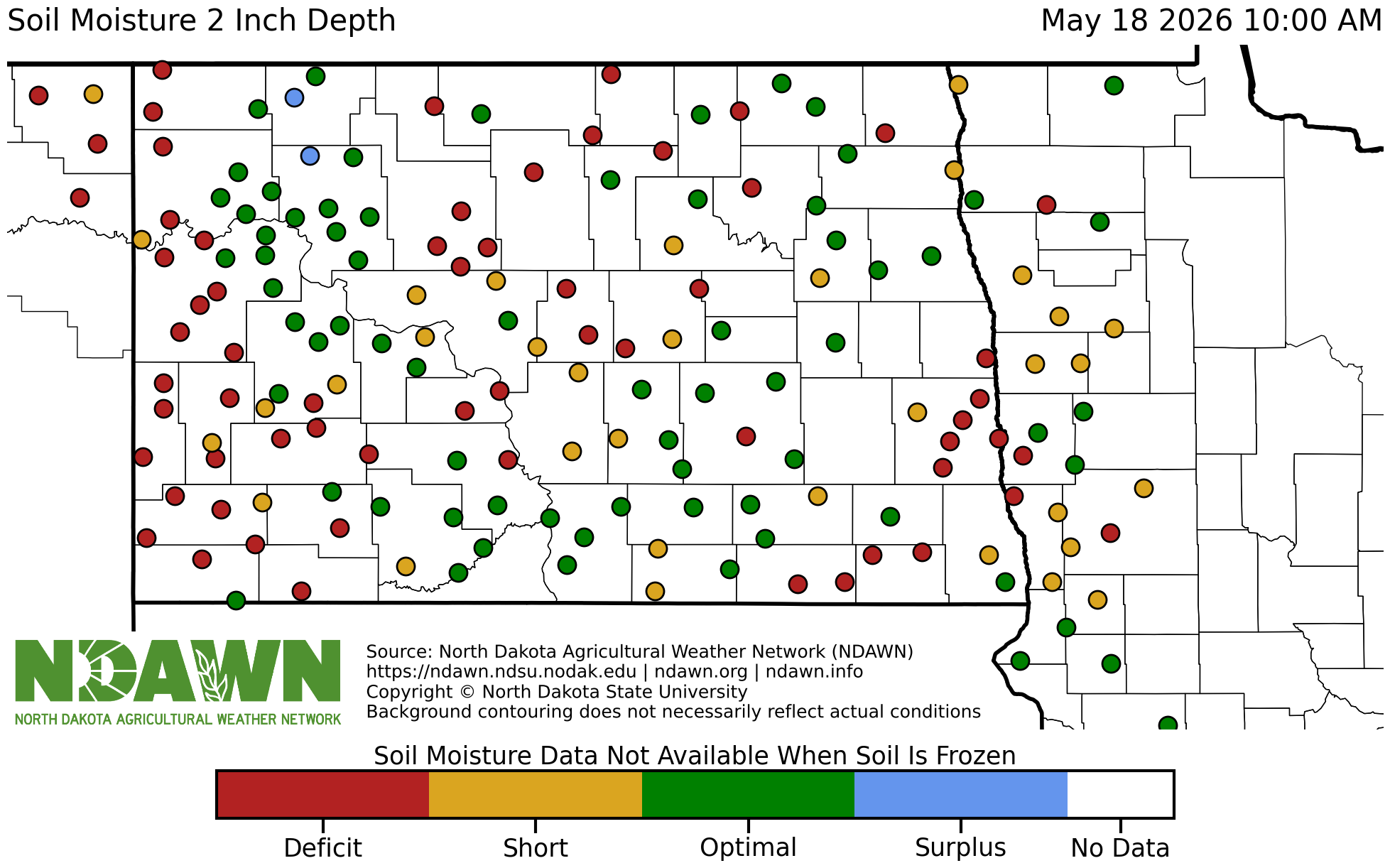
You probably don’t need NDAWN to tell you it’s dry outside, but recent maps have shown much of the state in red, indicating extremely poor spraying conditions.
When Delta T reaches the upper 20s and 30s, many herbicide droplets are evaporating too quickly to effectively deposit on and penetrate weed surfaces.

Practical Recommendations
Realistically, we can’t simply stop spraying during busy seasons. To help overcome these conditions as best as possible, consider the following:
-
Increase water volume whenever possible. 15 GPA is strongly recommended, even if it slows productivity.
-
Use an oil or humectant adjuvant to slow evaporation.
-
Utilize coarse to very coarse droplets in extreme conditions.
-
Spray earlier in the morning when weeds are less stressed.
-
Add a DRA to the tank and reduce the amount of fine droplets
-
If using Last Chance Pro, these are conditions where increasing the rate from 1 to 2 qts per 100 gallons can provide additional benefit.
Understanding Delta T and adjusting accordingly can make a major difference in herbicide performance during hot, dry conditions.
Hope this helps, and happy planting & spraying!
Codee Lee
Technical Specialist
CHS
Nozzle Know-How: Balancing Coverage, Deposition, and Drift for Effective Weed Control
Check out this episode of the War Against Weeds podcast covers how nozzle selection influences coverage, drift, deposition, and weed control, with practical recommendations for ground applications and pulse sprayers.
Listen Here

Scouting for Flea Beetles
Flea beetles are insect pest number one for canola growers, with estimated losses of $300 million annually in North America. The most critical time to protect canola seedlings is from emergence to the 4-leaf stage; later growth stages can tolerate feeding injury. To prevent yield loss, scout emerged canola fields regularly for flea beetle injury.

Image credit: Canola Council of Canada
Flea beetles begin to emerge at 58°F with peak activity and movement at 68°F. Insecticide seed treatments work very well, but only provide protection for 3 to 4 weeks. Dry and warm conditions favor flea beetle development, and suppress crop growth, so early seeded canola could be at risk.

Canola planted April 28 at the cotyledon stage on May 13
We want to minimize the use of foliar insecticides, both to protect beneficial insect populations and to avoid the development of insecticide resistance. Economic thresholds were developed to help make flea beetle spray decisions, and avoid unnecessary applications. The economic threshold is when yield loss due to feeding exceeds the cost of control (insecticide application). Canola can tolerate up to 50% feeding damage, however, injury can quickly progress beyond that before an insecticide application is made to the field. For that reason, the economic threshold is set to when approximately 25% of the cotyledon and first true leaves are damaged from flea beetle feeding.
Flea beetles can also feed on the stem, so monitor both stems and cotyledons/leaves for feeding damage. Damage to the stem can result in plant death, so that is considered as 100% on the damage rating scale. If flea beetle populations are heavy and the plants don't seem to be growing, this could be the cause.

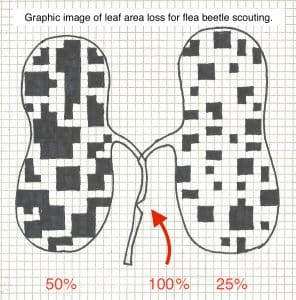
Image credit: Canola Council of Canada. Visual depictions of flea beetle feeding damage from 10 to 50% cotyledon damage. Bottom image is visualization of 25%, 50% and 100% damage from flea beetle feeding.
Insecticide seed treatments used on canola for flea beetle travel systemically into the cotyledons and first leaves (graphic below). Flea beetles will need to ingest the insecticide for it to work so a little bit of feeding injury shouldn't be cause for concern within the first three to four weeks after germination when these products are active. If cotyledons are damaged but newest leaves show little to no injury, that could be the seed treatment at work and/or plants might be growing more quickly than the flea beetles can damage them. In these circumstances, damage might not warrant a foliar insecticide application.

Plant population can also influence your spray decision. If you have fewer than 5 plants per square foot, any lost plants could result in yield loss. Whereas a field with 7 to 8 plants per square foot can tolerate losing 2 to 3 plants per square foot before damage will result in yield loss.
Check multiple areas of the field when scouting. Damage can be highly localized and field edges tend to be affected first. Its not necessary to spray the entire field if there are just a few hot spots. If damage around field edges is high but flea beetles have not impacted the field interior, it may sufficient to limit insecticide application to the field perimeter.
There are multiple effective foliar insecticides for management of flea beetle in canola. Just be aware that they are restricted use pesticides (RUPs) and can only be purchased and applied by a certified applicator. With the updated state law as of April 1, 2025; private applicators can now only supervise a non-certified applicator to apply restricted use herbicides or non-restricted use (general) pesticides.
As you scout fields for flea beetles and monitor canola growth stage, keep an eye on weed height and check the weather forecast. Early competition with weeds can greatly reduce canola yield and we want to to target Liberty applications for warm, sunny and humid days. Refer to the article by BASF Rep Chris Binstock in our May 5th newsletter for more tips on getting the most out of your Liberty application.
Dr. Audrey Kalil, CCA
Agronomist/Outreach Coordinator
Challenging Weeds: Planning for the Rest of the Season
My consulting area covers most of Stark and Dunn Counties, with the bulk of it sitting north of Interstate 94. Planting progress is 80%+ complete here. I have just a handful of wheat fields left to go in, canola and flax are in the ground, pulse crops are wrapped up, corn is well past the halfway mark, and a few growers are starting on sunflowers. The earliest wheat and durum is in the one-leaf stage and rowing up nicely. Most of this past week has been spent walking and driving fields to check whether burndown applications worked the way we needed them to because the application windows we got were far from ideal.
This has been a unique spring, but then again what two seasons are ever the same? We had an extended cool, dry stretch that kept planting progress rolling but also kept a lot of weeds tucked underground past the burndown window. Logistically, burndown still had to go out for what was up, but plenty of what we normally catch hadn’t germinated yet.
Fast forward to today. The last 10 days have been warm and unbearably windy, and post-burndown scouting is showing us exactly which weeds slipped through:
Kochia — too small and too tucked into that puffball stage at spray time. No matter the water volume or active ingredient, you simply couldn’t land herbicide on the plant.
Marestail — noticeably heavier this year than the last two seasons in my memory. Makes sense given the wet fall: marestail is a winter annual (germinates in fall, comes back in spring), and last fall’s conditions were tailor-made for it.
Canada thistle — some escapes showing up where regrowth simply wasn’t out of the ground before burndown went on.
All of this has me doing some critical thinking on the in-crop side: what herbicides do we lean on for the weeds we missed during burndown, plus whatever else is on the way? I work with several pulse crop producers running lentils, field peas, and chickpeas in rotation, so plant-back restrictions are priority one when I’m building a recommendation.
Fortunately, I keep detailed field records through FarmQA (the same tool the agronomists at Horizon Resources use), including crop rotation and herbicide history. That lets me identify when a field was last in a pulse crop and judge how likely a pulse is to land back on that acre next season. As an example: you’re probably not planting lentils every other year on the same field, so I can usually flag which wheat fields are likely going to any crop but lentil next year. That’s critical, because it opens up the herbicide toolbox. It also tells me which fields are likely heading back into pulses, where we need to stay disciplined on chemistry to keep that rotation option alive.
With that baseline of where I can be flexible and where I need to be restrictive, I start building options by weed of focus.
I know running two different in-crop tankmixes in one crop like wheat is a logistical pain. But introducing some complexity into your herbicide plan and even just swapping to a different chemical family within the same mode of action is a good thing. Hammering weeds with the exact same modes of action year after year is how resistance builds.
Disclaimer: the choices below are not an exhaustive list but they’re some of my go-to picks for wheat.
Kochia
My favorite way to crush kochia is a multiple-mode-of-action product built on, at minimum, Bromoxynil (Group 6) and an HPPD inhibitor (Group 27). Most of these are reasonably pulse-friendly, but there are wrinkles:
Huskie (6 + 27), Huskie FX (4 + 6 + 27), and Talinor (6 + 27) are not safe to lentil the next season. Field peas are 9 months (Talinor stretches to 12 months in NW ND counties). Chickpea is 9 months.
Tolvera is the only Bromoxynil + HPPD combination that is a true 9-month plant-back to all pulse crops. If pulses are in the rotation, this is the one.
Carnivore and Kochiavore are another pair that is rotation-friendly to all pulse crops. Both are built on Bromoxynil (Group 6) and Fluroxypyr (Group 4). The difference: Carnivore adds MCPA (Group 4); Kochiavore adds 2,4-D (Group 4).
That Bromoxynil + Fluroxypyr base is a great kochia foundation. The 2,4-D in Kochiavore gives it a little extra edge on kochia. But if you’re tankmixing a Group 1 grass product like Tacoma or Discover, 2,4-D can be antagonistic to grass control and MCPA is not. That makes Carnivore the more attractive pick when a Group 1 grass herbicide is going in the tank.
Marestail
I know after reading the kochia section you probably had Tolvera circled as your top dog. Then marestail walks in and blows up the plan because Tolvera gives suppression at best.
The good news: Huskie, Huskie FX, Talinor, Kochiavore, and Carnivore all provide control of marestail. Just keep an eye on those plant-back restrictions to lentil and field pea for Huskie, Huskie FX, and Talinor. Kochiavore and Carnivore stay in the truly rotation-friendly column.
I’ll also mention a non-rotation-friendly option I really like for marestail: Pixxaro EC, which combines Fluroxypyr (Group 4) and Halauxifen, trademarked as Arylex active (Group 4). Halauxifen is an exceptionally strong marestail tool with efficacy that outshines other options. If you’re dealing with a bad marestail infestation, Pixxaro is hard to beat. The trade-off: no lentils the following season.
Canada Thistle
This one is the arch-nemesis for any operation running small grains and pulses in rotation because the most effective herbicides also carry the longest rotation restrictions.
My favorite for Canada thistle is Clopyralid (Group 4) and the trade name most folks know is Stinger. The catch: 18-month rotation restriction to chickpea, field pea, and lentil. You’ll also find Clopyralid in pre-mixes like Widematch and Perfectmatch.
Clopyralid is also an effective marestail herbicide, so dropping it into a tankmix with other marestail tools gives you a real 1-2 punch.
When pulses are a real possibility next season, I shift to 2,4-D (Group 4) plus Tribenuron (Group 2). Tribenuron most commonly known as Express. Neither one should be used solo on thistle; the combination is what gets the activity you need. You’ll also find Tribenuron in Affinity Broadspec and Audit (1:1), which are common tankmix partners in a lot of small grains programs. I’ve run this combination many times with good success.
Pulling It Together
Hopefully after working through this, it’s clear there is real complexity in picking the right combination of herbicides for what’s actually in your field. Rotation is the first filter since it tells you what you can and can’t use without painting yourself into a corner for next year’s crop. From there, the combination of weeds matters more than just chasing the worst one. What you choose and what you mix has the potential to cover every weed species that’s going to show up, not only the headline problem.
The silver lining in all this complexity? You have a great group of agronomists at Horizon Resources at your disposal to help you sift through the weeds (pun intended) and put together a mix that fits your operation.
Kyle Okke, CCA
Agile Agronomy
Agronomists Happy Hour Podcast
Weed Management in the Age of Herbicide Resistance With Brian Jenks, Ph.D.
Dr. Jenks shares about the latest in kochia management including what’s working and not working. He also discusses a few other key weeds like palmer amaranth, wild oat and green foxtail.
Listen Here

Weather Update
|
Wheat Planting Date |
Growing Degree Days (Williston, ND) |
Wheat Growth Stage |
|
April 10 |
615 |
3-Leaf |
|
April 15 |
512 |
2-Leaf |
|
April 20 |
451 |
2-Leaf |
|
April 25 |
381 |
1-Leaf |
|
April 30 |
339 |
1-Leaf |
|
May 5 |
256 |
1-Leaf |
|
May 10 |
166 |
- |