Agronomy Update
Early Season Scouting Report
While both crops and weeds were slow to emerge this spring due to dry and cool conditions, warm temperatures and some much needed moisture has changed that in a hurry. As we transition to making in crop herbicide applications, knowing the weed spectrum, crop stage and what crops will be planted in that field next year are essential both for adequate weed control and preventing future herbicide injury.
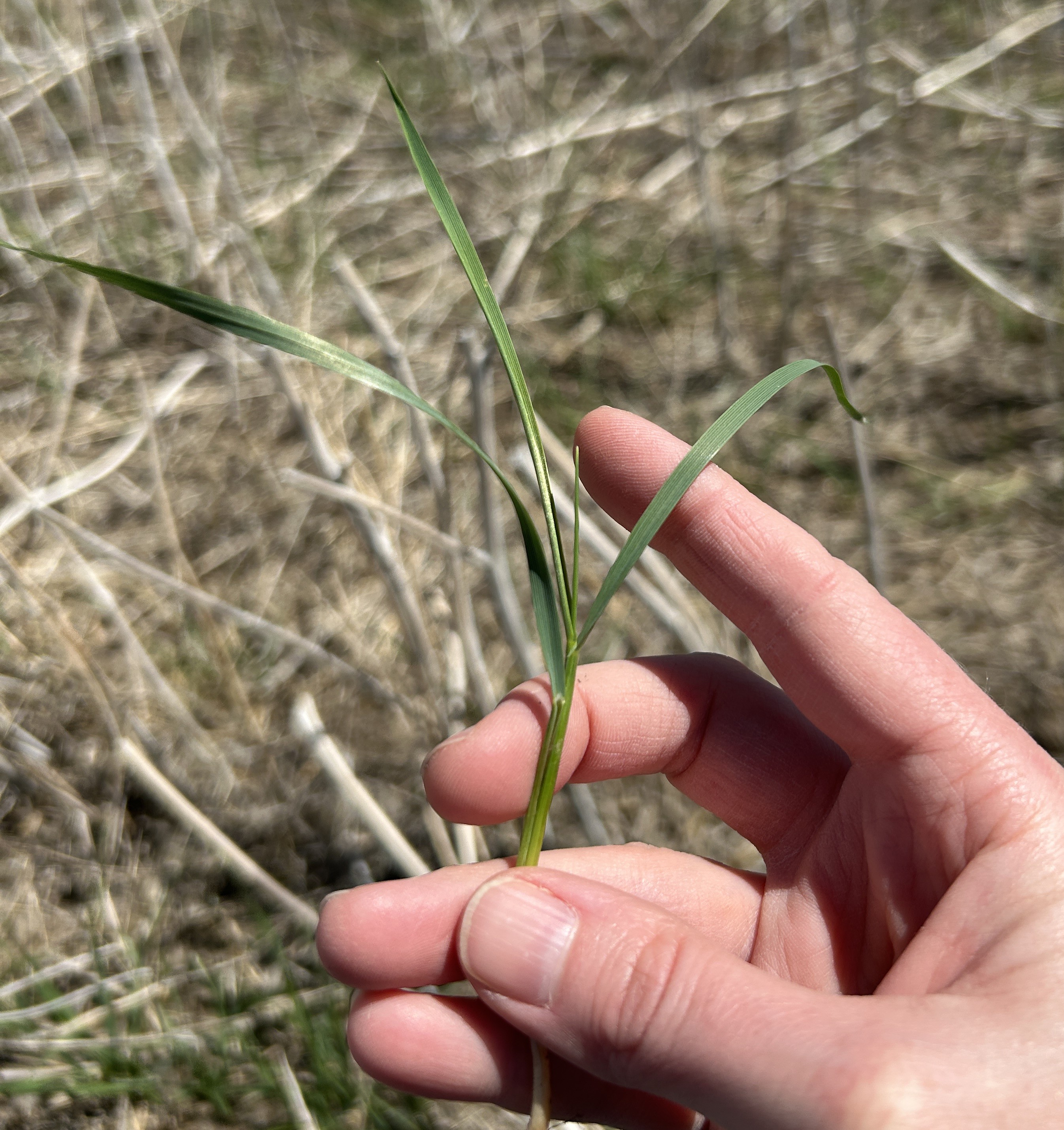
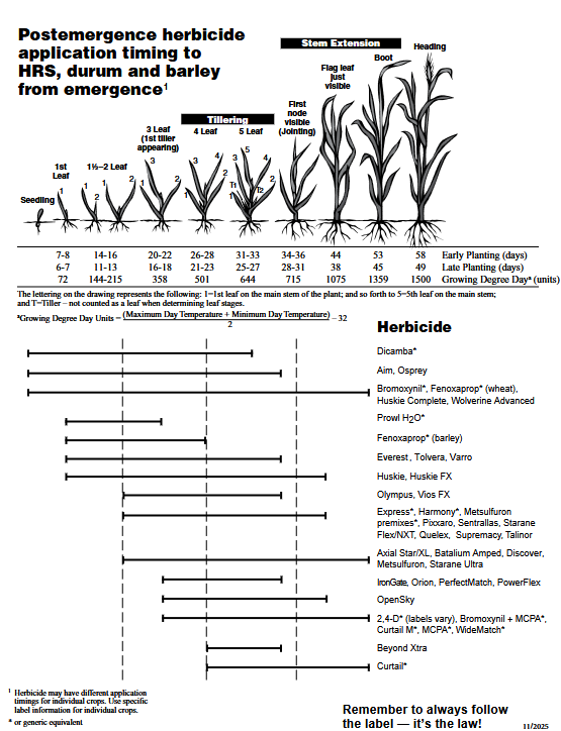
Durum planted mid-April is now in three leaf stage (picture below) to four leaf stage, although in poorer/compacted areas it might be one or two leaf. While we can apply many of the in-crop products we use at that stage, weeds are still emerging and waiting could provide better control. The North Dakota Weed Control Guide has a figure on page 16 (shown below) which shows at what growth stage we can apply different herbicides in wheat.
|
|
|
Accumulated Rainfall (Williston, ND) |
|
|
April 10 |
44 |
0.52 |
4-leaf |
|
April 15 |
39 |
0.52 |
3-leaf |
|
April 20 |
34 |
0.52 |
3-leaf |
|
April 25 |
29 |
0.51 |
2-leaf |
|
April 30 |
24 |
0.48 |
2-leaf |
|
May 5 |
19 |
0.48 |
2-leaf |
|
May 10 |
14 |
0.47 |
1-leaf |
|
May 15 |
9 |
0.47 |
- |
Winter annuals like Narrowleaf Hawksbeard and perennial weeds like Canada thistle are actively growing and in some circumstances seemed to survive burn down with only minor injury. Note fields where these weeds are present. Following up in the fall with a residual herbicide for winter annuals or post-harvest burn down for perennial weeds can help get populations under control.


Canada thistle patch (above) and Narrowleaf hawksbeard rosette (bottom) on May 20th.
Much of the emerged kochia was still under an inch late last week but in some areas plants were almost 2 inches tall. We want to target applications for when kochia is under 4 inches tall. Russian thistle is approximately 1.5 inches tall in places and foxtail/pigeon grass is just starting to emerge.


Kochia (top image), Russian thistle and foxtail/pigeon grass (bottom) on May 20.
We rely heavily on group 1 and group 2 herbicides to control grasses in wheat, pulse and Liberty Link canola rotations so consider adding additional modes of action for grass control where you can.
Tolvera, labeled in HRSW, durum and barley, includes the active ingredient tolpyralate (group 27) which provides excellent activity on green and yellow foxtail. If you have wild oat in your field as well, you'll have to add either a group 1 or group 2 product to the tank. If you have been using group 1 products repeatedly for several years, look into the group 2 options like Everest or products containing pyroxsulam like OpenSky.
With populations of green foxtail and wild oat becoming resistant to both group 1 and group 2 herbicides, take the long view on your rotation and in the future try to find ways to include other effective modes of action. We can use residual soil applied group 15 products like Anthem Flex to provide activity on both wild oats and green foxtail.
Spray season is hectic and there are a lot of moving parts. Your rotation is central to successful weed management long term, and it all starts with a plan. Once you figure out your rotation, we can take a look at your weed spectrum and find the best herbicide options for your fields.
Dr. Audrey Kalil, CCA
Agronomist/Outreach Coordinator
A Progress Update from Your Neighbors to the South
We're nearing the finish line down here, with mostly just sunflowers left to plant. But before we wrap up, I wanted to share what we've been seeing in the field after that brutal stretch of wind we all just lived through.
What the Wind Did
The week of gale-force winds, combined with the dry spring we've had, moved a lot
of soil through the air. Wind erosion was as bad as I've seen it in a long time. Thankfully, the week ended with a shot of rain that helped settle the dust. Our big mission last week was assessing how badly those young seedlings got hit.
The damaged spots had clean, distinct lines, like a sandblasting pattern. They lined up almost perfectly with low-organic-matter sandy areas, which makes sense. Those spots tend to run out of moisture early, never produce vigorous crops, and had little to no stubble cover. That bare soil blew, and the soil that blew out of those spots wreaked havoc on the seedlings sitting downwind.
Pulse crop stubble, especially lentils, blew the worst. That tracks too. Lentils are dainty plants to begin with and leave very little residue after harvest.
How Each Crop Held Up
Here's what we observed across the crops that were up:
- Small grains (barley, durum, oats, wheat): Damage visible, but recovering fine.
- Pulse crops (chickpeas, peas, lentils): Took a beating, but bouncing back.
- Corn: Very little was up, but what we saw looked A-OK
- Canola: This is where we had real trouble. There was significant injury and re-seeding decisions to make.
Why Canola Took the Worst of It
Why did canola get hit so much harder than everything else, even when the other crops looked roughed up from a distance? It comes down to one piece of crop science I remembered from freshman-year crop production class (turns out that degree was worth something 😊):
Epigeal vs. hypogeal emergence.
- Epigeal emergers keep their cotyledns below the soil line. Examples: corn, all small grains, field peas, chickpeas, lentils, and almost all grasses.
- Hypogeal emergers push their cotyledons above the soil surface. Examples: canola, soybeans, sunflower, flax, dry beans, and sugar beets.
The cotyledon is the life source of a seedling until the first true leaves form. Damage to it means real injury to the plant. Of the crops we had up, canola was the only hypogeal emerger. Its cotyledons were sitting up there fully exposed to wind-driven sand on dry ground. The small grains, pulses, and corn all had their growing points safely below the soil line and were already pushing new growth thanks to that end-of-week rain.
Assessing Canola Stands
Let's start with a benchmark. Most seed companies, InVigor is a good example, recommend a target plant stand of 10 plants per square foot. The seeding rate guidelines printed right on the bag for each seed size are hard to miss, and they're good ones.
So that's the ideal: 10 plants per square foot.
Can you get by with less? Yes. Plenty of producers flirt with lower numbers. That 10 plants/sq ft target builds in wiggle room for things like soil crusting, flea beetle feeding, and, in this case, getting sandblasted by a dust storm.
Canola is also a remarkably plastic crop. It can compensate for thin neighbors all the way down to about 4 plants per square foot, but with one big caveat: uniformity .
The Uniformity Question
If you've got a uniform stand at low population, you can leave it and be fine. The problem comes when stand counts vary wildly across the field. Yes, canola can technically yield the same at 4 plants/sq ft as at 10 but two significant differences show up that you need to think about:
At 10 plants/sq ft, a single post-emerge herbicide pass usually carries you. At 4 or less, canola compensates in size but it takes time to canopy. Canola's aggressive canopy is critical to its weed control. Once it shades the soil, new weeds can't germinate. Thin areas will likely need a second herbicide pass. Skip it, and you'll see weedy patches late in the season that hurt yield and harvestability.
Thinner areas have more soil moisture per plant, so those plants keep growing longer and mature later. Even if you make that second herbicide pass and keep things clean, you're still looking at an uneven crop at harvest. Getting the crop off as soon as it's ready always beats waiting.
Re-Seed or Leave It?
It comes down to uniformity vs. average stand count:
- Even stand of 4-6 plants/sq ft across the field: Leave it alone and go on with your day
- 10 plants/sq ft in most of the field, but 30% + of the acres are at 4 or less: Strongly consider re-seeding
Yes, in a perfect environment canola can hit optimal yield at low density. But when does everything ever go exactly as we'd hope? Avoid the weedy patches and uneven ripening, if you've got big swings in population across the field, re-plant.
You'll be happy you did.
Kyle Okke, CCA
Agile Agronomy LLC
Agronomists Happy Hour Podcast
Flea Beetle Spotting
Scouting yesterday revealed flea beetle feeding. Keep an eye on canola crops, particularly where stands were reduced due to wind damage and drought. High plant populations can withstand some losses due to flea beetle feeding, whereas thin spots will be less tolerant.
Remember to let us know about spray plans if we will be out in your fields scouting. We are always careful to follow re-entry intervals.

Applying the Five Soil Health Principles
The recent dust storm was a stark reminder of the impact Mother Nature can have on our soil. Hugh Hammond Bennet, known as the “Father of Conservation,” stated it best in 1943, “If we are bold in our thinking, courageous in accepting new ideas, and willing to work with, instead of against our land, we shall find in conservation farming an avenue to the greatest food production the world has ever
known.” Farmers and ranchers have made tremendous strides in reducing erosion and improving soil health by incorporating these five principles of soil health.
Principle 1: Keep the Soil Covered
Keeping armor on the soil is the first line of defense when improving soil health.
- Controls erosion: Wind and water are powerful forces. A 5-millimeter raindrop is traveling at 18.2 feet per second when it strikes the soil surface (Marelli, 1983). Wind erosion can start at wind speeds as low as 12-15 miles per hour. By keeping the soil covered with the previous crops’ residue and/or living plants, the energy from the raindrop or wind is absorbed by the cover.
- Reduces weed pressure: Cover reduces the amount of sunlight that reaches the soil surface. For weed seeds that require some amount of sunlight to germinate, a good cover will inhibit germination. Any weeds that do germinate will have to contend with a low light environment and may not have the energy to grow through the residue. Some living covers, such as cereal rye, have an allelopathic effect on weed seeds and prevent their germination.
- Moderates soil temperatures: Soil armor acts like a blanket in cold weather and a shade in hot weather.
- Moisture retention: By shading the soil surface, evaporation rates are greatly reduced, allowing more plant available water to be stored for use by your crop. Reducing evaporation rates also aids in the prevention of salts moving to the soil surface through capillary rise.
- Reduce compaction/crusting: When soil aggregates are broken down by the erosive power of rain, they are left as individual particles of sand, silt, clay and organic matter. When the sand, silt and clay are no longer held together in an aggregate, they clog soil pores and form visible layers on the soil surface. These layers become compacted and prevent water infiltration and seeds from sprouting.
- Home for biology: Having a high residue cover on the soil surface provides both the home and food source for surface feeding soil life such as earthworms.
Principle 2: Minimizing Soil Disturbance
The most obvious form of soil disturbance is by tillage. No-till production in our area has improved soil water holding capacity, and our recent dust storm would likely have been much worse without the widespread adoption of this practice in our region. Compared with soils under no-till soil health management, tilled soils have:
- Decreased water infiltration and storage: Tillage destroys soil aggregates and severs natural pathways and pores created by roots, worms and soil biota. When these pathways are broken, precipitation slowly seeps into the soil, often at rates slower than the rate of rainfall. Soil water storage is decreased because the aggregates that create pore space for water to be held are destroyed, and organic matter is reduced. Soil organic matter can hold up to 20 times its weight in water (Reicosky, 2005).
- Reduced organic matter: Tillage destroys organic matter by exposing it to air. When exposed to air, organic matter is consumed by opportunistic bacteria, and lost through erosion.
- Increased Erosion: Water erosion increases because of reduced infiltration rates and wind erosion increases because tillage leaves less protective residue on the surface.
Principle 3: Maximize living roots
Plants are the energy source for a healthy soil. Native prairie has living roots in the soil from spring thaw to fall freeze-up. Having living roots as long as possible in our crop production soils, will help mimic native prairie and provide a food source for soil biology.
How do we extend the amount of time a living root is interacting with the soil? Most of our cash crops have a living root for 12-15 weeks after planting, which is less than 30% of the year. Native prairies have a living root for 60% of the year or more. Diversifying crop rotations with winter crops, adding cover crops, or rotating with perennial crops like alfalfa are ways to help fill the gaps. Planting perennials on saline or marginal production areas establishes living roots in the soil, reduces weed establishment and can help improve the soil in those areas over time.
Principle 4: Maximize Plant Diversity
Prairie soils were built under a widely diverse plant community. This plant community consisted of grasses, sedges, nitrogen fixing legumes and wildflowers, all with different root types and depths. So, it makes sense that if we want to build healthy soils, we need to feed the soil microbiome a healthy, diverse diet.
If you currently graze perennial pasture that has never been sod-busted, you may have many of the original prairie plants already. To keep or increase the diversity of your plant community, proper grazing management is key. Change season of use yearly, stock properly, rotate regularly.
On the crop production side, try to imitate the native plant community, which consisted of warm and cool season grasses and broadleaves. This can be done through crop rotation and the use of cover crops.
Principle 5: Livestock Integration
Animals, plants and soils have play a synergistic role on the landscape. In recent years, animals are playing a reduced role due to fewer farms including livestock as part of their overall operation. Returning livestock to the landscape improves soil health, water quality and reduces nutrient management concerns.
(Sources: South Dakota Soil Health Coalition, Menoken Farm, Jay Fuhrer).
If you are interested in ways to help adopt these principles of soil health, please stop by the Williston NRCS office at 1106 West 2nd Street. You can also give us a call at 701-572-6729 ext. 3 and we can set up a time to meet in the field.
There are several programs available that can provide both technical and financial assistance to incorporate these soil health principles into your operation. Possible practices include:
- Converting to no-till
- Integrating cover crops or intercropping options into your crop rotation
- Purchasing a stripper header
- Planting grasses for hay, grazing or wildlife
- Managed grazing systems
These practices, and others, are supported through our office. We are looking forward to visiting with you!
Malinda Ferguson
District Conservationist
Williston Field Office
malinda.ferguson@usda.gov
Weather Update