Agronomy Update
Post-Harvest Burndown vs. Fall Residuals: Two Different Passes, Two Different Jobs
It's that time of year again. The early crops are in the bin, the late-season stuff isn't ready yet, and everywhere you look the stubble is greening up. Add in the fact that you actually have some time right now, and it's a no-brainer that something ought to be done to get ahead of next year's weed battle. The question is what. That's where I want to dig into the difference between a post-harvest burndown and a fall residual application — because they are not the same thing.
What's in a post-harvest burndown
Glyphosate (Roundup), paraquat (Gramoxone), dicamba, 2,4-D, and other non-residual to short-residual herbicides.
The goal is simple: kill what's green and growing right now and stop it from setting seed. That does three things for you. It draws down the annual weed seed bank headed into the soil this fall, it takes out emerged winter annuals and reduces pressure from perennials so you walk into cleaner fields in the spring, and it conserves moisture ahead of freeze-up. These chemistries have little to no residual, which is exactly what you want for this pass.
What's in a fall residual
Flumioxazin (Valor, Panther), pyroxasulfone (Zidua, Anthem Flexx), sulfentrazone (Spartan), and a few others depending on the situation.
The goal here is completely different. You're laying down a layer of residual late in the fall, before the ground freezes, so it's sitting there as the first line of defense when soils thaw in the spring. Think weeds like kochia and marestail. They germinate in cold conditions, they're the first weeds out of the ground, and by the time they're big enough to spray, the ground usually isn't fit to drive on anyway.
A fall residual keeps those tough weeds small or absent at seeding. Small weeds are a whole lot easier to kill than big ones, either with your spring burndown or your in-crop pass.
"Why not just tank-mix the residual with my burndown?"
I get this one every year. The days are already shorter and cooler than they were a couple weeks ago, the sprayer is sitting right there, so why make two passes?
Here's my answer: do you want that residual working for you right now this fall, or next spring? If it's next spring, hold your horses, partner. Plan on a separate late-fall pass. You'll be glad you did.
The reason is soil temperature
Residual herbicides are broken down mostly by microbial degradation. Hydrolysis and a few other processes play a part, but they follow the same general rules. The big driver is soil temperature. Above 50°F, the microbes are working. Mid-60s and up, they're working hard.
With soils above 50°F, plan on about 2 to 4 weeks of residual from flumioxazin, and maybe a week longer from pyroxasulfone. Apply that with a burndown in the next two weeks and you're looking at protection through the end of October, at best.
So, can you put a residual down right now and expect it to handle kochia next spring? No. Nobody is going to stop you from making that application but be honest about when that chemistry is going to be working. Go now and it gets spent on the rest of this fall. Wait until late October or early November, once soil temperatures have settled below 50°F, and you've preserved it — it goes to work first thing in the spring, exactly when you need it.
Bottom line
- Burndown now: kill what's green, cut the seed bank, save moisture.
- Residual later: wait until soil temperatures below 50°F, late October into early November.
- Two goals, two passes.
More on the residual side in a couple of weeks — details worth knowing as you plan that true fall pass. Until then, get on that post-harvest burndown.
Kyle Okke, CCA
Agile Agronomy
Herbicide Resistant Kochia Update
This summer, we submitted 103 kochia samples from 30 fields in Williams and McKenzie Counties for herbicide resistance testing. The genetic assay, conducted by the National Agricultural Genotyping Center (NAGC), screens kochia for herbicide resistance to:
- Group 14 (e.g., Aim, Sharpen, Valor, Spartan)
- Group 9 (glyphosate)
- Group 2 (e.g., Express, Raptor, Audit 1:1 or 4:1, Affinity products)
Group 2 resistance is already widespread, so our primary interest was understanding the prevalence of glyphosate and Group 14 resistance.
Overall we found that:
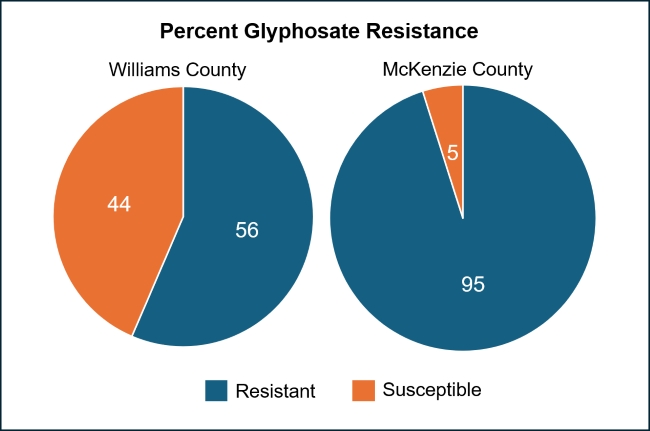
- Glyphosate resistance was present in 28 of the 30 fields tested.
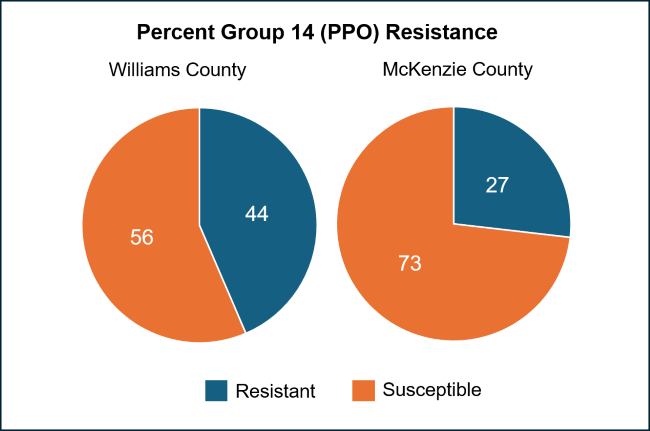
- Group 14 resistance was detected in 17 of the 30 fields tested.
- 25% of the plants tested were resistant to both glyphosate and Group 14
The charts below show the percent of plants tested that were resistant to glyphosate or Group 14 (PPO) herbicides by county. Based on the 12 fields tested in McKenzie County, glyphosate resistance appears to be much more common there, with resistance detected in 95% of plants tested, compared with just over half of the plants tested in Williams County.
In Williams County just under half of the plants tested were PPO resistant and McKenzie County it was about a third.
Given our reliance on glyphosate and products like Sharpen, Valor, Spartan and Aim, this widespread resistance leaves us in a tough spot. While Valor is still an important product in the fall residual line up for some situations, for early season kochia control you will need to either supplement or replace that with a different mode of action.
Anthem Flex (Group 15 + 14), Zidua/generic pyroxasulfone (Group 15) or Preview 2.1 (Group 14 + 5) are products that fit that bill. We discussed Anthem Flex in our last newsletter, and the articles below provide more details on Preview 2.1 SC and Zidua and how they might fit into your operation.
While these products are going to help in the short term, we also need to look at the big picture and consider the entire cropping system to get ahead of resistant weeds. Having a long term crop rotation plan can help facilitate the adoption of more of these management approaches. As we have already proven, just switching to the latest and greatest herbicide won't be enough to out run herbicide resistance. Some other approaches we can consider include:
- Prevent escapes from producing seed with a post-harvest burndown
- Rotate AND tank mix multiple effective modes of action whenever possible.
- Mow kochia patches, field edges and ditches to prevent seed set.
- Plant salty or poor areas that only grow kochia to salt tolerant grasses or varieties of alfalfa.
- Increase seeding rates, avoid skips or gaps and incorporate winter wheat into the rotation to increase weed competition.
- Reduce or eliminate chem fallow acres.
- Consider fencing or tree rows to prevent kochia from other areas entering your fields.
I wish there were an easy fix to this issue, but the truth is that herbicide resistance is a complex problem that will require a multi-pronged approach. The good news is that, thanks to genetic testing through the NAGC and the work of weed scientists like Dr. Brian Jenks, we are aware of the problem before the entire kochia population becomes resistant. We still have effective tools available, but protecting those tools will require us to use them differently and think beyond a single herbicide application.
Dr. Audrey Kalil, CCA
Agronomist/Outreach Coordinator
Manage Resistant Kochia with Fall Applied Preview 2.1
As harvest winds down, it is time to start planning for next spring. Fall is a key window to implement residual herbicide strategies targeting winter annuals, early-emerging summer annuals, and resistant weed biotypes. Preview 2.1, a co-formulated SC product containing Sulfentrazone (Group 14) and Metribuzin (Group 5), offers broad-spectrum broadleaf control and early-season suppression of select grass species.
Registered in North Dakota and Montana for fall application ahead of HRSW, Durum, Barley, Corn and Soybeans, Preview 2.1 enhances spring weed management by providing consistent residual activity across varying soil types and environmental conditions.
Mode of Action and Resistance Considerations
Preview 2.1 combines two active ingredients with distinct sites of action, supporting integrated resistance management strategies:
Sulfentrazone (Group 14): A PPO inhibitor with activity on small-seeded broadleaves, particularly effective on Kochia, Waterhemp, and Lambsquarters.
Metribuzin (Group 5): A PSII inhibitor, underutilized in many rotations, adds a valuable alternative mode of action, particularly in fields with Glyphosate and Group 2, 4, or 14 resistance concerns.
The co-crystal formulation delivers uniform particle distribution, enhancing soil adsorption and improving performance consistency across a wide pH spectrum (typically pH 5.5–7.5).
Spectrum of Control
Broadleaf species controlled include but are not limited to:
- Kochia, including Group 2/4/14-resistant biotypes
- Waterhemp, Marestail, Redroot Pigweed, Wild Buckwheat
- Field Pennycress, Common Lambsquarters, Shepherd’s Purse, Mustard spp.
Grass suppression:
Green Foxtail, Wild Oat, and Brome species have shown early-season suppression in trials. Fields with later-emerging flushes or high grass density may require a sequential post-emergent grass herbicide.
A trial was conducted at the NDSU Hettinger Research Extension Center to evaluate Preview 2.1 in comparison to Valor (Flumioxazin -Group 14) , Zidua (pyroxasulfone
—Group 15) and Moccasin (S-Metolachlor—Group 15). The products were applied October 15, 2023 when soil temperatures were 45°F.
Spring wheat was planted May 5, 2024. Kochia and wild oat control were evaluated on June 11th. Weed control and yield data are below. Bars sharing common letters are not significantly different as determined by statistical analysis.
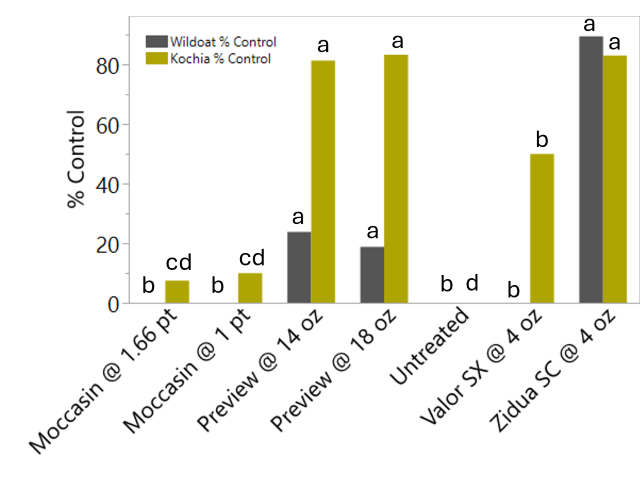
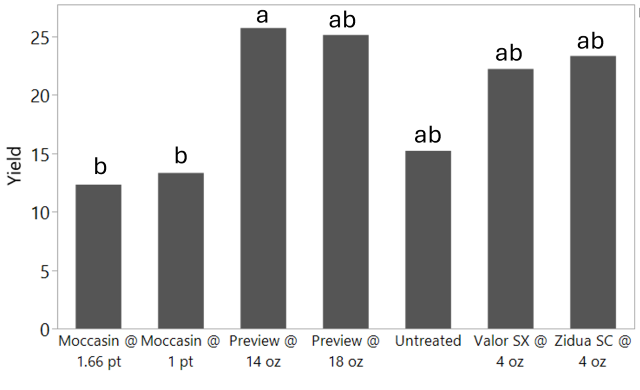
.Only Zidua and Preview 2.1 provided control of wild oat, and they did not differ significantly from one another likely due to high levels of variability in the data.
Application of Moccasin did not improve control of kochia over the untreated check. Preview 2.1 and Zidua provided 80% control, while Valor provided 50% control. They did not determine if the kochia population where the trial was located was resistant to group 14 herbicides.
Application Timing & Soil Considerations
- Target soil temperature: ≤55°F at a 4-inch depth and declining. Optimal microbial activity and herbicide activation are achieved under these conditions. Do not apply to frozen soils.
- 10 gal/A water minimum
- Activation: Requires 0.5 - 1" of precipitation for incorporation.
- Low binding potential with surface residue makes it well-suited for reduced- or no-till systems.
- Do not apply to soils classified as sand (< 1% organic matter)
Avoid tank-mixing with additional Group 14 herbicides (e.g., Valor), as this can increase crop response risk and reduce rotational flexibility. Compatible tank mix partners include most burndown herbicides and residual products such as Zidua (not for durum). For control of emerged winter annual weeds add glyphosate or 2,4-D to the tank.
Use Rates and Crop Rotation Considerations
Standard rate: 14 oz/ac
- Supports rotation to spring wheat, durum, barley, soybean and corn.
- Equivalent to approximately 7.8 oz/A of a 4 lb Metribuzin and
Higher rates (16–18 oz/ac) may be warranted when:
- Soil temps remain >55°F at
- Soil pH is low
- Fields have elevated early-season weed pressure.
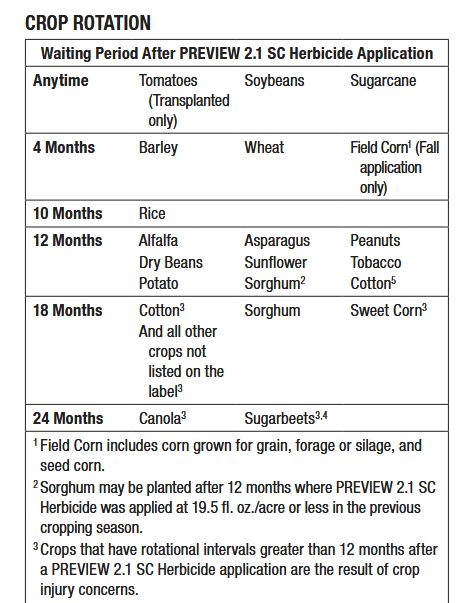
Exceeding 14 oz/ac will exclude corn from being planted the following spring. There is a 24-month rotation restriction for canola at all label rates and it will be 18 months to peas or lentils. The label rotation table is below but review the full label and 2ee supplemental label for details.
Summary
Preview® 2.1 is a strategic fall-applied herbicide that delivers consistent residual control of key broadleaf species and early-season grass suppression. It supports resistance management objectives and provides clean fields ahead of spring planting, particularly in early-seeded systems where spring burndown windows are limited.
For product placement recommendations, rate adjustments, or tank mix compatibility, contact your Horizon Resources agronomist.
Monte Kubas
UPL Territory Sales Manager
Fall-Applied Zidua SC: Building a Strong Start for Spring Wheat
Another season of field experience has reinforced the value of fall-applied Zidua SC ahead of spring wheat planting. Our results continue to show strong benefits for reducing wild oat pressure in hard red spring wheat (HRSW), particularly in fields where intense early-season wild oat pressure can make crop establishment challenging.
While we would not consider Zidua a perfect, season-long wild oat control solution, as is often the case with soil-applied residual herbicides, the investment has proven worthwhile. Fall-applied Zidua can help reduce early wild oat competition, giving wheat an opportunity to establish quickly and become more competitive.
Strong Wild Oat Control with Added Benefits
Our experience indicates that Zidua is performing as well as, and in some situations better than, triallate (Avadex/Far-Go) for wild oat control, while offering improved crop safety.
Zidua also brings some additional benefits to the weed-control program:
- Broadleaf weed activity: Zidua provides control of certain small-seeded broadleaf weeds, including pigweed species, along with suppression of kochia.
- Foxtail control: Zidua provides good control of green and yellow foxtail.
- Application flexibility: The low use rate and flexibility to apply with or without shallow incorporation make Zidua relatively easy to fit into a fall management program.
Incorporation and Timing Matter
Our observations suggest Zidua can perform well whether it is incorporated or left non-incorporated, provided the field does not receive deep tillage that can disrupt the herbicide-treated zone and create streaked or inconsistent weed control.
One of the best scenarios we've observed is slightly earlier-planted spring wheat, allowing the crop to establish while Zidua is still providing strong residual activity. The goal is to give wheat a head start and allow it to become competitive before the residual activity begins to decline.
We have also observed that Zidua can be reactivated following rainfall. In some cases, wild oats that escaped the initial application appeared to take up Zidua through their roots after subsequent rainfall events. Although these plants emerged, they were often noticeably suppressed well into the growing season
This reinforces an important point: fall-applied Zidua should be viewed as part of a weed-management system, rather than a one-pass solution. Its value is in reducing the initial wild oat population and helping spring wheat get established and competitive in fields with significant wild oat pressure.
Wheat Safety
Zidua has demonstrated very good crop safety on several wheat varieties, including:
- WB9590
- Murdock
- Buns
- AP Gunsmoke
- Wildcat
- SY Valda
University trials have also demonstrated increased crop safety with Zidua compared with triallate (Far-Go herbicide) on a number of varieties, including WB9479, AP Gunsmoke, Torgy, Murdock, Wildcat and WB9590.
Fall Application Guidelines
For growers considering fall-applied Zidua SC, the following practices have provided the best results in our experience:
- Application timing: Apply when soil temperatures are 50°F or below to minimize microbial breakdown of the herbicide in the fall before freeze-up.
- Application rate: Apply Zidua SC at 3.25 fl oz/A for spring wheat.
- Fall urea applications: If urea fertilizer is being applied in the fall, complete the fertilizer incorporation pass before applying Zidua SC. For example, make the chisel-plow pass first, then apply the herbicide.
- Spring urea with deep incorporation: If Zidua SC is applied in the fall and spring urea is followed by deep incorporation, such as with a chisel plow, expect reduced wild oat control.
- Spring urea with shallow incorporation: When spring urea is applied following a fall Zidua SC application, use shallow incorporation methods such as a multi-weeder or vertical tillage where appropriate.
When properly timed and incorporated into an overall weed-management system, Zidua SC can provide strong residual wild oat control, added broadleaf activity, good foxtail control and excellent flexibility for fall application.
Fall-applied Zidua SC has become a valuable tool in our approach to managing wild oat in spring wheat. It may not eliminate the need for additional weed-control practices, but reducing the early wild oat population can make a meaningful difference in crop establishment and competitiveness.
Chris Binstock
Business Rep- Western ND