Agronomy Update
Feb 09, 2026
February and March Meetings
In February and March there are several virtual and in person events offered in North Dakota and Montana. The NDSU Western Crop and Pest School will be hosted in Williston at the Grand Williston Hotel & Convention Center and the agenda has been posted. It looks like a great event so make sure to put that on your calendar. Registration is required. Early bird registration is $100 and closes February 27th.After that it jumps to $125. For further information about the content of this program, contact Barbara Nilles, 701-231-6285 or Victor Gomes, 701-456-1100.
Other upcoming meetings are listed below. Click the link for the website and registration details.
| Date |
Event |
Location |
| Feb 17 | Evolution Ag Summit | Jamestown, ND |
| Feb 17 | Getting it Right Dry Bean Webinar | Virtual |
| Feb 18 | 2026 Western Soybean School | Minot, ND |
| Mar 6 & 7 | Mondak Ag Days | Sidney, MT |
| Mar 11 | Western Crop and Pest School | Williston, ND |
| Mar 19 | Getting it Right Canola Webinar | Virtual |
| Mar 19 & 20 | NE MT Farm Expo | Plentywood, MT |
Introducing QA Farmer: A Simpler Way to Stay Connected with Tools You’ll Actually Use
During the growing season we use FarmQA every day to manage scouting and soil sampling and to track herbicide recommendations. QA Farmer is the companion app built for you, giving you easy access to that information without chasing emails or text messages.When we publish scouting reports or recommendations, they appear automatically in your QA Farmer app, organized by field and ready when you need them. If there’s an action for you to take, we’re notified when it’s completed, no extra calls or follow-ups required. You can also view crop plans, add field notes, and keep key field details up to date in one place.
QA Farmer also brings together everyday tools many of you already use. You’ll find hyper-local, spray-focused weather, local grain markets, and bin tracking alongside your agronomy information. The goal is simple: fewer apps to manage, less back-and-forth, and more confidence when deciding when to spray, sell, or haul.
Interested in trying QA Farmer? Let us know, and we’ll help you get set up.
Sara Erickson
Agronomist

Pulse Crop Seed Testing for Pathogens
Managing pulse crop disease in the 2026 growing season starts now, with seed testing and a plan for seed treatment. Several important pulse pathogens can be carried on seed and infect plants soon after planting, making early management critical. Soil-borne pathogens can also infect seed at emergence, leading to stand loss. Evaluating seed health and selecting a seed treatment that protects against both seed-borne and soil-borne disease helps ensure strong early-season vigor and a well-developed root system, improving the crop’s ability to withstand stress later in the growing season.Ascochyta pathogens, which cause disease in lentil, pea, and chickpea, can survive on seed and infect seedlings as they germinate. Other seed-borne pathogens, including Fusarium and Botrytis, can lead to seed rot or seedling death (damping-off). Pea Seed-borne Mosaic Virus can also be transmitted through seed and, aside from planting resistant varieties, can only be managed by planting clean seed.
The Montana State Seed Lab, in collaboration with the Pulse Crops Diagnostic Lab, offers comprehensive testing for seed-borne pathogens in addition to traditional germination and purity testing. The Ascochyta Plus test covers most common seed-borne pathogens of concern and costs $180 per sample. If Pea Seed-borne Mosaic Virus is a concern, the Smart-V package is available and includes testing for this virus.
Seed testing results typically take 7–10 days. Once results are received, established thresholds for certain pathogens can help guide decision-making. Your individual tolerance for disease risk may be higher or lower than these guidelines. The table below summarizes thresholds developed by the Canadian Ministry of Agriculture for seed-borne diseases of pulse crops.
| Crop | Pathogen | Threshold | Action If Over Threshold |
| Field Pea | Ascochyta | 10% on seed | Use seed treatment |
| Lentils | Ascochyta | 5% 10% |
Use seed treatment Do not use seed |
| Chickpea | Ascochyta | >0.3% | Do not use seed |
| Field pea, Chickpea or Lentil | Botrytis or Fusarium | 10% | Use seed treatment |
Fungicide seed treatments are recommended for seed lots that exceed thresholds for seed-borne Ascochyta, Botrytis, and Fusarium. In cases where recommendations advise against planting a seed lot, this reflects the high rate of seed-to-seedling transmission and the potential for severe crop damage. Not all seed-applied fungicide products contain active ingredients effective against Ascochyta. Given the high risk of Ascochyta blight in chickpea, I recommend always using a seed treatment that includes an active ingredient effective against Ascochyta for this crop. I would expect there to be some level of Ascochyta contamination present in chickpea seed lots, even when it is below detectable limits.
In addition to managing seed-borne pathogens, seed treatments are used to protect against seed rot and seedling blight caused by soil-borne pathogens, so it is important to select products with appropriate active ingredients for both risks. Stand loss due to soil-borne disease will negatively impact the ability of crops to compete with weeds, and ultimately, yield. Risk of yield loss is greatest when planting into cool, wet soils which favor infection by Pythium and Rhizoctonia.
The charts below published by Dr. Michael Wunsch on the NDSU Carrington REC website show stand and yield loss of field pea due to soil-borne pathogens in fields with a history of pulse crop production. The data is from small plot field trials conducted in Williams, Mountrail, Foster and Mclean counties from 2017 to 2020 (Wunsch & Kalil). The seed treatment was a mix of metalaxyl (pythium control), prothioconazole and trifloxystrobin (Fusarium/Rhizoctonia control).
This mix is similar to a combination of Evergol Energy and Trilex. These results were replicated when Obvius (metalaxyl, fluxapyroxad and pyraclostrobin) was used as a seed treatment. Essentially for peas, lentils and chickpeas you need to use a product with protection against Pythium, Rhizoctonia and Fusarium which are our primary soil
-borne pathogens that cause seed rot and seedling blight.


Instructions for submitting seed samples can be found on the Montana State Seed Lab website. If you have questions about sample submission, test results, or selecting an appropriate seed treatment, please don’t hesitate to reach out.
Dr. Audrey Kalil, CCA
Agronomist/Outreach Coordinator
Kochia Management Strategies
Minimizing in-crop kochia competition and seed production has to start with controlling it as best you can the previous year. In many cases, a fall-applied residual herbicide may be helpful to reduce early spring weed densities. This will make your spring burndown more effective because there will be fewer weeds to spray. We have few good options for post-emergence kochia control in pulse crops. We don’t have many good options post-harvest. We have to be aware of rotation restrictions with the products we do use post-harvest.But to decide which fall residual herbicide to apply, we need to know if our kochia is Group 14 (PPO)-resistant or not. Horizon Resources and your county Extension office has envelopes that you can use to submit kochia leaf samples to the National Ag Genotyping Center in Fargo for resistance testing. You just have to throw about 3 leaves in the envelope and put it in the mail. You’ll receive a report back within about a week. The Group 14 herbicides include Sharpen, Aim, Spartan, and Valor.
Do we have another option besides Group 14 herbicides? We have found that fall-applied Zidua (pyroxasulfone) and Anthem Flex (pyroxasulfone + Aim) can reduce spring-emerging kochia and wild oat by about 60-90% using 4 oz Zidua or 4.5 oz Anthem Flex. Zidua and Anthem Flex have been more effective fall-applied compared to spring-applied. That is because they need about an inch of rain to be activated and they must be activated before the weeds germinate. Given that kochia and wild oat emerge very early in the spring, it is difficult to get the spring herbicide applied and then get that timely rain before the weeds germinate and emerge.
Where possible, use herbicides in the following situations:
- Fall residual
- Spring residual + burndown
- Early POST
- POST-Harvest

PULSE CROPS:
Fall residual application:
- Sonalan or Treflan granules late October
- Prowl H2O
- Valor
- If you’re targeting spring-emerging kochia, apply Valor in mid to late October.
- If you’re targeting winter annuals, it would be better to apply Valor mid to late September.
- Valor is used here for residual weed control, not to control emerged weeds. Valor would need a tank mix partner to control emerged weeds (e.g., 2,4-D, Dicamba, Glyphosate, etc).
- Spartan can be used in pea and chickpea, but not lentil. I prefer Spartan be used in the spring, but can be used in the fall.
- Anthem Flex or Zidua
All of these provide kochia suppression, not 100% control.
Spring burndown:
Given that a lot of our kochia is resistant to Glyphosate and Group 14 herbicides, Gramoxone will be our best option to control emerged kochia in a spring burndown.
If you’re fortunate to not have resistance to Glyphosate or Group 14’s, then Glyphosate + Aim or Sharpen may still be an option.
Spring residual products:
- Spartan
- Even if you have Group 14-resistant kochia, Spartan is still beneficial because it controls other weeds.
- Metribuzin for dry pea and lentil
- Before you use Metribuzin, you need to know your soil texture, pH, and OM.
- We have to be careful with Metribuzin because it is much more active and can cause more crop injury in light soils with high pH and low OM.
- Do not use Metribuzin if heavy rain is expected in the next week. Dry pea is more tolerant than lentil.
- Prowl H2O
- Zidua has a 1-month rotation restriction to lentil and dry pea. Zidua can be used PP or PRE in chickpea.
- Anthem Flex can be used EPP or PRE in dry pea, lentil, or chickpea.
- In dry pea, only Basagran will provide kochia suppression or control. Apply 1 pt Basagran to 1-inch kochia and then again one week later. Do not wait until kochia is 3-inches to spray Basagran.
- In lentil, Tough OR Metribuzin can be applied POST to suppress kochia. We don’t recommend tank mixing Tough and Metribuzin. The Tough label indicates you can use 6-20 fl oz. We suggest you use 8-14 oz on small kochia. Lentils should be no less than 2 inches. If spraying Metribuzin POST, I suggest 2-2.75 oz of a 75DF formulation or equivalent. Again, lentils should be at least 2-inches tall. Expect SIGNIFICANT lentil injury from Tough or Metribuzin.
- In chickpea, apply Tough at 24 fl oz plus a COC. Tough is more effective when applied to 1- to 3-inch kochia on a warm, sunny, and humid day. Tough is not cheap. Be sure to check with your retailer about a Tough rebate program.
POST-Harvest products:
To control kochia POST-harvest, our options are limited:
- Gramoxone is our best option, but hot, droughty conditions in August and September can affect Gramoxone’s effectiveness.
- Dicamba is an option, but may not be recommended as you have to have the right conditions.
- Kochia can’t be dicamba resistant
- Can’t spray dicamba in high temps due to drift and volatilization
- Need a higher rate when dicamba is sprayed alone, which may carry over to the next year.
- Starane: I don’t like this option as I think we need to reserve Starane for in-crop use in small grains. Plus, we’re seeing kochia that is less sensitive to Starane compared to 20 years ago.
- Scorch (2,4-D + Dicamba + Starane): I might like this concept more than dicamba or Starane alone. This label does allow a POST-harvest application. Must pay attention to rotation restrictions (120 days non-frozen soil).
4 oz dicamba
0.5 pt 2,4-D (6 lb)
0.27 pt Starane Ultra
- Sharpen and Valor: these are not as useful anymore as a POST-harvest burndown option due to Group 14 resistance.
I think our best POST-harvest options are Gramoxone or a product like Scorch. However, there are some things to consider:
- Allowing a little time for weeds to regrow after harvest will help, but not too much growth. We want to spray leaves not just stems.
- These herbicides are not as effective in hot, drought-stressed conditions we frequently experience in August and September. Maybe wait until after a decent rain to apply the POST-harvest herbicide.
WHEAT AND DURUM:
Fall-applied residual herbicides may not be as necessary for controlling kochia in wheat and durum. This is due, in part, because we have effective POST products to use. Valor or Anthem Flex could be fall-applied, but I would only use those if you had a very heavy weed population or if you are managing resistant wild oat. We don’t want to be spraying Zidua or Anthem Flex every fall. Note that Anthem Flex and Zidua are NOT labeled for durum.
For a spring burndown, Gramoxone or dicamba could be used. Roundup + Aim or Sharpen could be used if you don’t have Group 14-resistant kochia.
A small list of POST-applied products that have been effective include (not an all-inclusive list):
- Huskie FX
- Talinor
- Tolvera
- Kochiavore/Cleansweep D (these contain Starane + Bromoxynil + 2,4-D)
Tolvera provides good kochia control, but will also provide good green foxtail control, including Group 1- and Group 2-resistant green foxtail (as long as foxtail is small).
IN GENERAL:
Consider using fall and spring residual products where possible and needed. Don’t rely solely on POST products.
When using POST in-crop herbicides, we must target small weeds, 1-3 inches. Too often 4-inch weeds are not completely controlled.
Dr. Brian Jenks
Weed Scientist, NDSU North Central Research Extension Center
Inoculant Update
It’s hard to believe spring 2026 is right around the corner. It feels like yesterday I was calling or texting growers asking what they’re thinking for inoculant needs for 2025 and now two months into 2026 I’m going to be doing that again.You may have heard that Lallemand will not be producing any granular inoculant this spring. That is true. Inoculant companies want to send out their best product and Lallemand has become one of the leaders in testing their products before sending them out. Their first go around of granular inoculant didn’t pass their inspections so they won’t be producing any granular pea, lentil, chickpea, or soybean granular inoculant this spring.
Thankfully we were informed ahead of time, so our sales team has been in contact with those who may be affected by this. When one company runs out of granular inoculant, it puts pressure on other manufacturers. As inoculants contain living organisms, manufacturers only want to produce so much. If they have overproduction, they end up having to get rid of it. If your agronomist hasn’t reached out yet, they will or get ahold of them to get your name on some granular inoculant.
There is still plenty of liquid and peat inoculant available for whichever flavor you prefer. Please reach out to our sales team or your agronomist and let them know how much you’re going to need. We want to get as close as possible for you so please try not to change the acres at the last minute. If there is still inoculant out there, we can source it, but we can’t source extra if we won’t have any takers on it.
Austin Semenko
Williston Agronomy Manager
Early Book Bonus Still Available for BrettYoung Canola
With low commodity prices creating a challenging outlook for most crops heading into 2026, the updated NDSU crop budgets suggest that canola remains one of the few options with potential for profitability. If you haven’t ordered seed yet, it’s not too late.BrettYoung is still offering an early order incentive. Growers who book a minimum of 16 bags by March 27, 2026, qualify for a $20 per bag rebate.
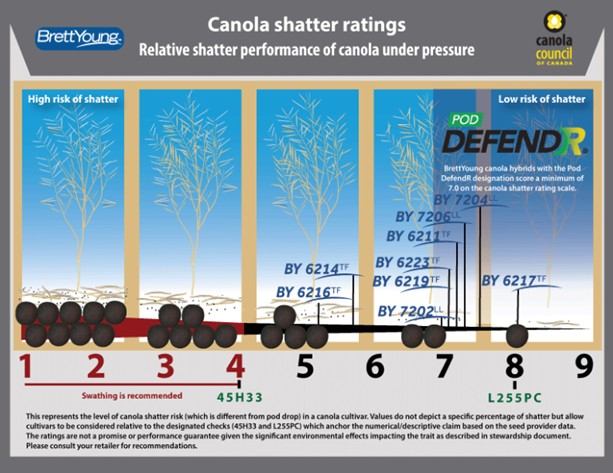
Whether you are looking for TruFlex or LibertyLink traits, BrettYoung has options available. BY7206LL and BY6217TF offer both blackleg and clubroot resistance. While we lack prevalence data for North Dakota, blackleg is a disease found in nearly every field across the Canadian Prairies, highlighting the importance of resistance. The pod shatter rating of BY6217TF matches that of InVigor L255PC, the first canola hybrid to deliver this trait. Additionally, BrettYoung hybrids are competitively priced compared to the InVigor lineup.
Weather Outlook